When the hem goes up and the leather rises to meet it, something inevitably gives. Sadly, with Michelle Yeoh, that goes largely unnoticed
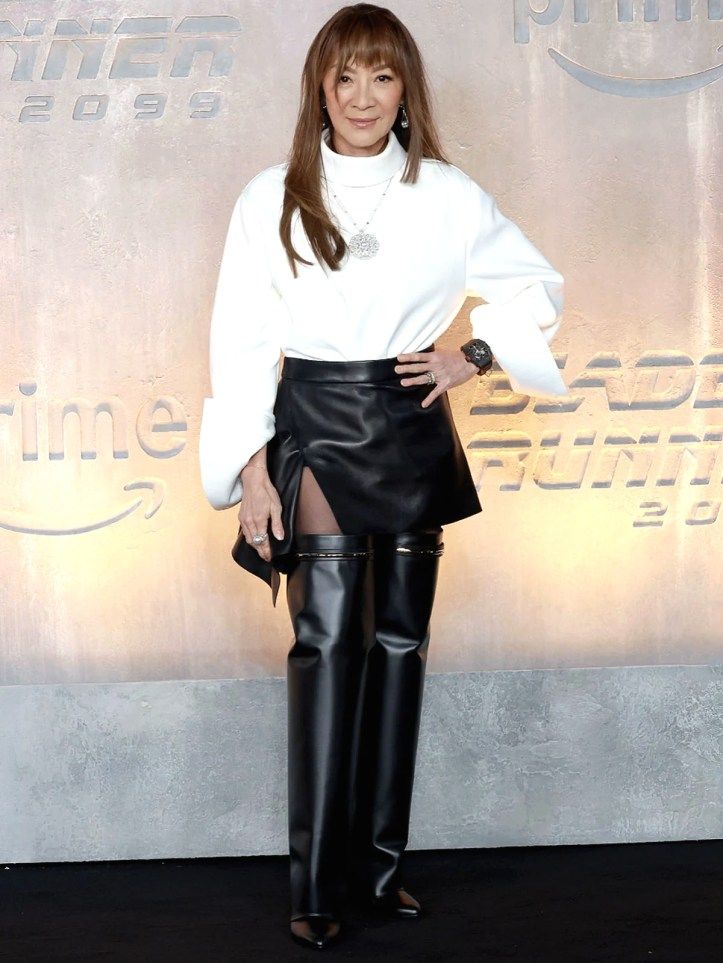
Michelle Yeoh completely togged in Givenchy
Michelle Yeoh, the red-carpet regular, was in London for the “special screening” of Blade Runner 2099, and stepped out looking every millimetre her reliably fabulous self. This time, it was to offer her version of the similarly dependable ‘method dressing’, more and more favoured by stars to reassure the public that they have, at the very least, grasped the plot of their own film. Or, perhaps, also to turn every press tour into a walking mood board for ravenous algorithms. And so, as the contract presumably dictates, she arrived in neck-to-toe Givenchy, specifically a black-and-white ensemble from the autumn/winter 2026 collection, minus the curious 白头巾 (baitoujin) or head wrap. The white leather shirt is designed to be worn backside front, and Ms Yeoh kept to that diligently. Instead of a long leather skirt from the runway look, styled by Camilla Nickerson, she wore a mini version, with the slit on the right intact. All went swimmingly until you see what went up to meet the hem.
It has never been truly clear why high boots are so extremely desirable despite their dubious utility. Yet fashion, as one knows, remains blissfully indifferent to anything so pedestrian as practicality. Much the same might be assumed of Oscar winners—a rank that places them comfortably beyond the advantage of usefulness. Ms Yeoh has an illustrative edge here. Shod in a pair of boots, also by Givenchy, that shot past her knees to underscore her rump, she looked prepared to wade through buttocks-deep mud on the way to Odeon Luxe Leicester Square. Standing alone against the photo wall, she looked fine, but when she was shot with Hunter Schafer, Ms Yeoh appeared positively diminutive—a predicament hardly helped by boots that seemed to have greedily swallowed her limbs entirely. She was vertically challenged, as has always been her custom. Ms Shafer, considered by Vogue to be the ideal future Bond girl, stood as a severe, lanky rebuke, throwing into sharp, unsparing relief just how thoroughly Ms Yeoh was overwhelmed by her own footwear.
Shod in a pair of boots, also by Givenchy, that shot past her knees to underscore her rump, she looked prepared to wade through buttocks-deep mud on the way to Odeon Luxe Leicester Square
From street-level observations, it can be said that many petite Southeast Asian women are attracted to what boots promise: height, presence, edge, and, most definitely, an escape—from being read as “small” or “cute”. In equatorial cities, even tropical ones, boots are often unzipped from their practical function. Nobody needs thigh-high leather boots in 33°C humidity. They do not deal with an environmental problem; they solve an image problem. The boots, whether on our shores or further afield, become an imported symbol of elsewhere: London punk, Paris Left Bank cool, K-drama sass, or luxury runway glamour. The irony is that the taller and more imposing the boot becomes, the more likely it is to have the opposite effect on a petite frame. A woman buys the boots because she wants to look more commanding, even on an MRT train. The boots arrive and become the most commanding thing in the outfit. Suddenly, the footwear has more presence than the person. For Ms Yeoh, it looked to us to be an Ipoh thirst not yet quenched. The Givenchy boots seemed to achieve full diplomatic recognition as an independent state.
This is not just about the boots. The way we look at it, this might be—let’s call it—aspiration geography. Michelle Yeoh may be one of the most recognised women on earth, but she is still unmistakably from Ipoh, daughter of the soil. Not literally in her aesthetics anymore, of course, but in the social DNA of what glamour looked like for ambitious middle-class Southeast Asian women of her generation. The fantasy was not (never?) about wearing sensible shoes; it is about the day when one will wear the things that belong to a bigger world. Boots have always carried an exaggerated symbolic charge in our part of the globe. They are hopelessly impractical, which is precisely why they feel glamorous. They belong to cities with winters, fashion capitals, movie stars, runways, and, at least in the past, magazines. Even after the Oscar, there remains a trace of that aspirational impulse. Or a sense that there is always another level of glamour to reach, another fashion fantasy to inhabit. The tragedy of that Givenchy look is that Ms Yeoh herself no longer needed a heeled prop.
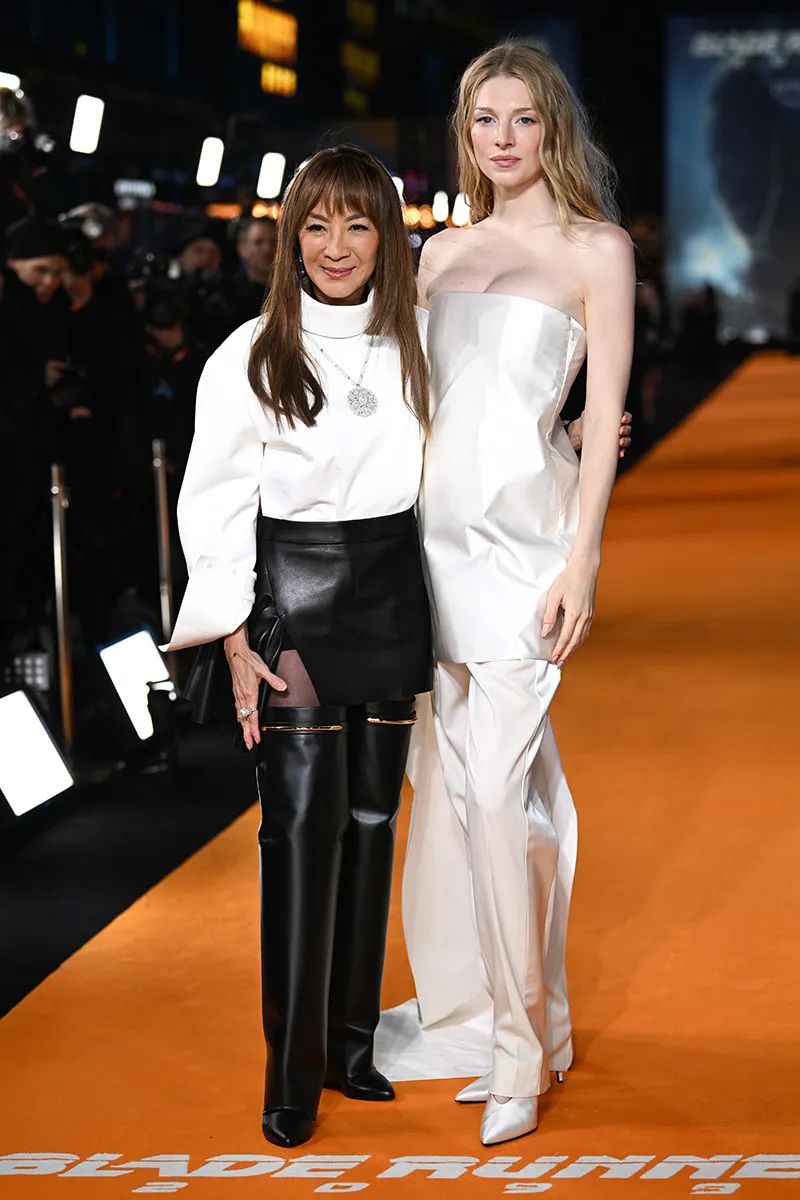
With the towering Hunter Schafer
In Kuala Lumpur, there are women—many, we gather—who believe that shopping at Gardens says more about her status than doing the same at Pavilion. To a non-Malaysian, both are just luxury malls in Kuala Lumpur. But culturally, the difference matters because the statement is not about shopping. It’s about the theatre of arrival. Pavilion has always had a slightly more democratic energy. Rich people go there, tourists go there, influencers go there, everybody goes there. It is a stage. The Gardens has long cultivated a different mythology. Not necessarily wealthier in objective terms, but quieter, more self-conscious, more those who know, know, more if you are a true KL resident, you know. When we said earlier that Ms Yeoh might be experiencing an Ipoh thirst not quenched, we did not mean she is provincial. She plainly isn’t; she’s lived a global life for decades. But many ambitious people from relatively small cities never entirely shed the emotional logic of their ascent. The goalposts move, but the mechanism remains. At a certain point there is nowhere left to arrive, yet the instinct to arrive tenaciously remains.
What made the Givenchy boots look absurd and feel comic to us is that they carried visible traces of that logic. This is not the confidence of someone who already owns the room, but the enthusiasm of someone still excited by access to the room. On the red carpet of the 2024 Met Gala, were she debuted a fresh bob and a new take on the Reynolds Wrap, Ms Yeoh buoyantly told the media: “This is my new look. Working with Demna, it’s the whole [look]. It’s not just the dress. It’s the hair. It’s the jewellery. It’s the make-up. So we all went through the process.” She did not go to a boutique to pick a dress; she was in the Balenciaga inner sanctum to walk the steps. It dawned on us that fashion may not be subordinate to her. And that she remains captivated by the magic of fashion itself, particularly when she talks about “the whole look” and “the process”. That’s why we still think of Ipoh, not because the city is small or Michelle Yeoh is embarassed that she came from there. Her emotional memory of aspiration appears to remain active, and that will always have her going after boots, not because she looks good in them, but because she, as they would say in Malaysia, sudah sampai—has arrived.
Photos: Getty Images

