Aina Abdul brought her big voice—and an equally big dress—to the Eurovision Song Contest Asia. Neither helped her win

On stage, vocal projection and costume styling can operate in tandem or actively trip each other up. Put a trophy on the line, and the two rarely stay out of the way. At last Saturday’s Eurovision Song Contest Asia (ESCA), Malaysia was represented by current pop darling Aina Abdul. Her calling card is sheer vocal force: dramatic range and the kind of high-belt gymnastics tailored for Anugerah Juara Lagu (AJL) competition nights, usually at the expense of subtlety or restraint. AJL is practically synonymous with theatrical staging, orchestral bombast, and towering vocal climaxes—what the fan base has rightly dubbed lagu bertanding (competition songs). With the Best Vocal trophy judged live on technical difficulty, ballads arrive packed with sustained high notes and sudden key changes, purposely engineered for radio play than for swaying the jury.
Ms Abdul has never quite switched out of competition mode, and it was with that same vocal onslaught that she walked onto the arena-like ESCA stage. For many fans across Malaysia and in Singapore, her win was practically a foregone conclusion. But ESCA was not a local vocal-prowess derby. It needed more than a singer standing and knowing when to move the mic away from her mouth as the gale-force breath surges, bringing thick vocal fold weight high into her upper register. Ms Abdul did not even offer a hand dance; she remained as animated as a fire extinguisher at a sekolah kebangsaan canteen pillar. But the voice used was for moving mountains. There is no denying that she has technical agility, but Ms Abdul tends to play the lyric soprano built for vocal dramatics—to the hilt. That is the only way she knows how to sing. Her career, branding, and competition success in Malaysia depend on delivering high-stakes vocal spectacles. That is understandable, but Bangkok is not Kuala Lumpur.
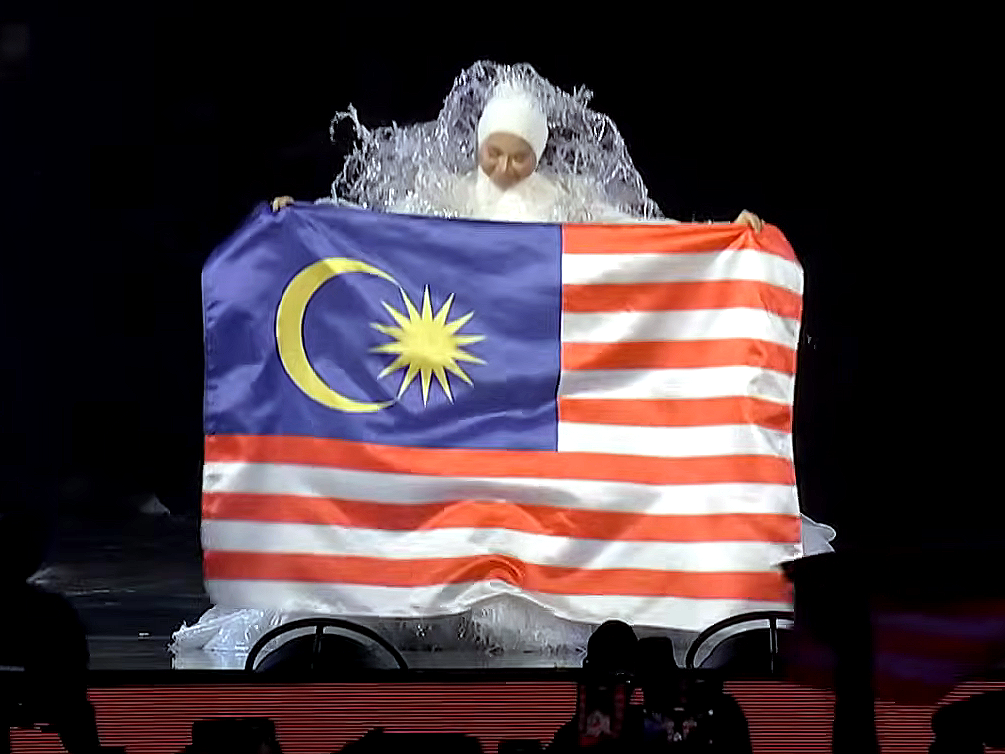
As with many of her stage appearances, what Ms Abdul lacked in footwork, she attempted to rectify in square footage. Enter the gown—first concealed in a curious half-elliptical cage. It is not clear why the production’s scenographer needed her to be first seen inside a penutup makanan (food cover), but the staging seems to suggest that the producers were expecting a performance that would be lacking in vim. When the cover was lifted so that the rim stayed above her head, we saw the gaun (gown) in all its uninterrupted scope. Weaned on Behati’s feats of load-bearing polyester with none of the utility, Ms Abdul made a slightly trimmer appearance this time in a Melinda Looi, another go-to name. It was an all-white manisan (confection), comprising an off-shoulder gown with an encrusted bodice and a three-tier skirt over what could be scuba wear and then finished with a gauzy, frost-speckled cape and train that threw on needless friction to an already congested silhouette. Even the bushiest bunga manggar (coconut palm blossoms seen in weddings) recognises the advantage of adding less tinsel.
Melinda Looi has designed several of Ms Abdul’s stage outfits that left nothing to the draughting table, most notably the tikar (mat) gown of 2024, worn at the Konsert Malam Sama-sama Kita, originally conceived with rattan artisans from the Penan ethnic group in Sungai Tutoh village, Baram, Sarawak. However earnestly kreatif Ms Looi’s work is, it falls short on the one thing central to the Eurovision ethos: the celebration of camp. This is not just flamboyance, but camp in the deeper sense Susan Sontag was getting at and the 2019 Met Gala failed to convey: an appreciation of artifice, excess, theatrical failure, sincerity, and absurdity—all mixed together. A man dressed as a space Viking singing about wolves? Eurovision can embrace that. A performance involving giant hamster wheels, dancing monsters, or a singer trapped inside a giant prop blender? Also Eurovision.
In a strange way, Eurovision’s camp may have been what saved it. Without camp, all that would be left is asking whether the songs are actually good. Transplanted to Asia, ESCA lacked that cultural operating system. But this is sharply ironic, as Bangkok entertainment is steeped in camp and the opening act showed that it can communicate that with considerable aplomb. Unfortunately, that was not translated by the anaemic Thai entry that was curiously placed second. Aina Abdul and her designer similarly failed to grasp, and did not understand that the performance needed self-aware absurdity, artifice, and theatrical failure. There was not even half a costume change. They were trapped in what looked to be a virtuosity paradigm. It was all about proving legitimacy. Added to that, we suspect, was the burden of representing national culture, vocal competence, artistic merit, and international respectability, all at once. That’s a heavy load for a three-minute song. Yet even volumes narrowly missed a place in the top three.
Screen shots: eurovisionsongcontest/YouTube

