Developed in-house, the first bag from Common Man Coffee Roasters’ CMCR line proves remarkably full-bodied
By Ray Zhang
All my friends know I have an unsound love for totes. It has been this way since before it was accepted as a bag men would carry. I still remember my first tote—a truly useful and long-lasting one from Porter that I bought with immense pleasure when I visited Japan for the first time. This was during the boom years of Ura-Harajuku subcultures and I walked straight into the store of Hiroshi Fujiwara and Porter-Yoshida’s collaboration Head Porter (now the label’s successor brand Ramidus), with the clothing unit opposite. I remember that vividly because it was not long after the Tokyo Bay earthquake. But since only services on the Shinkansen were suspended then, I reasoned that the subway trains might be safe. That confidence led me from Bakurocho station, near where I was staying, to Harajuku station. I bought the tote I had been eyeing and put it to use on the spot. The utility of totes requires no explanation, and one can never have too many.
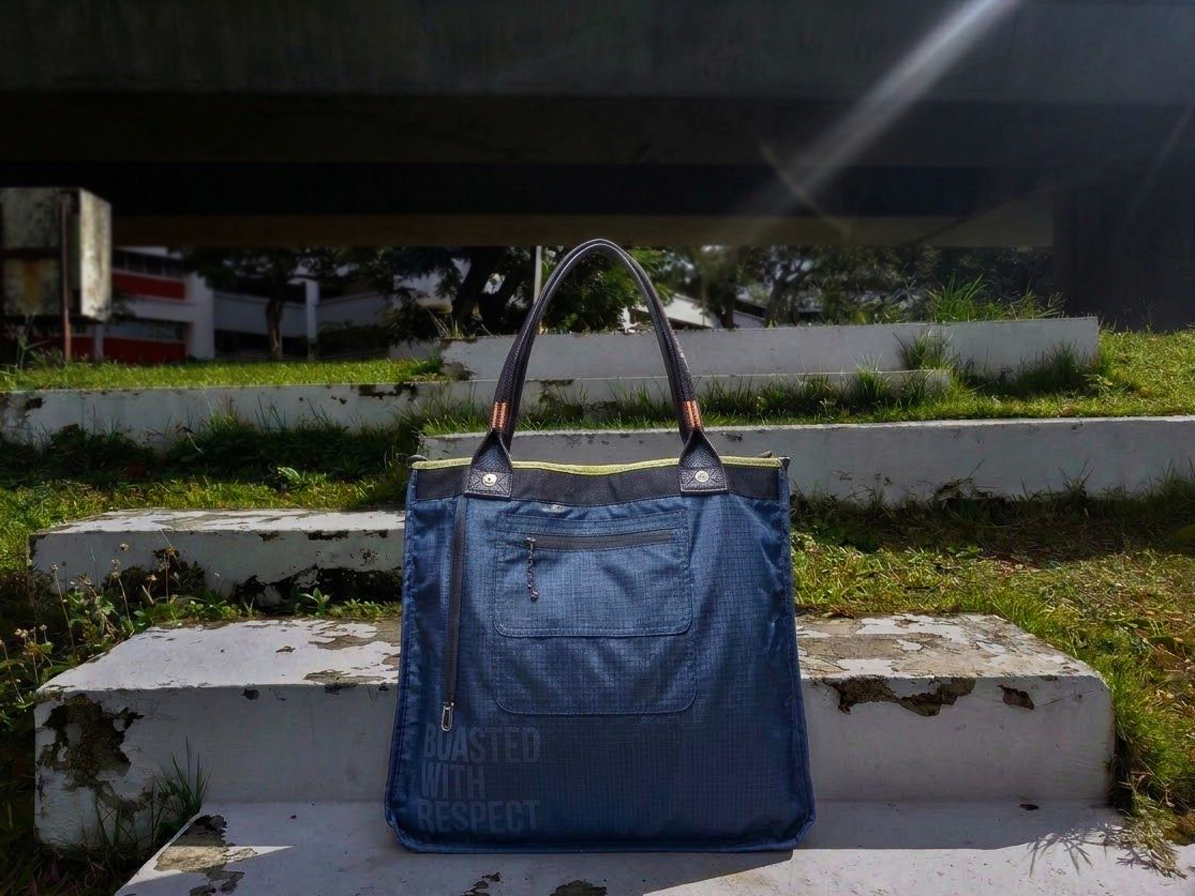
Totes do have a way of beckoning. I was running errands one Wednesday afternoon and decided to have a latte break when I spotted Common Man Coffee Roasters. As I walked in, the usual coffichor that always led me to think of their 22 Martin Blend was overwhelmed by the sight of a tote hung invitingly on a slender one-arm stand. I had not expected the café to sell bags, just beans, coffee-making equipment and gear. I hurriedly ordered my coffee, and returned to it. When I held it, I immediately sensed that I was carrying something quite special. The handle of seatbelt-weave nylon webbing was of the right weight and it came with a centre-stitched folded grip zone. Where the handle met the body of the bag, apart from the box-X stitching, there was a rivet that sat on the centre where the diagonals of the X meets, a classic sign of heavy-duty, heritage-inspired crafting. Right where the folded grip transitioned back to a flat, single-layer strap, two parallel bar-tacks served not only as reinforcement (as the rivet did), but also decorative accent as they were zig-zagged in orange thread.
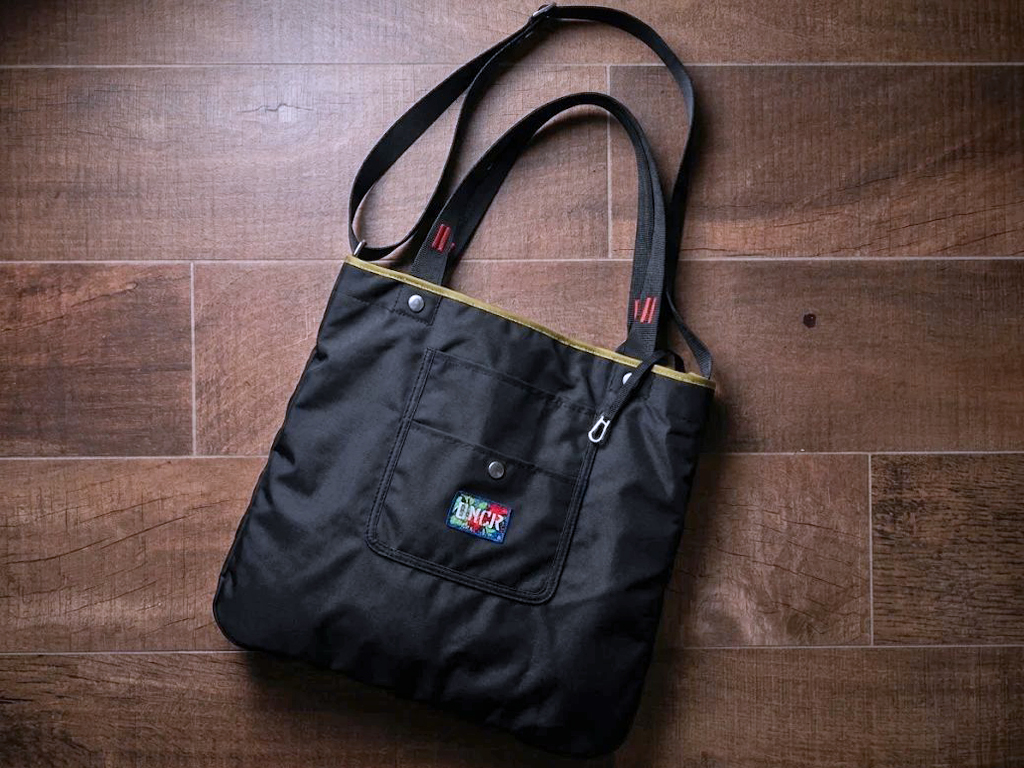
The default of outer of the CMCR tote
And that was just the handles. I wanted to understand more about the making of the bag. I returned to the barista, but she was unable to brew up more detail. She made a valiant effort to be helpful, though my line of questioning was apparently too granular, prompting her to eventually deflect me to the brand’s website. But there was little to extract from that quarter either. It stated that the tote can be treated as a “portable storage unit” and “is spacious, stylish, and ready for whatever [you] insist on carrying ‘just in case’.” I think “carrying” is key here because the tote looked and felt to be assembled to withstand a small siege or, at the very least, a heavy-handed grocery haul. With enough pockets inside and out for modern miscellany, it is a reversible bag that and, with the added shoulder straps for cross-body use, it is also what the Japanese call a “two-way” tote. In its default configuration, it is clad in a black shell, but turning it inside out reveals a navy interior—my preferred colour, and infinitely less stark and unforgiving than smooth, solid black.
Unlike, say, a slouchy satchel or a floppy bucket bag, a tote is much better off with a well-fabricated body that actually knows how to hold its own. I was rather pleased that CMCR had used a handsome nylon twill of at least 300-denier (yarn weight) for the primary shell, matched in mass by a graph-paper micro-grid rip-stop—eschewing the usual diamond weave—on the reverse. Both nylons were uncoated and sandwiched a lightweight inter-lining which gave the tote structure without stiffness. As reversing the bag is an option, the seams are finished with ribbed grosgrain tape and a contrast, olive-coloured jacquard-woven grosgrain for the top, which appears to keep the rim from stretching out of shape when reaching inside or carrying heavy items. The silhouette, too, makes for a compelling proposition: neither too wide nor too tall, it is proportioned so that I can trust it to haul my records around. Impressive in the sum of its parts, it did well to validate my first impression. This is not Beams X Starbucks, still trending in Tokyo; this is better. I finished my coffee, relieved the display stand of one bag, took it to the cashier and happily paid.
Photography: Jim Sim

