First came the queue. Then came the queue for the queue—in a holding pen. Christmas, somewhere beyond, remained unseen
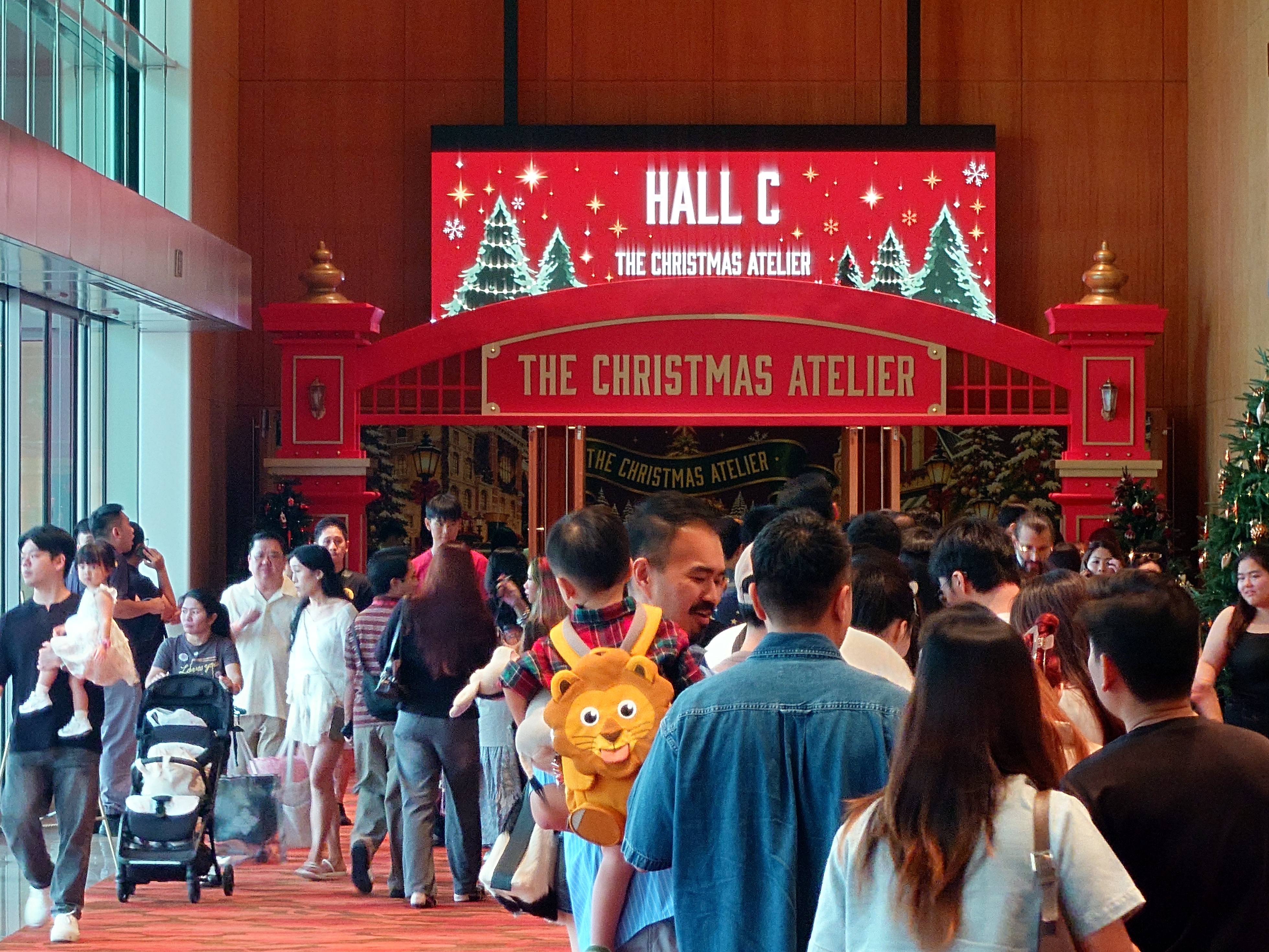
As a piece of branding, The Christmas Atelier is sharply conceived. This isn’t because it says anything concrete, but it does perform a particular class aspiration that is prevalent at this time of the year. We are familiar with Christmas markets. They evoke crowds, public space, sausages, beer, families, rides. Christmas fairs bring to mind charity fundraisers and YWCA. Christmas ateliers, however, conjure a different country: curation, craftsmanship, design, exclusivity, makers, discovery. The word atelier has become one of those lifestyle-signalling—even decorative—words, such as curated, artisan, bespoke, or experience. It imports the aura of the artist’s studio without actually requiring the event to be a studio. When we went to MBS this afternoon, we did not expect The Christmas Atelier to be a place of craft, intimacy, conversation between maker and visitor, slow looking, careful browsing. We did not expect the artist’s garret to have time for us. But queuing wasn’t exactly high on our list of anticipated activities, either.
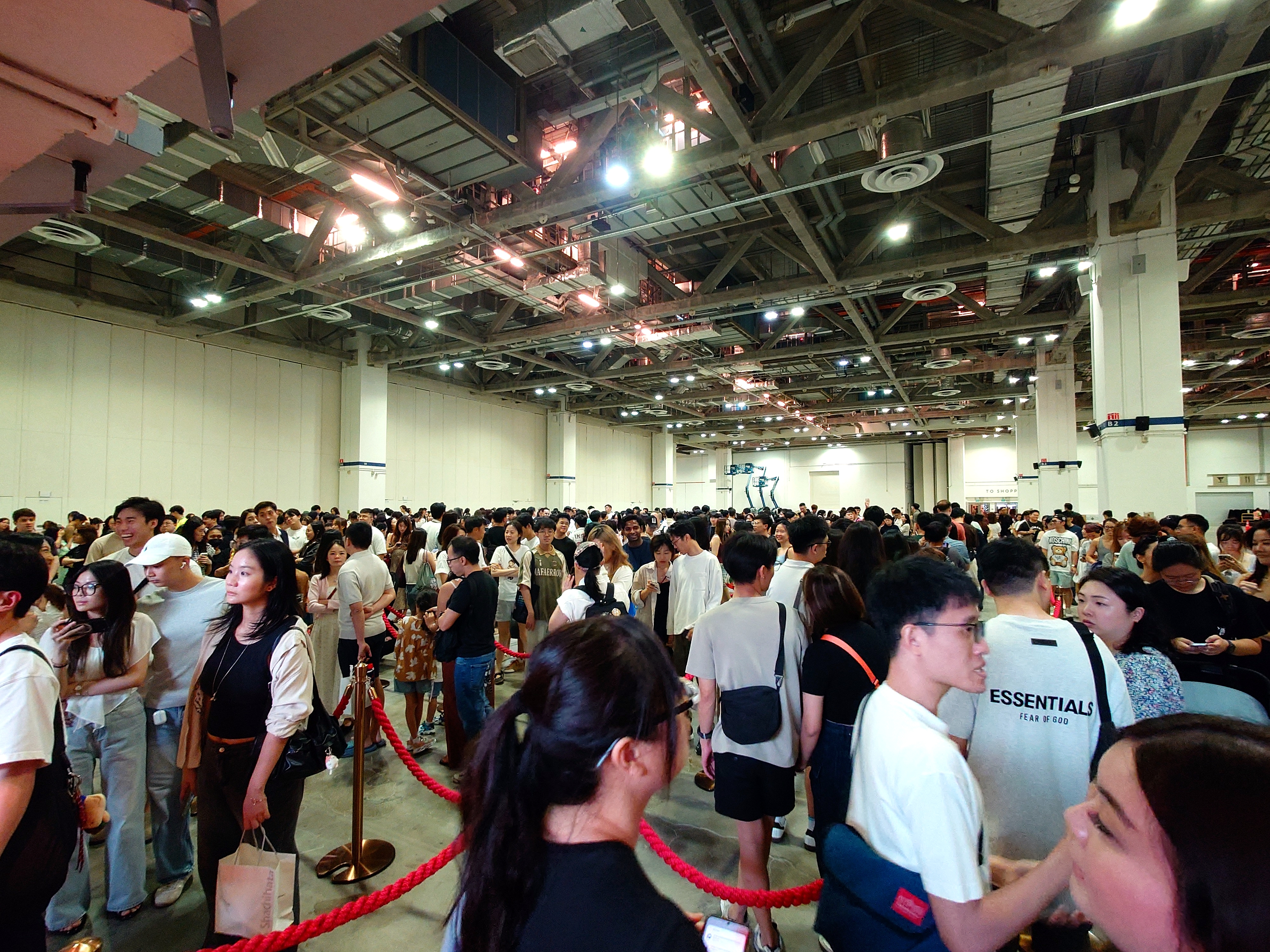
It took us seven editions to find our shoes, but we’re finally here at the eighth. As we entered the MBS Expo and Convention Centre at about three in the afternoon, we could see in the distance a gathering around something red in the far end, behind which are halls that the legendary Club 21 sales were held before. As we approached, we saw a sort of queue ahead of us. It was quite messy because people were also heading towards us, presumably to leave, but the queue was obvious. However, before we could join it, we were shown—by a hand of which its owner was not made apparent to us—to go to our right. It was then we realised we were told to head for a holding area. When we approached the space and finally stood at the entryway, we were ready to draft a will. Before us was a massive, unused exhibition hall, where, in July, the Singapore International Jewellery Fair had stood, but now, utterly stripped of every last cubic zirconia, leaving behind a concrete cavern so devoid of soul it made an HDB multi-storey car park look like Versailles. Now, it was packed with people. A deeply concerning amount of them.
When we approached the space and finally stood at the entryway, we were ready to draft a will
The orderly yet serpentine queue coiled back as far as the eyes could see. We lost count of how many rows deep the crowd stretched. A grim piece of work. Just as we were deciding whether to join the queue, a woman appeared out of nowhere and huffed: “Can’t bloody get out”. We glanced between the spillover contained inside and the queue that greeted us outside, and realised that the stark interior—bare concrete, white walls, an exposed ceiling—was merely the opening act of the long march. Next to us was a young woman keeping an eye on the cattle at customs. Taking her for the marshal, we asked her how long it would take for the queue to clear. She said, “maybe about thirty minutes”, in the form of a question. The sentence isn’t an estimate. It’s a hope. Thirty minutes to reach the front of the overflowed hall. Beyond that lay another queue, and beyond that, apparently, Christmas. Staring down a snaking labyrinth of stanchions and red velvet ropes was a sharp reminder that leaving was really a better option. Our contribution to the queue’s demographic was entirely redundant.
Back outside, we saw two women leaving the cordoned area and asked them what it was like in the Atelier. One of them said, “You have to pay to go in.” She should be thanked for the field report, as the snaking mass of humanity beside us had completely obliterated our knowledge of that. We told the lasses, instead, that we knew, but were trying to establish whether the reward matched the queue’s creeping absurdity. Helpfully, the other said, “a lot of fashion and beauty”. So it was Boutiques Fair and Sephora with a cover charge? Neither looked particularly illuminated by our line of questioning. Maybe more atas? They were thoroughly underwhelmed and sauntered off before we could ask them if they bought anything. At that moment, a man—balancing a child with his right arm and pushing a stroller with his right—walked past, grumbling to a sour-faced wife. Before he drifted out of earshot, we caught: “Told you sure nothing, you die-die want to come…” Nothing sells a festive event quite like the sound of domestic resentment. Armed with this final verdict, we walked away with our time—and our entry fee—intact.
The Christmas Atelier markets itself aggressively on social media for the three-day (12 to 14 November) affair. The EIC of Grazia SG, Pakkee Tan, interviewed the event founder Lelian Chew (both festively using their given names as first names) and rhapsodically shared it on Instagram. The editorial-commercial symbiosis led to the inevitable recommendation of five stalls. The founder gleefully feigned reluctance: “That’s such a hard job. I’ll do my best.” She quickly demonstrated the entrepreneurial spirit that had brought hundreds to a holding pen by first introducing her anchor business: The Floral Atelier, presented as an invitation into a world of festive beauty. Yet for many visitors, the dominant installation was not floral but logistical: barriers, holding areas and an uncertain wait time. It was, of course, her event and nobody should be shocked that the founder foregrounds her founding business. The problem, for us, is that the fantasy presupposes access. The first stall recommended was a vision redolent of Christmas. The first thing visitors actually encountered was crowd control.
While deciding whether to join the queue, we didn’t hear a phrase of a Christmas jingle, see a stray piece of plastic holly, or catch a whiff of Christmas-blend made-in-China candles. What we encountered was not Christmas so much as the logic of the paid Yuletide fair. We were sold an atelier, yet the experience was far from intimate. The queue, to be certain, was expected; how it was managed was not. Ultimately, these events occupy an awkward space between market, trade fair, and ticketed entertainment. For us, the market no longer exists to facilitate commerce. Rather, commerce exists to justify the market. In a traditional Christmas market, the centre of gravity is the stallholder. In an exhibition-centre Christmas market, the centre of gravity is increasingly the event brand. Of course, The Christmas Atelier is not called The Christmas Market. The word atelier signals aspiration: it transforms shopping into culture and browsing into participation in a curated lifestyle. But there, Christmas ceased to be a civic event and became a managed experience. The organiser was no longer a host but a gatekeeper. Admission was monetised, capacity was controlled, and festive abundance was encountered only after a visitor had successfully navigated the infrastructure erected to ration it.
Merry Christmas.
Photos: Zhao Xiangji

