Despite a fortnight of editorial gestation, the published piece on an award-winning tailor yielded little more than recycled PR and a well-worn formula for local cheerleading
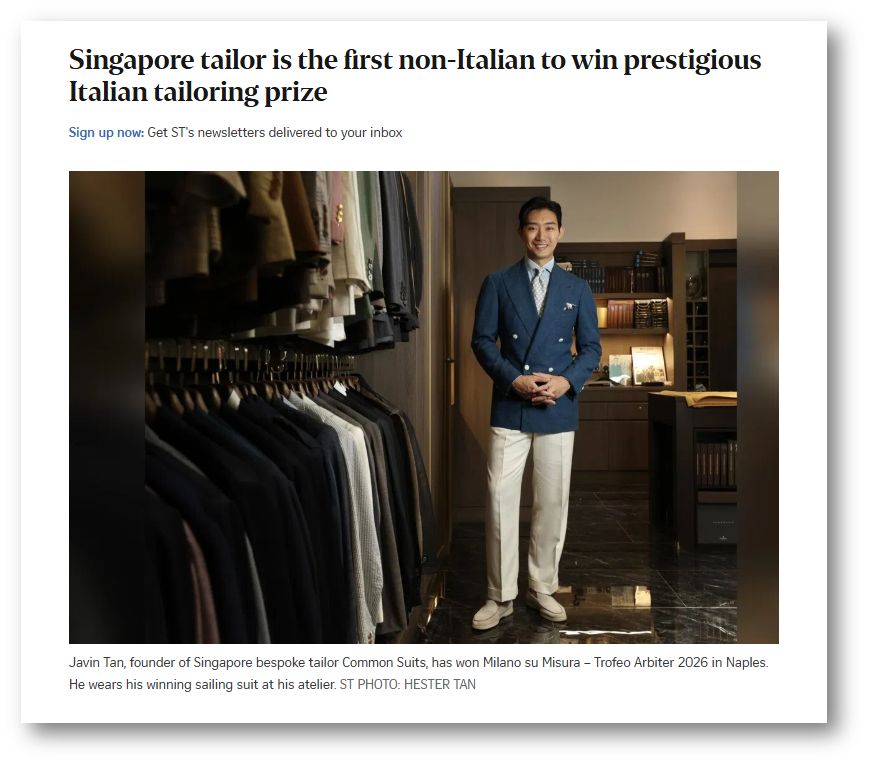
The captivating report in The Straits Times. Screen shot: straitstimes.com
Twelve days after Javin They’s (郑烨骍) Trofeo Arbiter win—and nine days after our report—The Straits Times finally took notice. The belated coverage is fascinating. For a paper that delights in breaking news of national triumphs, this tardiness is extraordinary. The eventual cheerleading is expected, since this is the kind of reporting that ST staunchly believes everyone loves to read: there is a local protagonist, a foreign stage, a trophy, and a first Singaporean or non-Italian angle. That’s a ready-made ST feature. It almost writes itself. But if an achievement genuinely captures the news agenda, coverage is usually immediate. Think of Joseph Schooling’s 2016 Olympic gold. When he was named a brand ambassador for Hugo Boss two years later, the update was immediately filed. Although the Javin They feature stated that the award was handed out on 17 October, the delay itself suggests that ST did not treat it as an urgent event worthy of immediate national attention. Fashion, as we know, always takes a back seat to sports or tech. Apparently, it still does.
Yet, on 29 September 2017, when veteran tailor Thomas Wong won The Prestigious award given by the Singapore Retailers Association (SRA), ST reported the news that very night. Mr They’s* win for his brand Common Suits is more reputable, even when both are industry awards that are generally unknown to the average reader, yet timeliness was not accorded to him. To be sure, news organisations reveal their priorities not only through headlines, but through urgency. There is, however, a clear distinction between an event that demands immediate same-night reporting and a subject reserved for a comfortable profile piece next week, or later. We understand that a Singaporean winning an Italian tailoring competition can be genuine news, professionally meaningful, and personally impressive, while still occupying a relatively niche place in the larger hierarchy of fashion and cultural news. But the delayed coverage indictates that ST regarded it as a good story, not necessarily, perhaps, an urgent one.
For a paper that delights in breaking news of national triumphs, this tardiness is extraordinary
We are not denying the value of the recognition, even when it is deferred. We are asking, as we have, whether recognition within an existing Italian tailoring framework should be mistaken for the emergence of a Singaporean fashion voice. The ST piece explicitly pointed out that Javin They’s suits follow the construction of “Neapolitan tailoring”, which is “a soft, lighter style developed for Naples”, they describe. But, while Mr They said that “the win is not just for myself and my team. It’s also for the whole of Asia”, the article does not say why Asian tailoring is represented in Italy. Or why, other than the warm-weather attributes, Neapolitan tailoring, rather than, say, Shanghainese tailoring performs. It would be good to know what specifically makes the work Asian rather than an Asian execution of an Italian paradigm. But we are reminded that this a lifestyle piece.
ST truly ratified our initial suspicion. The article announced with considerable pride: “His winning look, created for the theme Style on Board and Dockside, was an ocean-blue double-breasted jacket in Loro Piana wool, silk and linen, paired with ivory trousers”. Loro Piana is mentioned three times. It is also revealed that in May, Mr They was “invited as a guest of Loro Piana to sail at the Tre Golfi Sailing Week in Sorrento, Italy. Much of his winning suit was shaped by what he noticed on the boat.” It is not determined at all why specifically Loro Piana cloth or why only that mill. That, to us, is crucial because it gets to the heart of whether ST is reporting on craft choice, commercial strategy, or cultural allegiance. Or must we simply assume that it is because the brand is “prestigious”? But that should be elicited, not assumed. We had to remind ourselves, this is lifestyle journalism.
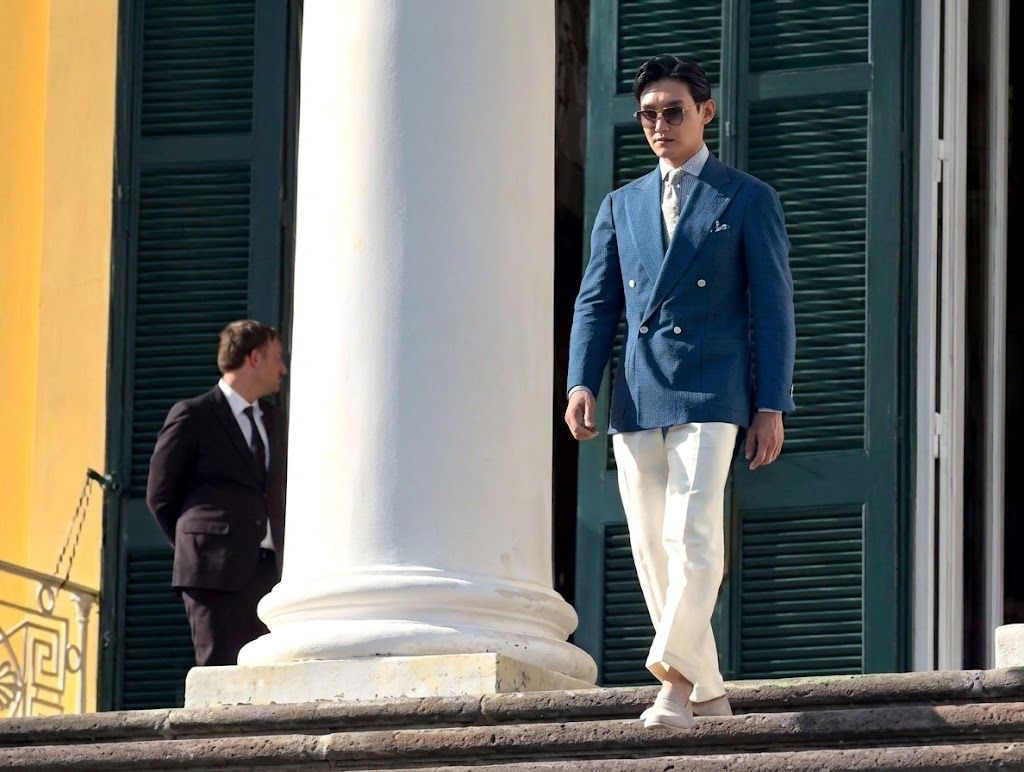
Javin They dramatically introduced in Naples. Screen shot: commonsuits/Instagram
What struck us about the piece and Javin They’s public presentation as described in the article is that the relationship with Loro Piana is presented as entirely self-evident and therefore beyond interrogation. It did not establish why this particular mill occupies such a central place in Common Suits’ identity. The missed opportunity is that once a tailor claims the win is significant “for the whole of Asia”, the conversation should arguably expand beyond a single Italian mill. But it is not. We would like to know, for instance, what happens to the Common Suits aesthetic if Loro Piana disappears tomorrow? Yes, hypothetical, but valid question. What then happens to Common Suits’ Italian solution? Even if we are talking about brand rather than design, either identity needs to survive the disappearance of a supplier, even one that can fund an award and invite potential nominees to sail in the Mediterranean. The award is not the end of the inquiry. It is the reason the inquiry becomes interesting in the first place. But, again, we are reading a lifestyle story.
Classifying this editorial as “lifestyle journalism”gives the beat a bad name. It is becoming a convenient scapegoat for what is simply—and recurrently—uncritical feature writing. Good lifestyle journalism can be extraordinarily rigorous. Some of the best writing about fashion, food, design, architecture, travel, and luxury comes from lifestyle desks. Yet, ST was easily charmed by “a booth outside a campus canteen for $25 a day to sell his first suit”, even when scores of people start in retail with a market stall. And there is the obligatory parental support. Nothing inherently wrong with that, but it does point to a narrative habit born of a very well-used moral template, beloved by columnists such as Wong Kim Hoh. But the problem arises when that device becomes so reflexive that it displaces the actual subject of the story. In a piece about a tailoring competition, if a parent must be mentioned, we might expect: “did they draft the pattern?” Instead, we are told of maternal “support”. It becomes a question of proportionality. If the story is ostensibly about technical achievements, why does the emotional infrastructure receive more scrutiny than the tailoring itself? One is universally accessible, the other demands expertise. And the emotional story is, as always, far easier to write.
*In reporting on the Trofeo Arbiter win, The Straits Times addresses the tailor as Javin Tan. Coverage of him across media offered varying renditions of his surname. Even SPH’s own legacy title Her World, in an editorial from 2024, referred to him as They. In his own LinkedIn profile, he identifies as Javin They Ye Xing. For continuity with our original critique and in accordance with his primary public handle, we continue to refer to him as Javin They

