A Singaporean tailor has won the Trofeo Arbiter. Securing an accolade backed by a trade magazine and a textile mill proves technical proficiency and clean assembly. Precise execution may not, however, reveal design vision
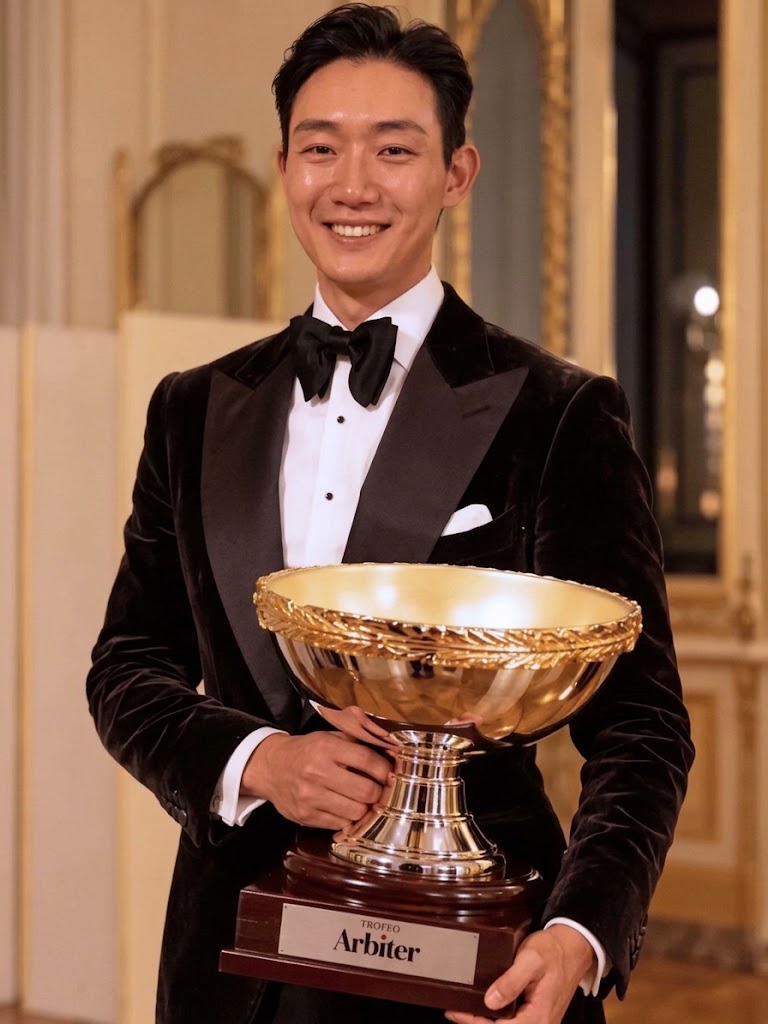
Javin They winning the Trofeo Arbiter award recently
We do live in a world that loves to award. But while a true independent prize honours a creator for turning raw clay into art, an industry trophy often feels like a closed-loop validation system—particularly when the people handing out the medal are the same ones selling you the material to make it. Still, congratulations to Javin They Ye Xing (郑烨骍, Zheng Yexing) for being the first Singaporean—and Asian—tailor to win the Trofeo Arbiter (held under the banner of Milano su Misura) in the coastal city of Naples. This is a fascinating milestone. Our island is usually discussed, if at all, among tailoring circles as a commercial hub rather than the source of a distinct tailoring tradition. We might get a room full of suits, but precious few who actually look like they belong in one, even the groom.
The tailoring that Mr They (in some media reports, he is identified as They Quan Wei and on Instagram, he uses the handle Javin Tan) advocates has long been focused on solving a specifically equatorial problem: how to preserve the visual discipline of classic European tailoring while adapting it to our unforgivingly warm and humid, and annually hazed weather. That such work was recognised at a European bespoke competition suggests what is erroneously called “tropical tailoring” is being treated not merely as a regional adaptation, but as a serious contribution to contemporary tailoring culture. Mr They is behind the label Common Suits, so chosen because of the “common” denominator of core values he found in successful people while growing up in a single-parent family. But there is now undeniable Demna Gvasalia-style irony in selling an award-winning, five-figure made-to-measure two-piece from a brand named Common.
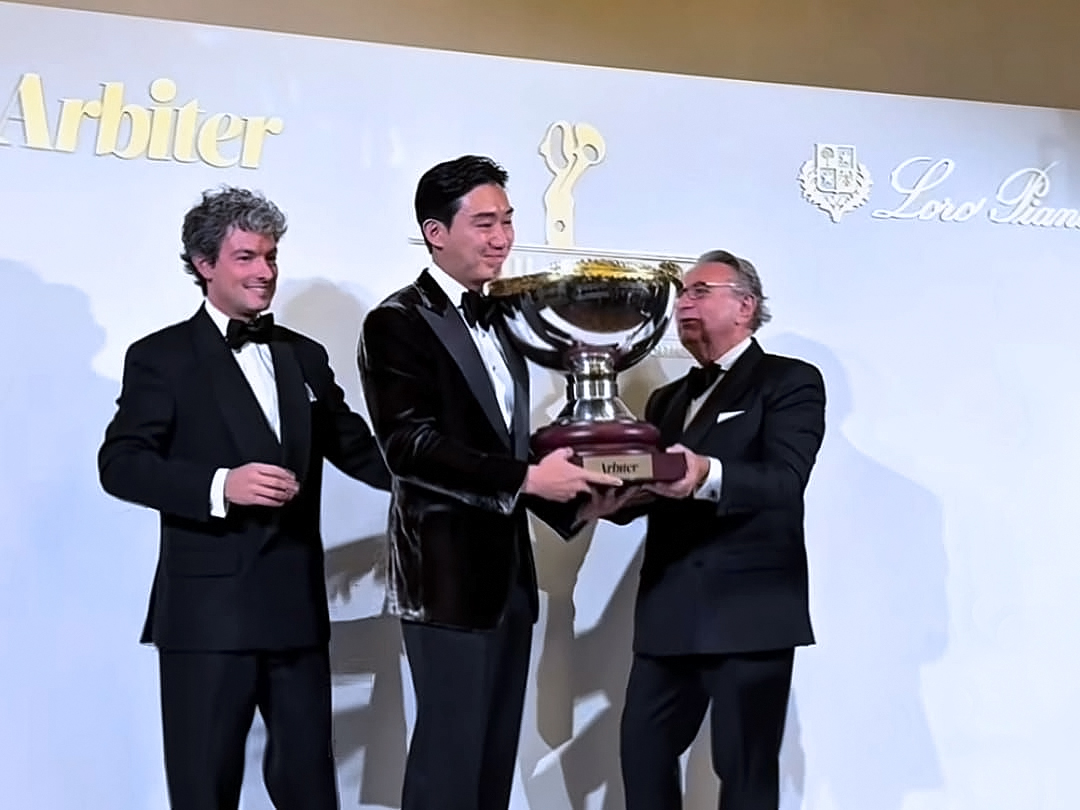
Javin They receiving his award
There is something intriguing about the Trofeo Arbiter. Launched in 2020, it is a competition that revives the historic Festival della Moda Maschile (Festival of Men’s Fashion), which originally debuted in 1952 as the world’s first major event dedicated strictly to men’s custom tailoring and textile production. After a long hiatus, the trade magazine Arbiter resurrected the concept and modernised the format to celebrate international bespoke cultures. Arbiter was originally established in 1935. Back then, it proudly called itself “un giornale di modi e non di moda (a magazine of manners, not of fashion)”, but it evolved into a title that played a significant role in building the modern aura of Italian style and defining the global reputation of Made-in-Italy luxury. Revitalised by editor-in-chief Franz Botrè after his takeover in 2010, the publication staged this modern incarnation of the festival under the banner of Milano su Misura—underwritten, predictably enough, by Loro Piana.
The fabric maker’s sole sponsorship of Trofeo Arbiter is essentially a B2B vertical marketing suited as high-style promotion. Loro Piana, also a luxury retailer, was acquired by LVMH in 2013, allowing the historic family-run mill to officially enter the LVMH portfolio, and to enjoy a rather agreeable balance-sheet injection. For Trofeo Arbiter, Loro Piana doesn’t just cut a check to put their logo on the event’s marquee—they provide all the raw materials. Typically, when independent mills want to showcase their craftsmanship, they host small, quiet regional conferences or trade shows. But Loro Piana thinks bigger: it can afford to fly 22 master tailors to a luxurious gala dinner at a private club in Naples, hand them the keys to a Mediterranean estate, and command the global spotlight. It may, therefore, account for Javin They’s delightfully evangelical zeal for the brand’s cloth.
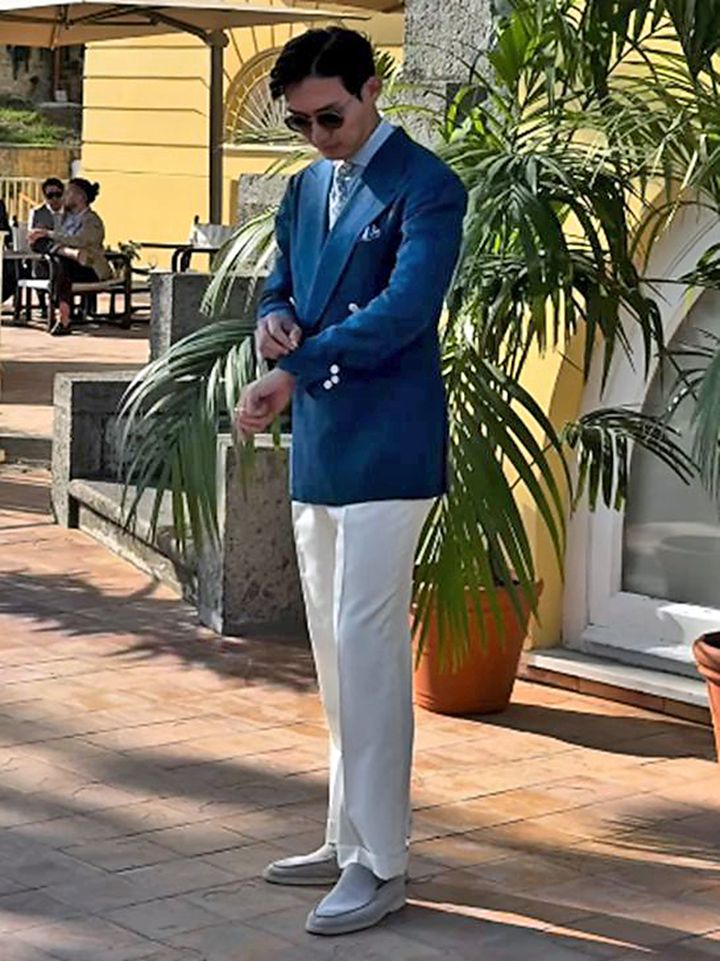
Posing while introduced to the guests in Naples
This commercial alignment makes his tireless cheerleading for the Loro Piana seem less like spontaneous affection than sound business hygiene. There is nothing inherently amiss with a tailor mentioning the cloth they use. Many do. But, when one repeatedly invokes a particular mill, associates that mill with quality and aspiration, and then receives recognition through a competition closely tied to that same mill, the public meaning of those endorsements can shift retrospectively. Interestingly, you don’t often hear a couturier announce that they use Maison Hurel silks, even for a house such as Schiaparelli, whose fabric suppliers are crucial, even historically indispensable to the brand. Designers rarely foreground their fabric preferences in their own public descriptions, definitely not frequently. To be sure, Mr They’s boast of using Loro Piana fabrics is not improper. He is using social media, and on the platform it could be harder to sell shoulder balance and chest construction than cloth. But a reliance on textile prestige often serves as a convenient substitute for design conviction.
In fashion, as opposed to tailoring, the supplier is subordinate to the author’s vision. Conversely, tailors do absorb raw materials into their own creative universe. In bespoke tailoring of today, the cloth is part of the sale proposition. If you don’t name drop Loro Piana, there is always Dormeuil, Holland & Sherry, Scabal, or Drapers. A client already comes to the tailor because of his cut. What else can be a lure? Details, which are key in tailoring, are often too subtle to discern. Many clients cannot easily evaluate them. So cloth, which takes up the entire garment, is the crux. The fabric label functions almost like a watch logo. It is an intelligible marker of luxury. But when you strip away the fabric story, the design language itself is less memorable. At Common Suits, Mr They offers mainly the Shenton Way, Tatler Ball, and once-a-lifetime tailored groom archetypes. The remainder is simply lining.
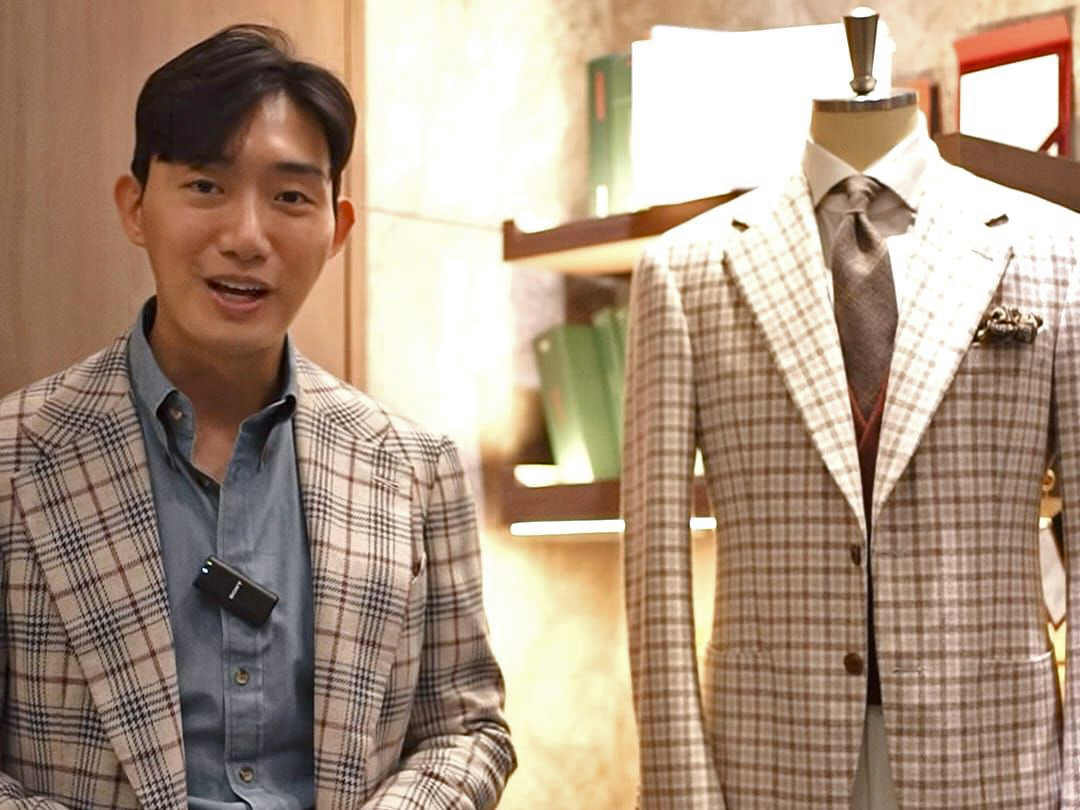
Javin They and his entry for the Trofeo Arbiter
From what we’ve seen of Javin They’s public presentation, the universe he inhabits is very specific: the CBD professional, the boardroom executive, the gala attendee, the lawyer, banker, consultant, entrepreneur, and, now, a Mediterranean sojourner. The aspiration is refinement, social polish, establishment success. There is nothing wrong with that, but it also reveals the ceiling of the brand narrative. Even on himself, his style seems to confirm the limits of the world he inhabits. When he was introduced in Naples during a photo op, he wore a navy double-breasted blazer with metallic buttons, teamed with a white shirt and trousers. If the yacht-club cliché was too subtle, he was shod—as he pointed out—in “boat shoes”. Similarly, on the night of the ceremony, he donned a velvet tuxedo. Were we in Naples or Monte Carlo? It looks to us that he chose the most predictable version of what a successful tailor is supposed to look like, making it the antithesis of sprezzatura—the art of looking as though you do not care about your appearance.
Make no mistake, this is a massive win for him and our island gets to go along for the ride. But it, perhaps, says more about how Italian tailoring can travel, even to Telok Ayer, Singapore, rather than a validation of a distinct Singaporean tailoring culture, the way there is in Britain or Shanghai. At the Trofeo Arbiter, it struck us that no one was asking, “This is what Singaporean tailoring looks like.” Rather, they seem to say that a tailor in Singapore can successfully execute the aesthetic values of contemporary Italian tailoring. Milan successfully produces itself in Singapore. For the Italians, it’s a very attractive outcome. The prize demonstrates that the Neapolitan or broader Italian tailoring idiom has become so internationally desirable that a tailor operating thousands of kilometres away can internalise and reproduce its codes at a level recognized by Italian industry insiders. In cultural terms, that’s soft power. It’s not unlike Michelin awarding stars to restaurants in Singapore, Bangkok, or Seoul. The immediate win is local, but whose standards did we abide by?
Another style for Naples
While LVMH is behind the scenes, the Trofeo Arbiter is not the LVMH Prize. And Javin They’s win is not the 2025 victory of Soshi Otsuki, founder of Soshiotsuki. Granted, one is a global tournament that vets over 2,400 independent applicants, and the other is essentially an invitation to 20-odd master tailors from largely Western Europe, working a single brand’s fabric. No one enters the LVMH Prize under the illusion that LVMH is absent. But the symbolic focus is on uncovering future creative talents. The winner is not being rewarded for demonstrating excellence with a particular LVMH fabric or how inspired they are by LVMH brands, or how cleverly they themed their output to the city in which the award would be presented. In winning the LVMH Prize, Mr Otsuki was not constrained. He earned the global recognition by completely reinterpreting Japanese heritage, using high-end Japanese artisanal cloth (and other international sources), and challenging the menswear status quo. He is not celebrated because he can cut a jacket well, but because he transformed tailoring into a language. His work carries a recognisable worldview: Japanese masculinity, youth culture, salaryman conformity, nostalgia, subcultural memory, and contemporary fashion are all fused into something identifiable as Soshiotsuki.
It takes undeniable skill to navigate both a flawless sleeve pitch and a multi-million-dollar luxury supply chain at the exact same time. Perhaps what Singapore needs isn’t a tailor who elicits “what cloth is he using?” but one who draws out “what is he doing?” We still lack a fashion auteur whose significance transcends tailoring itself. At this juncture, Sarawakian Dickson Lim comes to mind. Mr Lim can cut, though we are not certain that he is as skilled as Javin They. But he is poised to be someone capable of entering the global conversation at the level of creative authorship, cultural proposition, and industry influence. He is authoring, not just making. Tailoring competitions reward execution, while the fashion system rewards authorship. Singapore is good at churning out competent professionals, skilled technicians, or internationally-recognised specialists. Much less often, however, do we produce figures who alter the cultural conversation itself. Nations that take culture and fashion seriously require both: craftsmen who can prove they belong on the world stage and authors who can define what being on that stage looks like.
Photos: javinthey/Instagram

