And how batik suffers for it
Much like the rest of the digital populace, we consume our news online. Between the digital versions of The Straits Times and CNA, we tend to pick the latter for its moderately less stenographic reporting. Increasingly, however, we suspect we have merely traded traditional scribes for insentient typists who are utterly devoid of the capacity to feel what words mean. And, worse, are indifferent to, or even possibly hostile towards, the nuance of language, culture, and, especially, art. One CNA article sought, and miraculously received, our focus yesterday evening—“Not your regular batik: This Indonesian fashion brand is making hand-drawn batik for a new generation”. We have long since ceased to track the broadcaster’s descent into the frightfully algorithmically-optimised abyss; to critique this particular headline would be to acknowledge it as anything more than a rote performance of digital inanity. However, the further we read, the experience became a test of our intellectual restraint—a final, desperate defense against the contempt for linguistic nuance, and with it, the death of anything resembling grace.
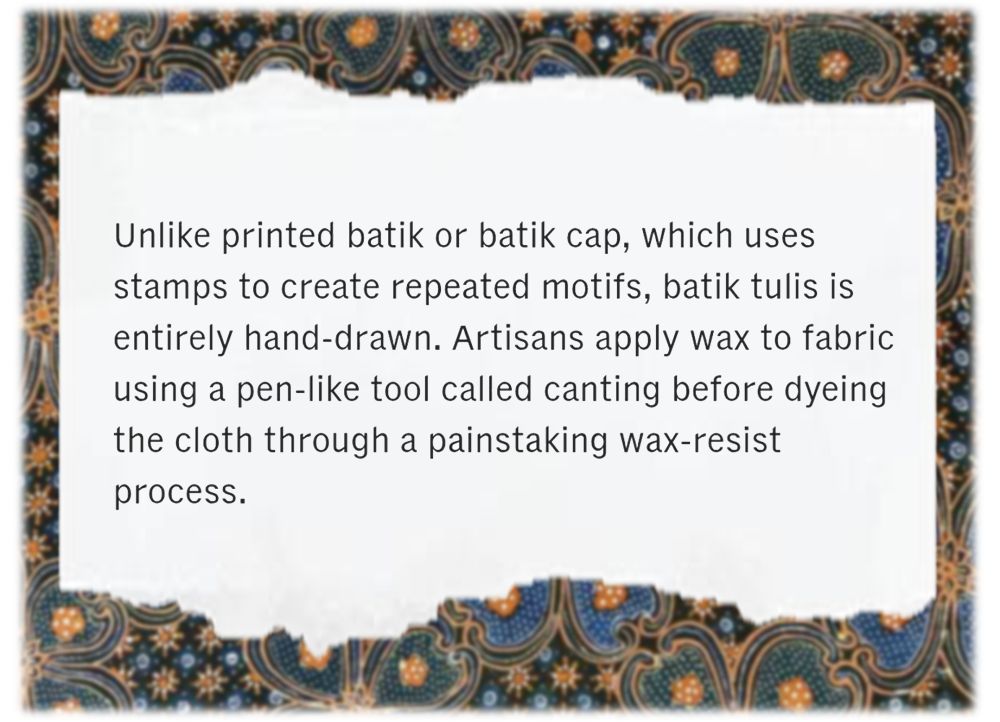
This was not merely a lifestyle feature on a batik label; it was also an introduction to the craft itself, but made shallow by a curious exercise in descriptive brevity and an adamant and inflexible stance against the use of italics. In the sixth paragraph, we were told: “Unlike printed batik or batik cap, which uses stamps to create repeated motifs, batik tulis is entirely hand-drawn.” We’ve noticed for quite a long while that both ST and CNA have dropped the use of italics for foreign words. People in the know told us it is in line with the editorially trendy obsession with keeping text looking “clean” and “frictionless”. Where once you’d see foreign words, book titles, or emphasis set apart in slanted type, now they’re kept as plain Roman font. But CNA’s categorical refusal to employ italics has yielded a typographic landscape that renders foreign terminology indistinguishable from the surrounding vernacular, leaving their editorial needlessly arduous to navigate. This is especially egregious in this batik feature. The word cap, in all likelihood, would be read as the English ‘cap’, not the Indonesian cap (pronounced ‘chup’, with the soft ‘ch’ consonant sound, rather than the hard ‘k’). That a broadcaster—able to “Understand Asia”—would conflate two entirely distinct registers with such confident indifference is rather fascinating.
CNA’s categorical refusal to employ italics has yielded a typographic landscape that that renders foreign terminology indistinguishable from the surrounding vernacular, leaving their editorial needlessly arduous to navigate
There was, in that sentence, the explanatory clause “which uses stamps to create repeated motifs” and it did some work, but it didn’t fully solve another problem. It elucidated what batik cap is, but it didn’t clarify how to read the word itself. There was no phonetic guidance, so using “stamp” explained the process, but not the pronunciation or that it is a technical word. Italic formatting serves as a visual flag: a signal that the word, and its attendant cultural context, resides outside the English lexicon. That’s a typographic cue that explanation alone cannot replace. It’s like explaining ‘pho’ as a Vietnamese noodle soup without acknowledging that its pronunciation bears no relation to the English ‘foe’. The italics are the typographic courtesy that signals: pause, this is foreign, don’t default to English phonetics. (And there is also the strange conjunction “or”. Grammatically, it sets up an equivalence: printed batik or batik cap are presented as parallel categories, both glossed by the clause “which uses stamps to create repeated motifs.” That structure implies that printed batik is also stamped, which is inaccurate. Industrially printed fabric with batik-like motifs requires no stamping. Syntax should have separated the categories. Since we have come this far, allow us to offer a suggestion: “Unlike printed batik, which is machine-made, or batik cap, which uses stamps to create repeated motifs…”)
We optimistically assumed the non-italic plague had run its course (there were already two cases, tulis [or write] the other), yet there we were, marvelling at how many times it can strike within a single, mercifully short sentence when, in the next line, the pen used for the application of wax was referred to as a “canting” in total sedia (the Malay military command for stand to attention) form, terlanjang (naked) of italics. It was as if we needed another beautiful example of why dropping the slanted font is disastrous. In Indonesian, canting (pronounced ‘chanting’, with an open “a” or an ‘ah’ sound) is the tool used to apply hot wax in the drawing of the patterns to be ‘resisted’. But in English, canting, which risks sounding terribly rude, already has meanings—“acting hypocritically pious” or “whine like a beggar”. To be fair, the reference to “a pen-like tool” clarifies the meaning, but it does nothing for the pronunciation. Without italics, batik made with canting sounds less like wax-resist art and more like cloth patterned in hypocritical whining. Or, worse, the artisan, too, was whining or being hypocritical with their own craft. There is admirable effort in this: It takes real editorial vision to make batik read like a whiny manifesto instead of a textile tradition.
Italic formatting serves as a visual flag: a signal that the word, and its attendant cultural context, resides outside the English lexicon
If we line up the examples—cap, canting, and definitely tulis—we see the same pattern: without italics, the words collapse into English homonyms or false cognates, and the explanatory clauses have to work overtime. But explanation alone is never enough because the eye reads before the mind interprets. What’s disconcerting—and, frankly, embarrassing—is CNA’s devastating boldness to declare that they Understand Asia. The irony of the tagline is brutal. Instead of helping readers cross linguistic boundaries, they confuse them.The marketing slogan performs authority, but the typography in their pages undermines understanding. They’re not helping readers comprehend Asia any more than misunderstand the content, cleanly formatted, one homonym at a time. But there’s a deeper, stinging wound here: it’s not just typographic laziness we are concerned with; it’s a cultural erasure executed as editorial efficiency. These aren’t just random words—they speak of craft. Cap encodes the artisanal stamping tradition, while canting, delicate wax‑drawing technique. By refusing to mark them as foreign, specifically Indonesian, the copy team reduces them to generic English homonyms, cruelly severing them from their roots. This is not just steadfast adherence to a style guide, it is cultural betrayal.
To be certain, Italics have not totally disappeared, but their role has shrunk: once a prestigious typographic invention used for emphasis and scholarly distinction, italics today are often sidelined in digital design, replaced by bold color or layout cues. Their decline is tied to the shift from print culture to screen-based communication, where italics are thought to be less legible and, therefore, less supported. Readability and accessibility concerns drive CNA (and other news outlets) to adopt Western‑centric “neutral” formatting that strips italics in favor of plain Roman or bold. CNA’s choice reflects a globalised editorial minimalism rooted in Anglo‑American style guides rather than Southeast Asian linguistic realities. Italics are also wiped out to discourage what editors call “bias” or “ornament” or the unnecessary exoticising of foreign terms. Italics today are caught between heritage and accessibility: still vital for clarity in multilingual contexts, but sacrificed in digital minimalism. CNA’s nod-to-the-Western formatting overlooks Asia to project global neutrality. But in trying to look objective, the broadcaster undermines the very cultural comprehension its tagline promises. There is one more foreign guest to address in the room: batik, Like khaki, batik has been safely domesticated into English—earning its exemption from the italicised dump—but no such luck for cap and canting. We must, therefore, still apply the decorative tilt to them so that readers might be reminded that those ‘C’ words (and many others) have not quite earned their citizenship yet. The decoration is really the difference between sense and nonsense.
Illustration from an actual screen shot of the article: Just So

