Has it really been the abundant, luxurious existence promised by the title of this autobiographical “theatre piece with music”? For Jacintha, whose global audiophile legacy was built on sonic warmth, her martial reality delivered on stage suggests something far more barren
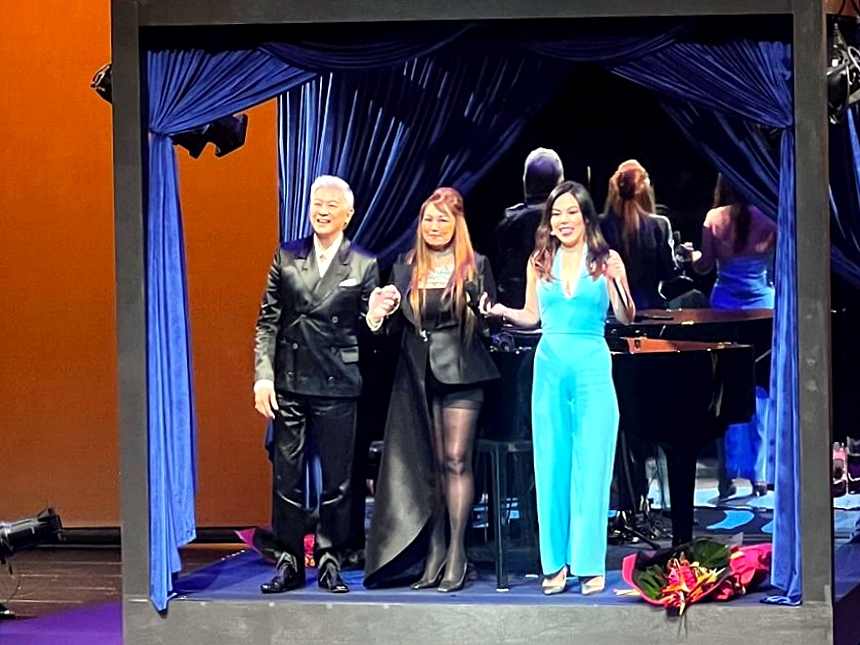
Life of Lushness. From left, Dick Lee, Jacintha, Frances Lee
Last Monday morning, when offices on our island began their operations of the week, Dick Lee (李炳文, Li Bingwen) shared on Instagram a photo of him and two others of the three-member cast of Lush Life, with the comment: “Excited to finally share our stories…” What could those stories be and what untold tales might be served up? And had he been that eager to make these revelations about him and his ex-wife Jacintha Abisheganaden, whose life of lushness this play would be about? Mr Lee was operating, as he tends to, strictly within his element as a master impresario. He was setting a hook: He wanted the audience to think they would be buying a ticket to raw, unfiltered (even tawdry?) disclosures. But because this is an Ong Keng Sen/T:>Works production for Singapore International Festival of Arts—built on a surprisingly paltry 15-plus hours of recorded verbatim interviews—what has been hitherto untold would likely be a highly curated, intellectually buffered script of their lives. But we waited with bated breath.
And the suspense expired. From the first set-free scene and the first Singa-song, it was clear to us that this was not going to be forty years of cultural history or marital clarity, or the quiet compromises of one vocal artist’s life. Known professionally by her mononym, Jacintha is a multifaceted and mostly inscrutable figure; that she would suddenly allow herself to be defined, at least on this night, by her three failed marriages was an unexpected decision to validate rumours that had long since lost their novelty. During the intermission, we overheard someone remark that director Ong Keng Sen was signalling that “Jacintha’s biography isn’t a private memoir, but part of the nation’s cultural archive.” If so, this evening was less about her artistry than it was an institutional claim on how Singapore’s cultural icons lived, loved, and faltered. For the celebrity class, marital mess is not verboten. Her marriages were forced into our collective memory because she herself is positioned, like the opening song, as The Best of Singapore.
Jacintha is a multifaceted and mostly inscrutable figure; that she would suddenly allow herself to be defined, at least on this night, by her three failed marriages was an unexpected decision to validate rumours that had long since lost their novelty
Not heard until now, The Best of Singapore is imbued with the nationalistic pitch that characterises our National Day songs, including those written by Mr Lee. It retains the hummable quality that ensures it will find a loudspeaker at the NDP. The placement as opener didn’t just celebrate Jacintha’s artistry; it framed her life as emblematic of Singapore itself. It was a rhetorical gesture that says: her story is our story. Ironically, instead of rallying collective pride, it became the operatic overture to a story of vulnerability and fracture. But elevating not a particularly riveting private heartbreak into national heritage risks trivialising the archive. It’s not that her marriages are historically significant; it’s that Mr Ong wants to dramatise the myth of Singapore’s icons as fully human. Lush Life lifts the veil on how Singapore’s cultural institutions sometimes inflate private lives into public heritage to sustain the aura of national icons. But do we really care? Is it vital to see private pain transmuted into public information, even in song?
Lush Life is a strange amalgam of celebrity confessional, community theatre, and sanitised cabaret. This hybrid form is what makes the piece both intriguing and frustrating. It is neither pure concert nor pure documentary, nor pure theatre. Instead, it occupies that awkward cultural purgatory where we were not sure whether to applaud, take notes in the dark, or just book a Grab. It gives you just enough narrative to get hooked, just enough music to get distracted, and just enough stagecraft to remind you that you were sitting on a very uncomfortable theatre chair. The “theatre piece with music”, as Jacintha described her show on Instagram, was presented in four acts of uneven consistency. The first two were bare-stage performances of her younger self (played by Frances Lee), accompanied by a video projection of her regaling us. Act three suddenly turned into a Dick Lee concert, reminiscent of those he used to stage around his birthday. And the closing act shifted into a mere hint of a cabaret, ensnared within a cubed frame. We were certain we did not buy tickets to Frankenstein’s Cabaret. The discernible messiness could be due to Mr Ong spending too much time in Berlin, where he has professional and personal obligations to fulfil, leaving him with insufficient room to coddle or properly discipline this project here.
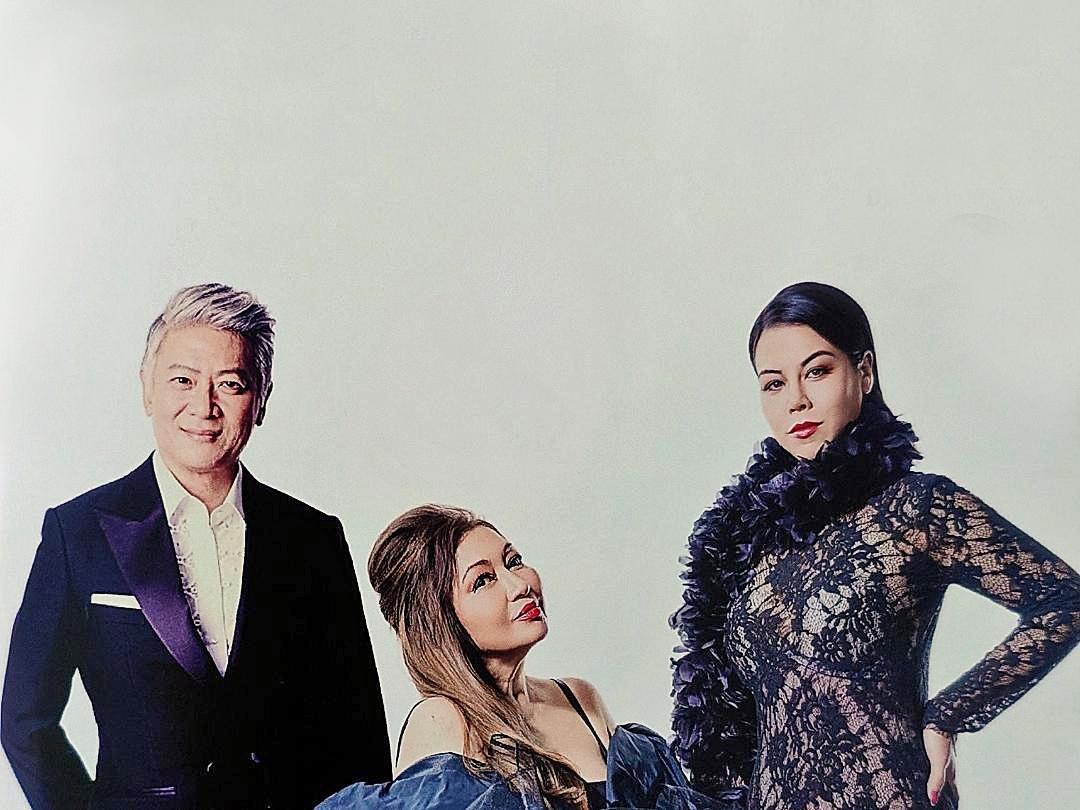
The cast of Lush Life, as seen on the program cover. Photo: T:>Works
In an IG reel shared on T:>Works’s account, Jacintha said earnestly: “This is a biopic of my life.” That is rather telling of how she sees her life: cinematic. In popular imagination, a “biopic” suggests a sweeping, intimate, filmic portrait of a life—warts and all. By calling Lush Life a biopic, she’s positioning it as that kind of comprehensive self‑portrait, even though it’s staged in a theatre with a projector screen, not quite amounting to a cinema. She continued: “Nobody really knows I got married three times.” Except, perhaps, only the theatre’s janitors? Who cares? “Nobody really knows” is humblebrag. As she narrated her story, often hamming it up, it became clearer that it was not about informing the audience; it was about staging intimacy, making them feel they’re privy to something exclusive. And many hoisted themselves unto the hook. As we had expected, any show about Dick Lee and Jacintha tends to attract those who saw them grow up, the many who grew up with them, as well as those who consider them Singapore’s OG pop stars. It was a fan-meet, a nostalgia trip, and old-timey entertainment, rolled into one sugar roll of not-so-neat celebrity marital discord.
Although Jacintha spoke about her career sketchily and, out of the blue, mentioned her wedding dress and the virgin experience making a custom gown (designed by Yang Derong [杨德荣], now an artist) in Paris, the thrust of the narrative was the men she married. One woman and three husbands, each sketched in shorthand—the ideal but geographically inconvenient, the glamorous but absent, the abusive and punishing. She mentioned her first by name—David (John) Scheffer, noting that he wrote “law books”, but the detail is perfunctory. Mr Scheffer is a distinguished figure in American law and diplomacy; he served as the inaugural U.S. Ambassador-at-Large for War Crimes Issues under the Clinton administration and was a central architect in drafting the jurisprudence and structure for the International Criminal Court, blending a prominent career as a lawyer, diplomat, and law professor. But, in the Victoria Theatre last night, he was a footnote in the construction of her iconic status. The second, who appeared in person, needed no introduction. The third she called not by his moniker, but as a “Jack the Ripper” of her emotional life. Why he needed to be anonymised is baffling since the local papers reported their union (The New Paper headlined their report: “Ja Weds Again”). Mr Lee was not only given a face and a name, but also an entire stage and the entire act three to himself to perform his celebrity brand. He was structurally advantaged by his live presence—the only ex-husband granted the agency to contextualise and defend his actions in real time. The other two men were afforded no such luxury.
It was a fan-meet, a nostalgia trip, and old-timey entertainment, rolled into one sugar roll of not-so-neat celebrity marital discord
Her final nuptials were exchanged with the theatre veteran and former journalist of The Straits Times, Koh Boon Pin (许闻品, Xu Wenpin), eight years her junior. At some point in his professional acting career, he identified as Peter Boon Koh. The unnamed ‘he’ made the dishonourable mention in the last act. He was, at this final part of the Jacintha story, not a footnote but an exclamation mark. The revelation of domestic abuse was made while she was in her most comfortable environment: jazz. Notably, in the same year she married Mr Koh (1998), she recorded Here’s to Ben—her debut audiophile album, a tribute to Ben Webster. Mr Koh first rose to prominence in theatre in 1992 with his role in Michael Chiang’s Private Parts, a comedy that saw him play Mirabella, a character about to undergo a sex-change operation. Despite a storied acting career, Mr Koh settled into the world of corporate communications and worked as vocal trainer. His acting pedigree, his journalistic credibility, even his corporate communications profile—all of that was effectively wiped out in a single stroke when Jacintha spoke of his violent outbursts at home, smashing tableware and furniture. It was a theatre practitioner vilifying another theatre practitioner. That was a revelation, and a fascinating coda to the whole narrative arc. It shifted the dramaturgy from longing to be home to home at war. Every story has a villain. Jacintha’s is no different. This was her belated #MeToo reckoning.
Despite the seriousness of her revelations and the severity of her allegations that, towards the end, was a theatrical version of revenge porn, a considerable portion of the performance was played for laughs. From her first semblance of a couture experience when the première refused to cut a fabric that had a mere “snag” to the sampan that somehow became unseaworthy midway, ferrying her wedding guests to the now-closed Beaufort on Sentosa, the comic relief allowed her to serve the camp. On the screen as the narrator of her own story in the third person, Jacintha was a neat amalgam of Rosemary Joseph (Beauty World), Bee Lian (Fried Rice Paradise) and her pop avatar, Dramamama (also her titular 1991 album). This was further strengthened by the use of the non-vocal parts of Mustapha (duet with Dick Lee on Mad Chinaman) for the entr’acte. It has long been known that since embarking on her jazz journey, Jacintha wanted not to be linked to her pop past. Yet, in revisiting the years of her marriages, she could not avoid encountering what truly made her and the very reason so many in the audience came to watch her: the Dick Lee songbook.
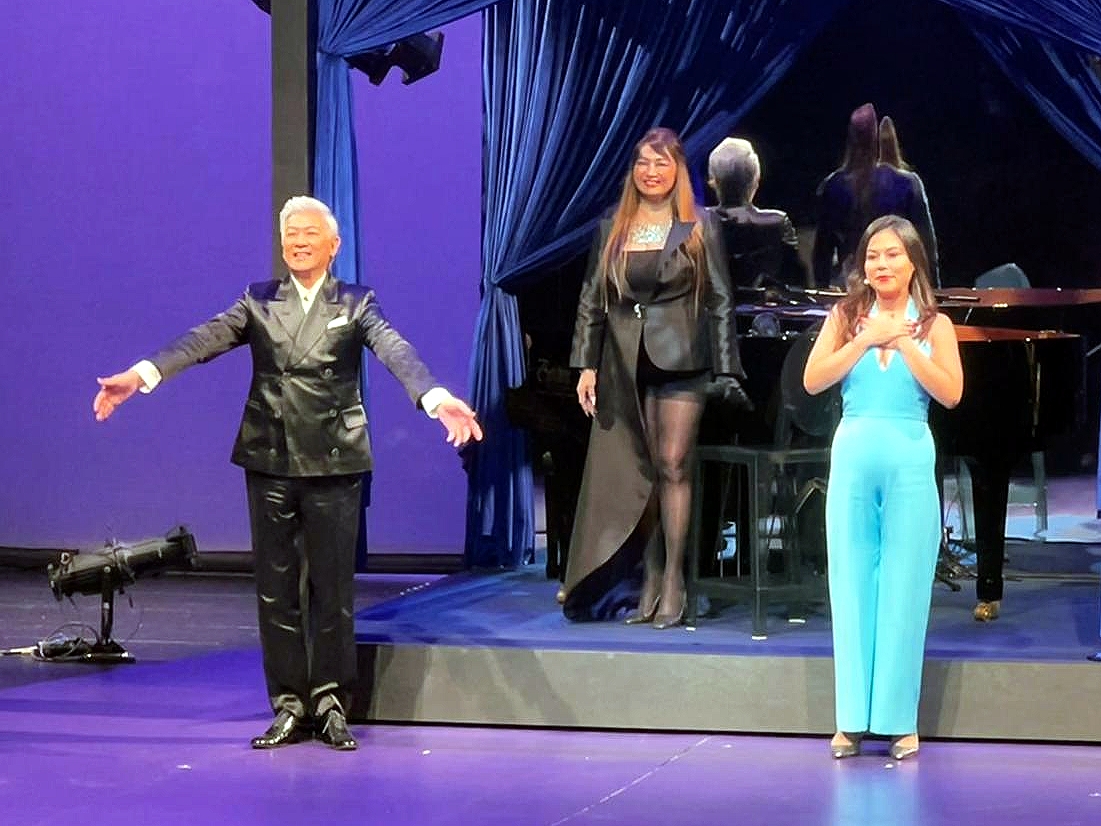
Curtain call. From left, Dick Lee, Jacintha, Frances Lee
In a “theatre piece with music”, the songs were the main characters too. People came to listen to Jacintha sing (and were treated to a mini Dick Lee concert), but this evening, her vocal cords had other social plans. To be sure, she was now a galaxy away from the girl who won the best performer at the fourth ASEAN Song Festival* (during which she tripped on the way to the stage to receive her trophy). It is clear Jacintha has transitioned from a pop voice to a “pure jazz voice”, as she called hers on stage. Friends have said that she has largely pulled away from the world of pop. In fact, she had not properly revisited it until now, and it was audibly clear to see why. She no longer sings with that rapturous voice of the debut album Silence, arguably the best in Singapore’s pop history. When she handled Still Burns from that seminal album, you quickly sensed that her vocal cords had lost their youthful elasticity. Now, she’s traded the athletic, pristine production of pop for the vocal-fry and vibrato of jazz. By the time she reached It Takes Two (also from Silence), a power ballad before they even called it that, she struggled with keeping her larynx from officially undergoing an industrial downsizing. But, in jazz, she might have convinced herself, a cracked note isn’t a mistake; it’s ‘phrasing’.
Although Jacintha proclaimed she loves fashion, she is not a fashion fanatic the way her contemporary Madonna (or, a less pop but younger artist, Esperanza Spalding) is. For Lush Life, a marquee name was used to give her the aura of a diva: Thomas Wee. He is part of a gang of creatives from the late ’80s and the early ’90s that was involved in the production, including the two main performers, the director, and the make-up artist, a Dick Lee alum, Cecilia Chng. A vintage extraction to ensure a certain aesthetic credibility, no doubt. Mr Wee, known for his tailoring and a penchant for “one-seam” engineering, created outerwear that was meant to be aggressively visible. But, while friends of the singer voiced publicly that she has lost weight, she wore her clothes like an exercise in textile accumulation. Or, from a more haute perspective, an avant-garde exploration of volume. Jacintha was costumed by Thomas Wee, but no one would have guessed it without the declaration on the cover of the cheaply produced programme. In William Forsythe’s 1991 contemporary ballet, The Loss of Small Detail, no guessing was required to place the costumes’ designer as Issey Miyake. But with Lush Life, it was harder for those who could not discern the distinctive Thomas Wee silhouette. His authorship was legible and simultaneously invisible.
Jacintha was costumed by Thomas Wee, but no one would have guessed it without the declaration on the cover of the flimsy programme
For almost the entire performance, Jacintha was seated. The reality of her recent hip situation was an acknowledged truth within the auditorium, a physical constraint that clearly dictated the entire concept of the production—forcing her into a static narrator whose screen-bound projection had to do the heavy lifting her body could not. Her inability to use her costume to diva-esque effect is, perhaps, understandable. Thomas Wee’s voluminous designs, which might have been deployed for dramatic effect in motion, became more like sculptural shells. They assumed a protective role, less about flamboyant display, more about testimony, and the weight of memory. But if so, why was she wearing shorts in the last act, exposing her stockinged limbs? This was Jacintha attempting to negotiate a truce between seduction and camp, though seduction clearly lost the territory. As Susan Sontag famously noted, camp thrives on failed seriousness—gestures that aim for glamour but collapse into irony. In a performance obsessed with confession, the shorts became another disclosure—not of allure, but of limitation.
This structural weakness extended directly to the casting of Frances Lee as the younger Jacintha—a decision that appeared to reveal a misunderstanding of vocal identity and physical posturing. Ms Lee is a musical theatre performer. She belts. Jacintha did not. Her appearance in the musical Cats in 1993 as Grizabella was the exception; in that context, she probably did belt, but it was a borrowed medium, not her preferred way to sing. Jacintha has a very sure sense of self. She has always carried herself with a precise certainty of what she will and will not do. Ms Lee, as the young diva, opened the show, curling sideways on the stage boards. Jacintha, in any performing space, would not do that. She has draped herself over a piano, but not gone foetal on the floor. Was it a show of vulnerability? But the problem is that vulnerability in Jacintha’s idiom looks very different from vulnerability in musical theatre. And as one old collaborator said, “Jacintha is, by nature, campy. Frances is not.” True, she wielded camp like a shawl, draping it over herself when needed to heighten posture and presence. That is lush. However, what the audience saw was not lushness lived, but lushness staged, barely.
*The event was also reported as ASEAN Pop Song Festival
Photos (except when indicated): 色影师
 Style on the Dot