As the rest of the world navigates a protracted energy crisis and shuns American isolationism, European fashion houses arrived in New York and LA to treat a violent superpower like a private theme park
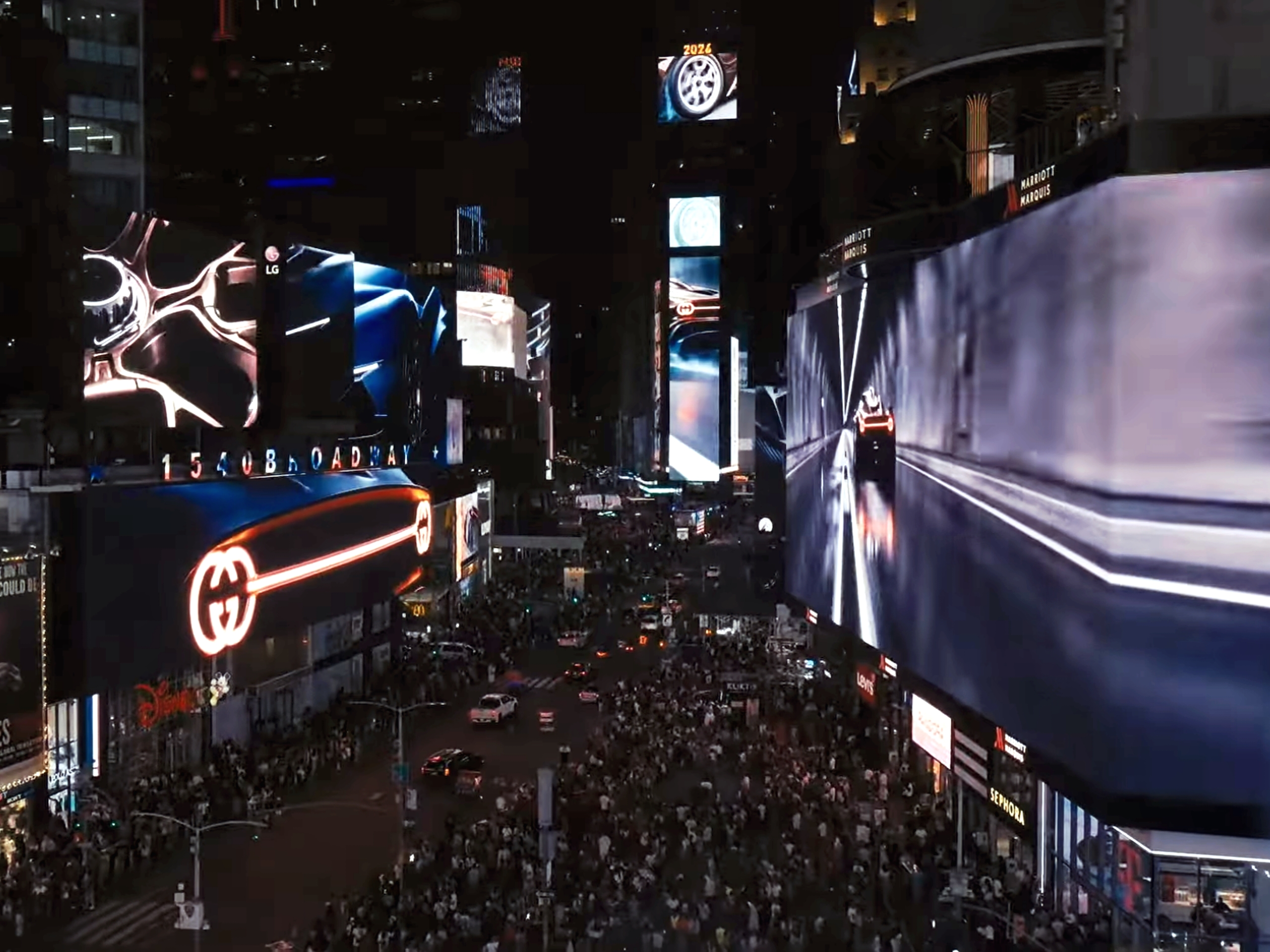
The Gucci Cruise show in Manhattan. Screen shot: gucci/TouTube
Six days ago, there was the Dior show at the Los Angeles County Museum of Art (LACMA) Forty-eight hours later, the Gucci show in New York’s Time Square. Then just this morning (our time), the Louis Vuitton show at The Frick Collection, also in the Big Apple. This trifecta does not include the Chanel Métiers d’art 2026 collection, shown in an unused New York subway last December. In the immediate wake of the much-derided Met Gala,, America is the epicentre of a profound cultural paradox. The very country that’s abhorred for its aggression is simultaneously consumed as a glamorous stage set. For regular travellers, the war in the Middle East and the ripple effects of the energy crisis make transatlantic movement fraught, expensive, or even morally complicated. Yet, for luxury brands, the skies seem magically clear. On one hand, war constrains ordinary mobility; on the other, elite brands flaunt their immunity to those very real limitations. A comforting reminder that when civilization crumbles, the front row will still receive their gift bags on time.
If Dior had wanted the minimalist organic modernism that the LACMA represents, they might have found a similar back home or nearby, say the MuCEM in Marseille or, if the closest visual match were absolutely important, The Rolex Learning Centre in Écublens, Lausanne. But they chose to go to L.A. to plant themselves in the heart of American spectacle, leveraging Hollywood’s aura and the myth of California modernism. A civic space became a branded stage. Gucci chose Times Square, already the global shorthand for excess, neon, and perpetual motion, not merely to borrow a ready-made spectacle, but to multiply it and magnify the extravaganza many times over. Times Square guarantees saturation: tourists, media, influencers, all converging in a single hyper-illuminated node. Louis Vuitton chose The Frick Collection, which is compact, compared to Times Squares or the LACMA, yet its aura of exclusivity and old-world refinement magnified LV’s gesture. Smallness doesn’t mean modesty; it carries the exact same weight of corporate occupation. Rather than choose, say, the Musée Jacquemart-André in Boulevard Haussmann, LV’s pick allowed them to enjoy the same amplification on the same soil. Even in choosing a less spacious venue, LV still participated in the same theme-park logic.
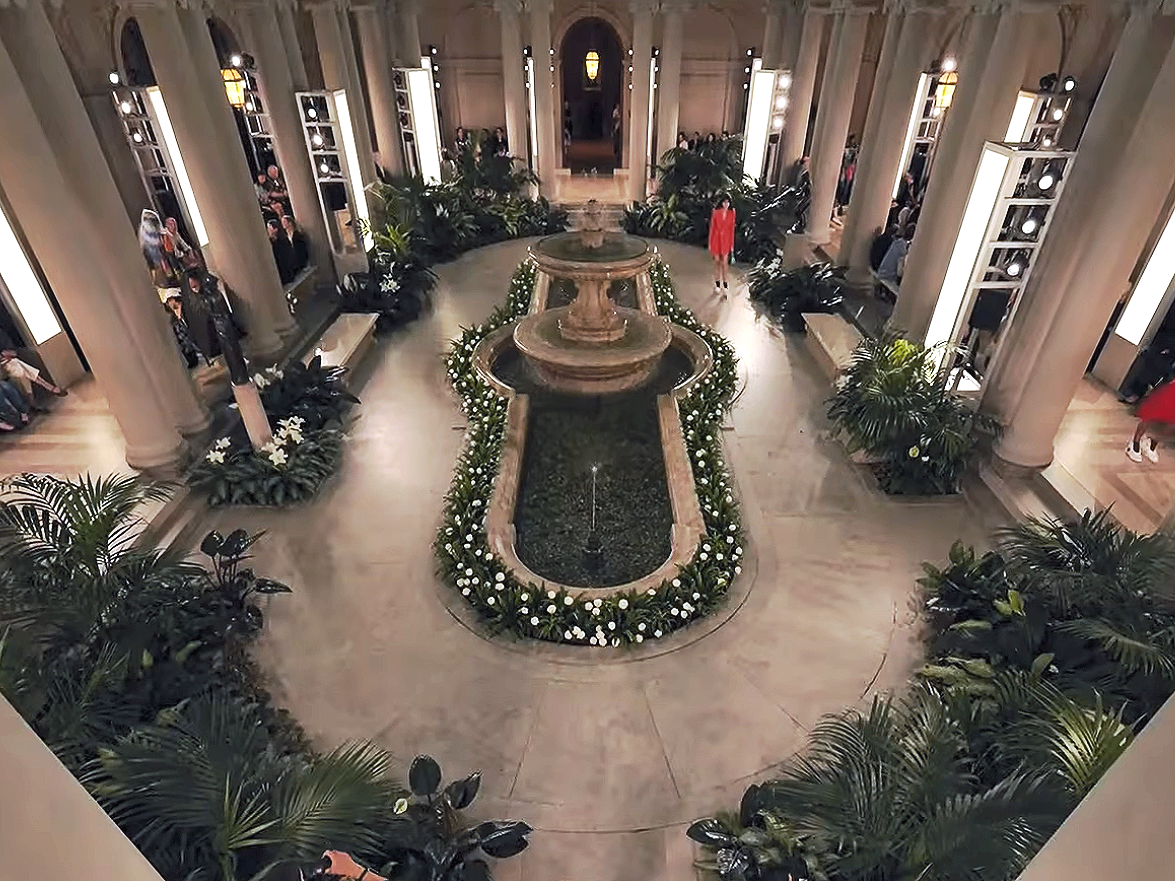
The Louis Vuitton show at The Frick Collection in New York. Screen shot: louisvuitton/YouTube
But there was more than just strong locations. Dior’s LACMA affair was decorated with vintage American automobiles, brightly painted, mid‑century models associated with Hollywood’s detective films and the nation’s car culture. But these were not the latest hybrids. These were from an era of Hollywood glamour that guzzled fuel at a rate that feels almost obscene in today’s energy‑crisis context. In a moment when Americans are anxious about affording gas, these cars read as tone‑deaf. Dior flaunted consumption in the face of scarcity like a slap in the face. Gucci was worse. The brand might be the poorest performing in the Kering stable, but they were not averse to massive expense: paying to use every single digital billboard in the stretch to broadcast their vulgar excess. One marketing consultant told us “it is the most expensive advertising stunt imaginable.” (According to Gucci CEO, Francesca Bellettini, the show cost US$10 million!) The American press called it a “takeover”. Does the term not evoke invasion and occupation, words that resonates uncomfortably when wars in the Middle East and Eastern Europe dominate headlines? Or are we imagining it? And Louis Vuitton in that minuscule museum? It spoke of a specific American flavor of old-world capital. Does that not conjure monuments and ballrooms?
You could choose distinct architectural archetypes, but each event colonised different facets of the American myth. From the revolution (the “origin story of American freedom) to the “Gilded Age” (the myth of boundless economic growth) to the post-war era (the myth of the American dream and the rise of American exceptionalism), these are not singular events. Each built a symbolic structure that Americans could inhabit imaginatively. Together, these archetypes form a kind of fantasy cityscape, where liberty, expansion, progress, equality, and prosperity coexist, sometimes in harmony, oftentimes with tension. The appeal is not architectural or logistical, but rhetorical: America offers the richest contradictions to exploit. For European fashion houses, we suspect those contradictions are fuel—instability becomes allure, crisis becomes backdrop, and spectacle becomes proof of dominance. This is all the more startling when America today is a massive needlework of isolationism, volatility, and cultural arrogance. Even the Met Gala that many of these brands crystallises the contradiction. It’s not just a fashion event; it’s a ritualized projection of America’s ugliest qualities—the greed, the hegemony, the flaunting of privilege, and the spectacle desperate to be cultural capital.
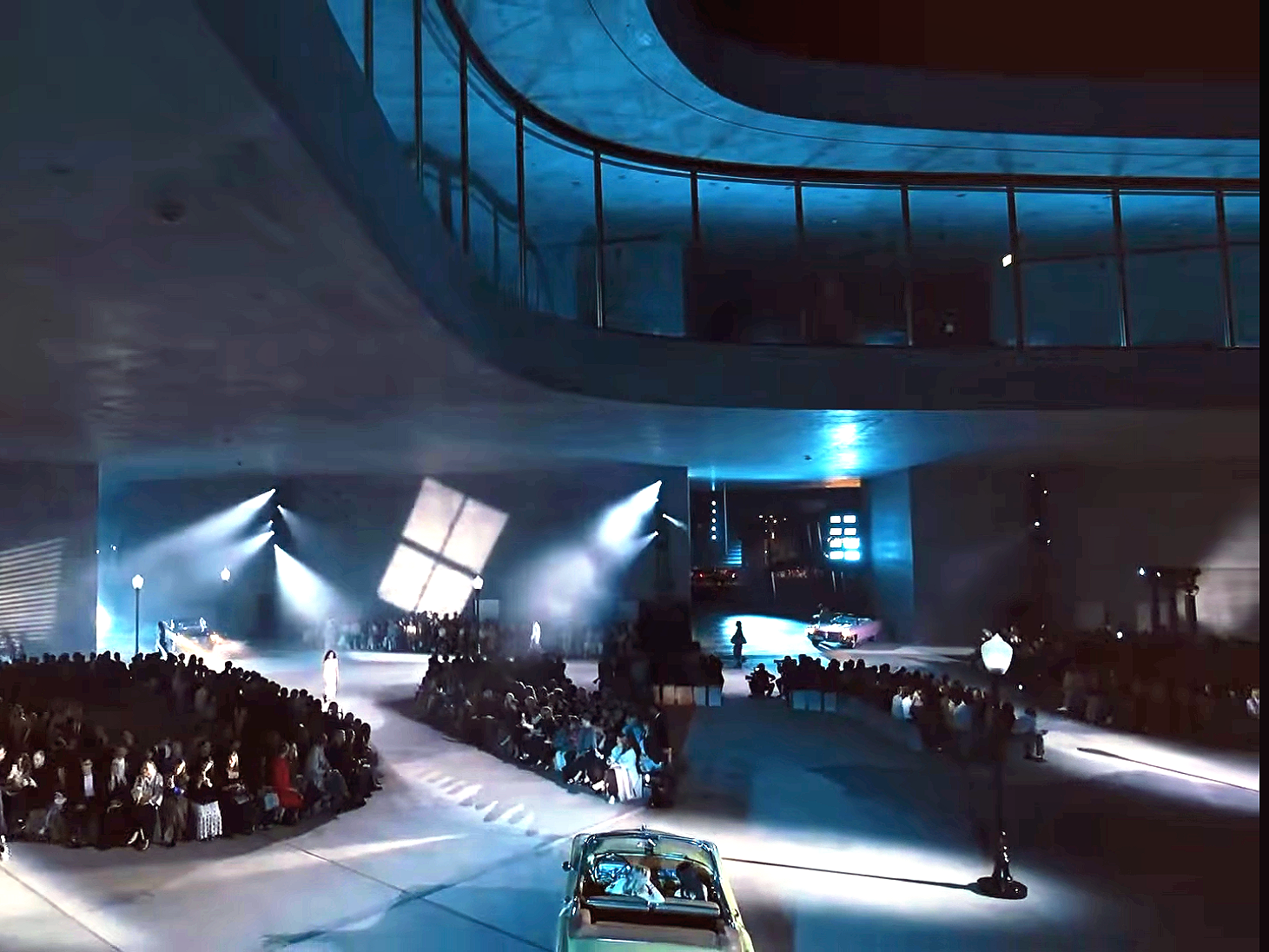
The Dior show in Los Angeles
These brands are not ignoring the mess; they are actively metabolising it. And while we watch the feeding frenzy, there is also another country to consider: China. The world’s second largest luxury market is absolutely part of the calculus. These European brands aren’t just staging in America for America’s sake; they’re also performing for the Chinese gaze. The Chinese are buying significantly less European luxury products, namely fashion, leather goods, and watches. According to media reports, domestic luxury sales fell 17–19% (garments alone dipped between 5% to 8%), one of the steepest declines in decades. The popular Western take on the contraction is that it was driven by the property crisis—Chinese real estate market gets the blame because it protects the ego of the luxury brands—and job insecurity. But on the ground in Beijing and Shanghai, the Chinese are fed up with the relentless, trigger-happy price hikes of these European brands, with no perceptible improvement in quality or tactile integrity. Shoppers now prioritise value-driven luxury—items that balance quality, exclusivity, and practicality, and are fairly priced. 醒了. They woke up.
For a while now, the European brands, including those from the LVMH stable, have blamed China for their weak sales, while simultaneously betting on China’s long‑term importance. But for now, America beckons. Some observers are saying that the Europeans peacocking in America is necessary because the U.S. is still the largest luxury market in the world. But is it more about America as a market or a stage for spectacle and narrative control? In late 2024, when Chanel showed their Métiers d’art show, it was in China, specifically at Hangzhou’s West Lake, one of China’s most poetic, historically resonant landscapes. Chanel’s presentation (then under the doomed Virginie Viard) was seen as a gesture of cultural reverence and, the crude opposite, market seduction. Then a year later, the same line was shown in the grungy New York subterranean subway station. What a swing, we had thought. But fans do not see that as oscillation. Chanel was showing “range”, they said. But Chanel is not Shein! Then they asserted that they “swing” to show command”. But Chanel has been in command for more than a century. Silence. To us, Chanel doesn’t swing for survival, they swing for theatre. And isn’t that what going to America is all about?

