One timepiece created quite a rumble last weekend. But the ‘Royal Pop’ wasn’t a Swatch‑only stunt. The two letters AP were clearly stamped on every single piece. That makes Audemars Piguet irrefutably a co‑author of the chaos that dug for a new rock bottom
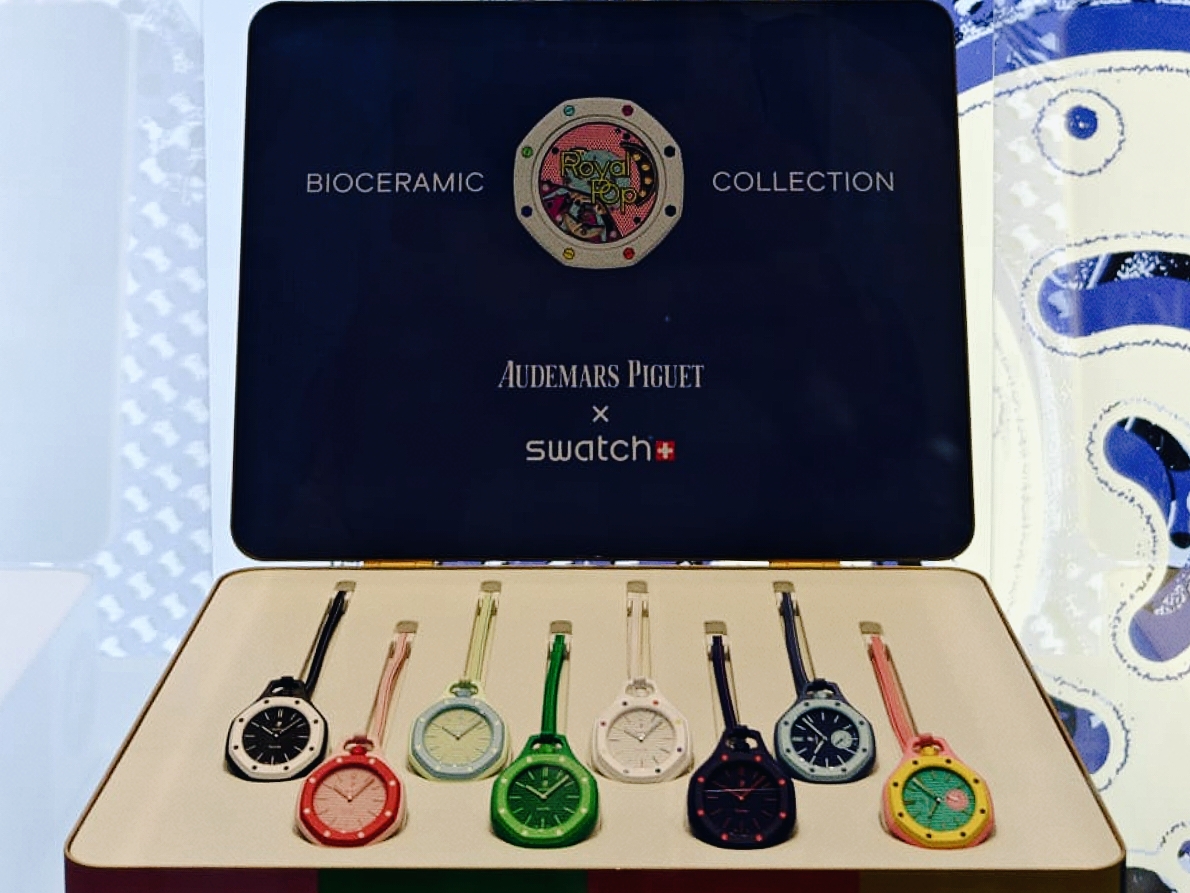
See no touch, see no buy; the Audemars Piguet X Swatch ‘Royal Pop’
By Ray Zhang
I want this upfront: I don’t own an Audemars Piguet watch and never will. I have no illusions about that. Nor am I unhappy or bitter. Some things will always remain out of reach, and thankfully, being miserable about them is entirely optional. Truth be told, I used to admire AP. Now, I cannot look at the brand with the same eyes that once admired the Royal Oak and kin. Where there was once admiration, there is now only the visual wreckage outside Swatch stores worldwide. I see people camping inside and outside commercial spaces, reduced to the optics of a war-zone soup kitchen. Most striking was a reel making its inevitable rounds on social media: a middle-aged man in India, standing above a surging crowd, shouting at a closed Swatch storefront, “We are not animals.” Whether or not the video was a product of AI generation is almost beside the point. If the pursuit of a product requires a crowd to be treated as less than human, the output isn’t prestige. It is humiliation.
I was down at MBS to witness the situation for myself. The line was long, and you could hear it before you spotted it; it stretched into the underground passage that leads pedestrians from Bayfront MRT Station to Gardens by the Bay. Many in the queue were young, seated—some on foldable chairs, others on the bare floor—behind metal barriers. You could easily mistake the scene for an Animal & Veterinary Service operation. The kids looked like they might have been out there without their parents’ knowledge. Among them, many appeared to be foreign workers, happy to be with other foreign workers, but they kept to themselves, not interfacing with others in the same queue, not establishing the camaraderie that usually comes among those with a shared mission requiring roughing out in a public linkway. It was the one, I noted, that recently discouraged social gatherings of the dancing kind. The foreign workers were all male—on social media later, I learned that they were being paid to queue. In fact, as I walked back to the MRT station, I wondered if they—or the majority in the line—could pronounce Audemars Piguet.

The mind-boggling queue at Bayfront Linkway
This was un-incentivized mobilisation. The call of AP X Swatch was more effective than any public siren announcing impending disaster. It was staggering: the mere announcement of AP X Swatch carried enough symbolic weight to mobilise crowds across continents, not a few cities. No marketing budget, however splashy, could have engineered that scale of turnout. It was raw hype, amplified by social media reels, and exacerbated by both brands not clearly stating that the Royal Pop is not limited in its production run. The blitz that they had surely expected would not have struck. Swatch by itself would have had no pull. I have been observing their daily foot traffic the week leading to the frenzy. Slow would have been an enthusiastic appraisal. All that was needed was to drop the timepiece with the magical A and P on the face. AP’s aura was supposed to be quiet exclusivity. With this collaboration it didn’t just lower the bar, it allowed its name to become the trigger for mayhem. Luxury isn’t only about ownership. It’s about the aura held in common.
But why would AP let a false assumption simmer to stoke a panic-buy? In many of the news reports that have since emerged, a single theme is obvious: They say that “Audemars Piguet is now part of popular culture”. I was speaking to a luxury watch executive who tried to explain to me that this was AP’s “defense against becoming a museum piece.” This suggestion assumed that AP had only two options: hype or irrelevance. The contemporary insistence on not being pushed to the periphery and on transforming every facet of human existence into a ”cultural product” is remarkably tedious. Nothing is permitted to exist on its own merits and anymore; everything must be hollowed out, packaged, and optimised for rapid consumption. Expressions in any form must be curated for an insatiable, superficial market. What we are seeing more and more, and more is a sterile landscape of manufactured predictability—a deeply cyclical exercise made worse only by the dreary enthusiasm of easy-to-manipulate consumers.

The queue outside Bacha Coffee at Ion Orchard
But my understanding is that the business of luxury timepieces thrives on not initiating launches that become breaking news five minutes after the product is available to buy. Prestige brands are supposed to be immune to sirens. Conversely, AP became the siren. And the land nymph who lures the uninitiated to social ruin with her sweet calls is Ilaria Resta, AP’s CEO who has been vocal about wanting to “open up” the brand, make it more visible, and prevent it from being seen as a tired relic of the past. To do so, she reached out for the handy playbook she has used for many years during her career at Procter & Gamble: mass visibility (only now delirious), pop culture embedding, collaboration and accessibility. But AP could have engaged culture through less chaotic ways—design innovation, storytelling, or art partnerships. It didn’t need reels of ruckus and roars of rage. They really could do less. The world is already full.
In her press statements, Ms Resta claimed that the Royal Pop exists to “invite a broader audience including the younger generations to experience mechanical watchmaking differently.” How broad the audience should be, she did not elaborate. Or how young. The core delusion of the entire exercise is quite staggeringly clear and the corporate narrative that these overnight camp-outs are seeding the brand for the future generation of AP buyers is unadulterated fantasy. It is marketing fan-fiction designed to make a messy corporate cash-grab sound like a visionary cultural strategy. Those kids I saw are not going to be future AP customers. This isn’t an attitude; it’s an autopsy. The truly wealthy teenagers, whether here or those further afield, already have access to their fathers’ APs and they will have the means to buy even without the temptation of the Royal Pop. Expecting those queue-sitters to become actual AP customers requires a level of wishful thinking usually reserved for Big Sweep tickets. I seriously doubt the truly wealthy need a plastic gateway. An actual inheritance doesn’t take place with a baptism in a congested sea of the hopeful. Audemars Piguet did not build a bridge to the future, but they did bring the rowdy circus to their front door.
Photos: Chin Boh Kay

