The 9th edition of what is possibly the most prestigious award for crafts worldwide was staged here in Singapore last Tuesday. The works of the finalists are now available to view at the National Gallery
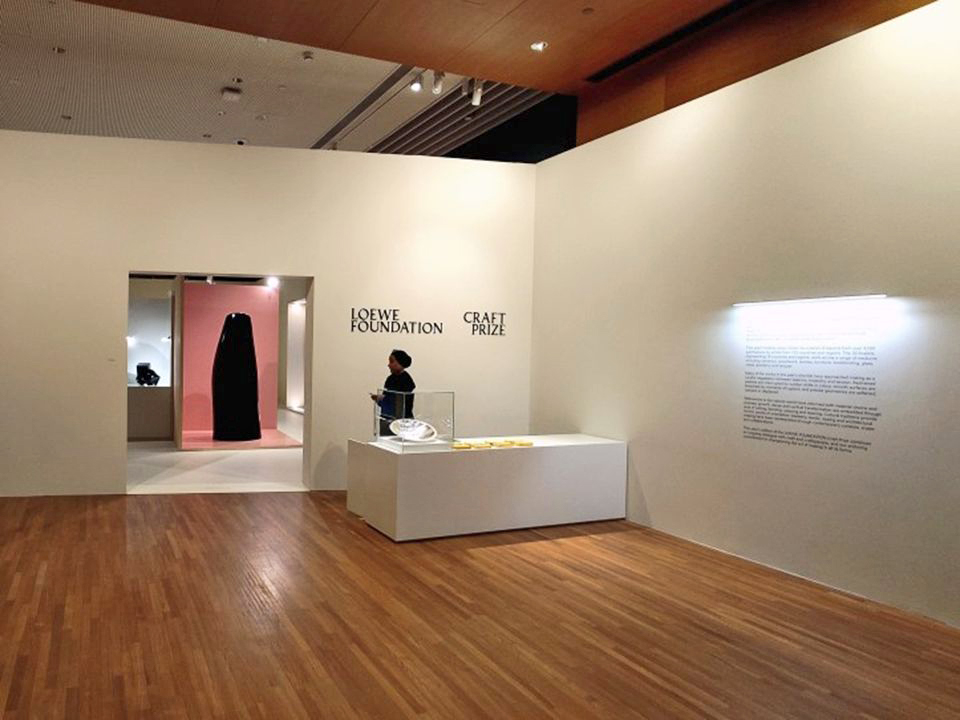
The Loewe Foundation Craft Prize has certainly cemented itself as the “Olympics of Craft” that our local media quickly latched on to. The 2026 edition feels particularly significant as it landed at the National Gallery Singapore last Tuesday. It was not just the exhibition that followed, but the award ceremony itself, during which this year’s winner was announced—Korea’s ceramic artist Park Jongjin with his entry Strata of Illusion. But the event, like so many linked to the business of luxury, was also a chance for Loewe to have regional stars, mostly from South Korea and Thailand, in attendance as a high-gloss harvesting season—so that they could be neatly pinned to a grid. It’s the cycle of modern prestige: assembling a room of glowing, cheerful faces, with uneven levels of English proficiency, simply to ensure that the social media intern has enough digital livestock to feed the algorithm for another profit-breaking quarter.
But the stars were not the only ones to be spotted. At the same time, the brand’s premier patrons enjoyed private access to the exhibition, too. According to one of Loewe’s store managers, overhead telling a visitor, these VVICs were also the reason behind the logistical dragnet deployed to make the event a regional one. Many high-net-worth zealots from Malaysia, Thailand, and Korea accepted the junkets to mingle with the judges of the Prize (including the “boys”, Jack McCollough and Lazaro Hernandez), artists (including the winner, Mr Park), and the stars whose practised radiance gave away the sobering realisation that there was likely no trace of technical interest, let alone a vestige of passion, for the work on display. You sense the palpable friction between the years of monastic devotion required to produce a shortlisted work and the fifteen-second photo op of a celebrity posing merrily beside it. The contrast is sharp: a lifetime of tactile rigour instantly reduced to a mere backdrop for a person whose admirable talent is standing in the right light without blinking.
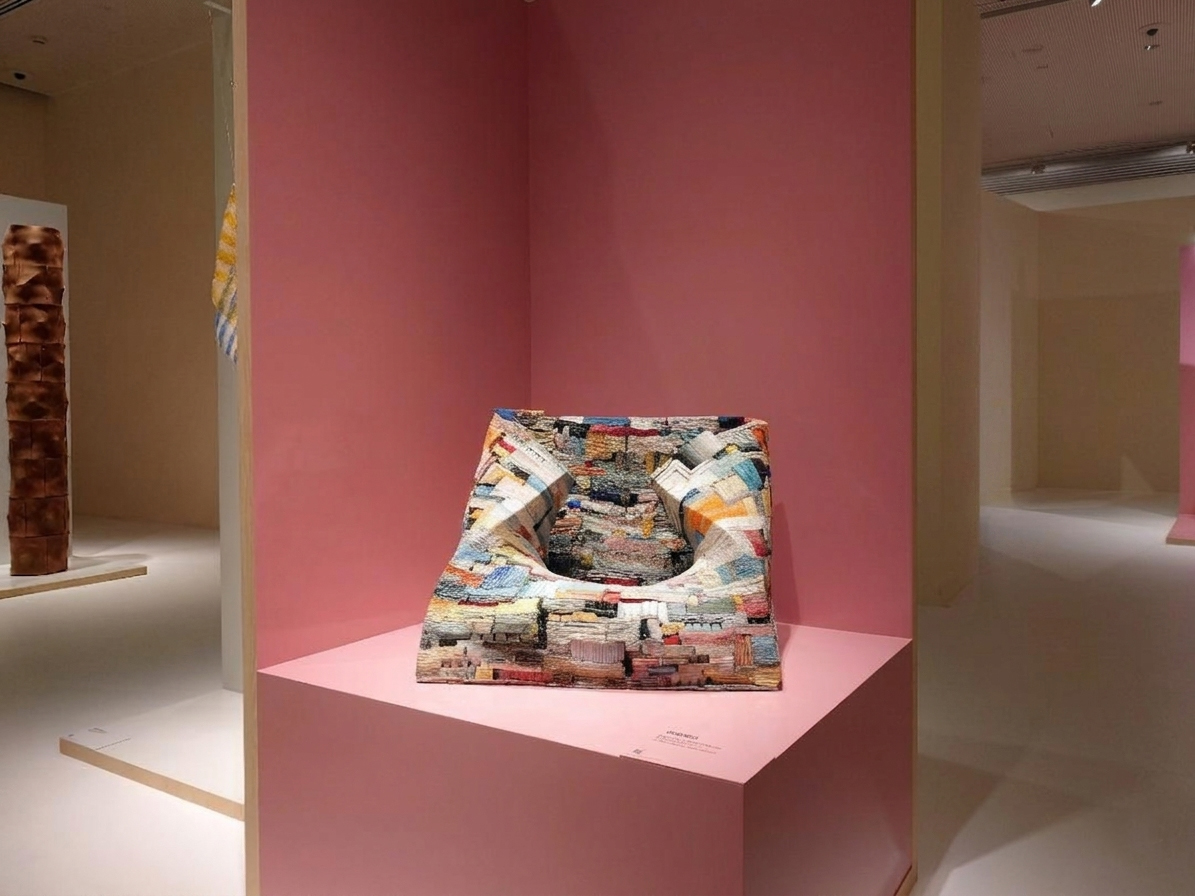
Winner Park Jongjin’s Strata of Illusion
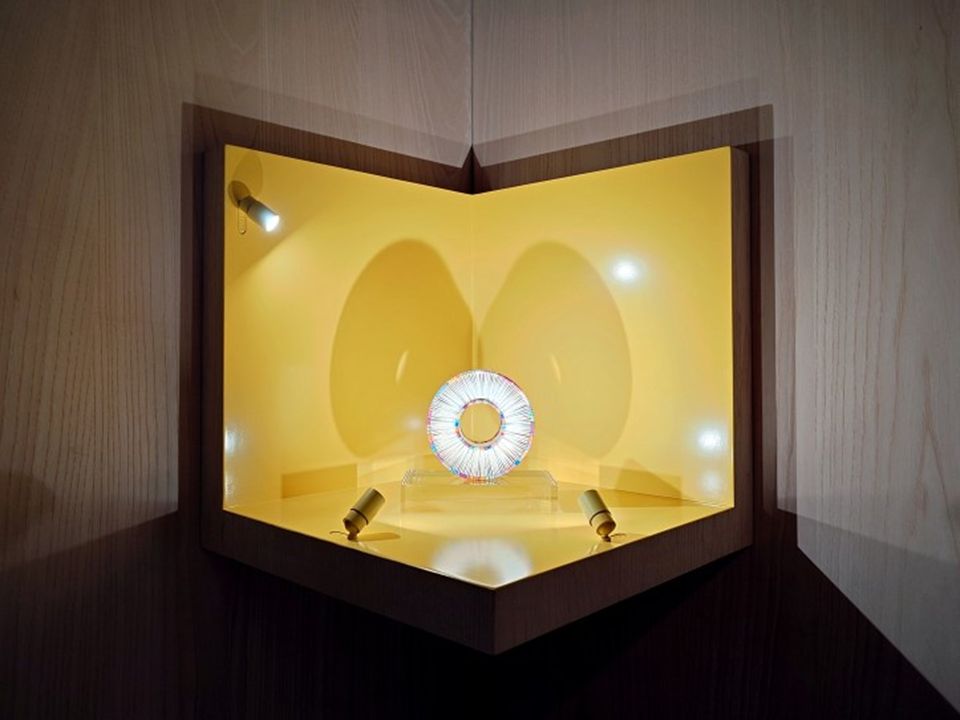
Singaporean Adelene Koh’s Endless (display unit not included)
We’ve been following the Loewe Foundation Craft Prize since its inception in 2016, the year German wood-turner Ernst Gamperl (whose pieces are part of Collection Issey Miyake in Tokyo) took the top prize, but we have never seen the post-award exhibition, now in its 9th year. Thirty shortlisted pieces from over 5,100 international submissions, across 133 countries, are now exhibited at the National Gallery. The number of exhibits is not large, but we were still surprised to find them housed in a gallery about the size of a two-bedroom apartment. If you are not inclined to examine every fibre, every fold, every crease, you will likely complete the exhibition in 20 minutes or less. There was no perceivable thematic zoning of the exhibition and no visual cues to help you navigate the space. It is also unclear why some of the pieces were placed where they were. One of the largest pieces, British sculptor Jobe Burns’s funnel-like Laying Vessel, which inherently requires 360-degree viewing to appreciate its volume and the technicality of its form, was set up in what appeared to be a corner of the gallery, with very little space for you to stand back and look at it properly. It is not clear if this was intentional curation or a spatial afterthought.
The winning piece was situated, rather curiously, apart from the primary gallery of the two-hall configuration. It seems the exhibition designers overlooked the potential of the winners work to serve as a primary attraction. We had to look for it and when we found it, the piece was smaller than we had anticipated. Placed on a shelf with the height of a chair, it looked like a papier mache box that had somehow collapsed inwards. Mr Park’s entry supposedly highlights the beauty of uncertainty and imperfection, resonating with contemporary debates about control versus collapse in art. His “Strata” is essentially porcelain slip layered with paper, then left to crumple in the kiln. The beauty of this presumably uncontrolled partial destruction is that it can be admired as sublime imperfection. That somewhat escaped us: The work, like many others, leans heavily on process-as-concept rather than form-as-affect. Much of what we saw had to be appreciated by first knowing the back story of grit and gruel. This is too America’s Got Talent audition rounds. We hear staffers telling visitors about the complexity of a piece or the struggles of the artist, but they do not necessarily come together to effect a sum of beauty. For a prize of this magnitude, uncertainty feels like a convenient excuse for a lack of formal resolve.
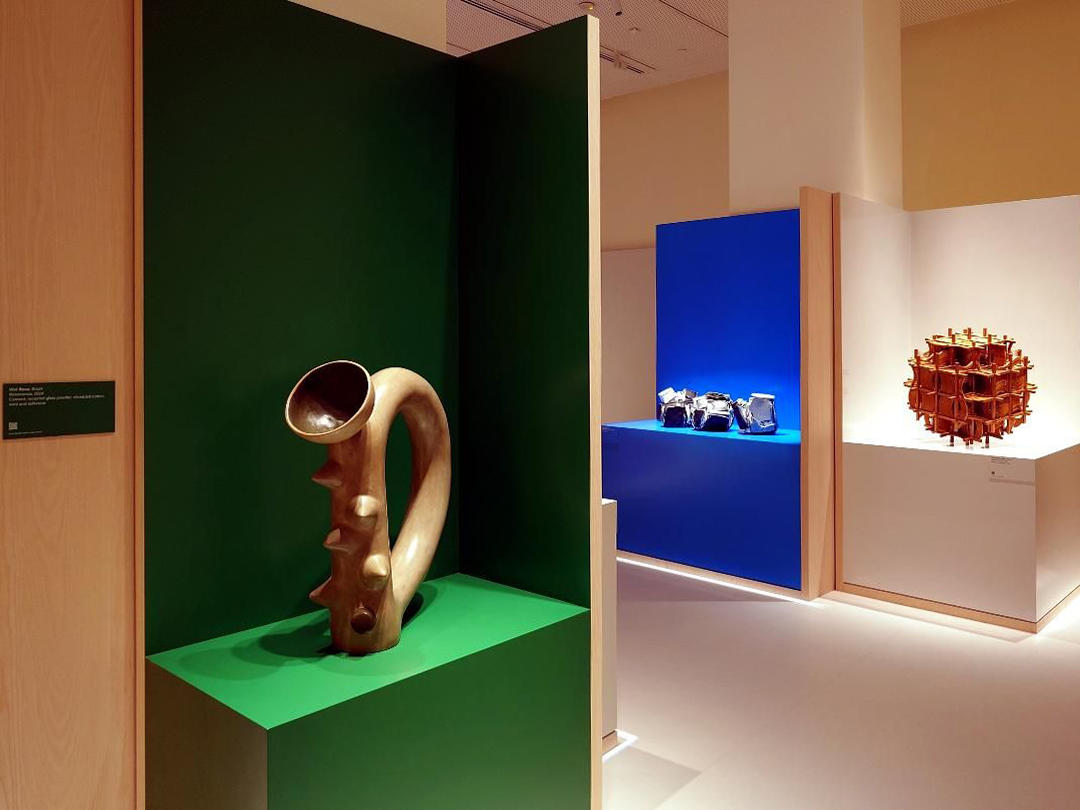
From left, VivibRosa’s Resonance, Rafael Pérez Fernández’s Time to Time, and Hsieh Chia Chen’s Rhythm in Grid
Among the thirty shortlisted is Singaporean bookbinder Adelene Koh’s Endless. She is only the second Singaporean finalist since Ashley Yeo’s hand-cut paper cube entry in 2018. If Mr Park’s winning entry was small, Ms Koh’s drum-like piece was tiny. In publicity photos that we saw earlier, her work looked to be as large as a wheel of a carriage, but it is about the size of a tin of Ma Ling stewed pork ribs. Unfortunately, Loewe’s digital image created a sense of monumentalism that the physical objects failed to deliver. The little-ness of Endless was probably deliberate: she magnified a hidden bookbinding detail—the end band—into a self-contained and somewhat modest-looking object. It did quite beckon. We noticed few people stood before it to ponder. In a prize that often rewards grand gestures or material experiments, we thought that Ms Koh’s decision to stay small and discreet reads as a statement in itself. We are not saying that everything has to be massive, such as Tanaka Nobuyuki’s rather towering Inner Side-Outer Side, which faced the entrance of the gallery like the entity Kaonashi, better known as No-Face from Spirited Away. But scale in craft can be about how a piece holds space: presence. Regrettably, we did not sense enough of that.
The Craft Prize, we thought, originally celebrated works that embodied mastery of shape and surface (we are thinking of Ernst Gamperl again), but perhaps they have shifted in their thinking or what they now prefer to embrace. In Park Jongjin’s winning piece, instead of rewarding form perfected, the jury valorised form undone. We wonder, of course, if it has anything to Jonathan Anderson no longer on the judging panel. As Loewe’s former creative director, he has often been the gravitational center of the prize—his sensibility is deeply tied to form, silhouette, and materiality. Now, with Jack McCollough and Lazaro Hernandez at the helm, the Prize could be titled towards valuing process, personal struggles, and conceptual fragility over the kind of formal mastery we associate with Loewe. But that’s not to say there were no sculptural clarity and tactile elegance. We were especially drawn to mainland Chinese artist Nan Wei’s mixed-media charmer Knot-Loving, a 包袱 (baofu, a bundle wrapped in cloth) with a lacquered body that was ‘fastened’ with a knot and its leather ends—a subtle nod, we thought, to Loewe’s artisanal history. As we left the exhibition, we kept thinking: craft as structure shaped by hands can be many things, but inert should not be one of them.
Photos: Galerie Gombak

