The Swedish retailer is moving its Southeast Asian regional headquarters from our island to the capital of our northern neighbour. Even H&M is pulling out. How much bruising can our retail ego take?
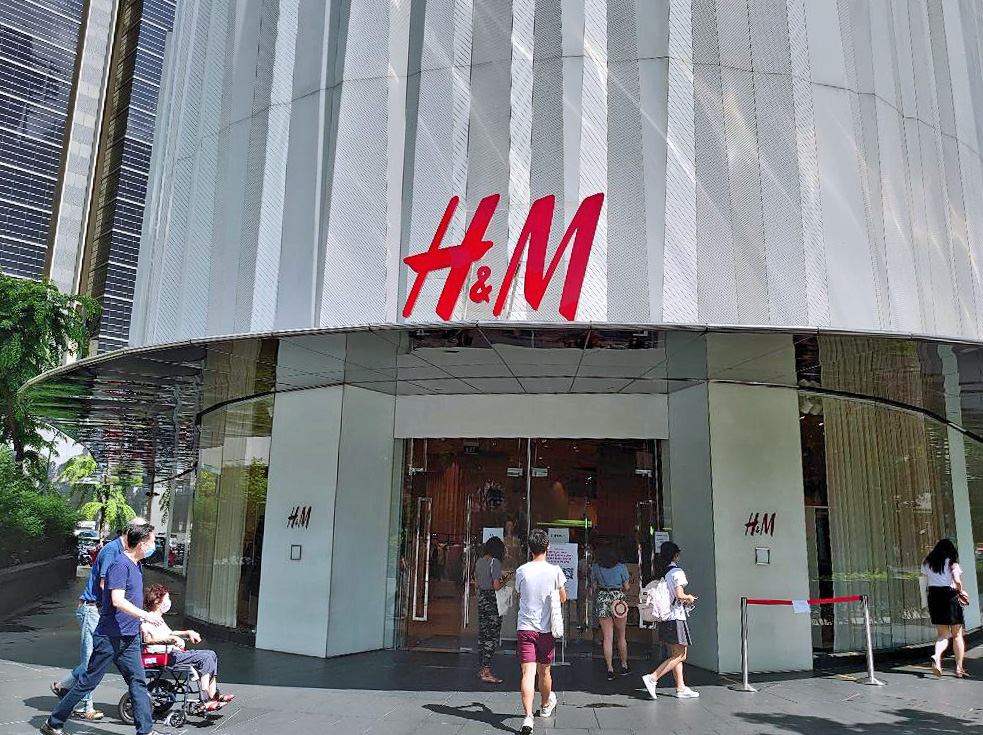
The H&M flagship store at the junction of Orchard Road and Grange Road. FIle photo: Chin Boh Kay for SOTD
To be sure, Hennes & Mauritz is not closing it stores here, even if they have been slowly puncturing their presence on our island. In Orchard Road, they are down to one single “flagship”, a four-storey store that has, in the past years, started to look a tad drab—just many racks of clothes without the affection of visual merchandising. Media reports surfaced yesterday indicating that Kuala Lumpur is set to become H&M’s new Southeast Asian home, following the company’s decision to cross the Causeway for greener pastures. The news has been startling, particularly within the corporate and retail sectors in Singapore, as the move is tied to a major regional restructuring and layoffs. When we mentioned this to a fashion retailer, she said, “even they?” The relocation appears to be a high-stakes operational gamble that, according to the Malay Mail, involves slashing 30% of its regional support headcount—specifically removing 78 positions from a team of 256—with the brunt of these redundancies falling on the Singapore office. This presumably includes the staffers running what is considered one of the most beautiful fashion press offices in our city. H&M has increasingly become less dependent on the press rack to communicate through the media. Influencers don’t need to borrow clothes; they just get them.
Rather than offering a seamless transfer, the clothier has reportedly initiated a “calibration process” requiring Singapore-based staff to “self-nominate”, as is said, for a reduced pool of roles in the new hub, with selection dictated by strict 2025 performance ratings rather than tenure or seniority. For those who survive this filter, the reality is a relocation to Malaysia, where roles are presumably benchmarked against local market conditions rather than Singapore’s higher cost-of-living standards. Those who are not selected or decline the move are being funneled towards “mutual separation agreements” by mid-June 2026, the Malay Mail reported. While the method has all the clinical efficiency of a spreadsheet, it tends to treat humans like hardware—reliable on paper, but prone to feeling a bit stiff and entirely blind to the fact that people aren’t actually mass-produced components from a 暗黑工厂 (anhei gongchang, dark factories). It’s great for objectivity, but it has the bedside manner of a brick wall and the flexibility of a potong popsicle. We note that Sweden is widely known for its cultural values of egalitarianism, fairness, and consensus-building, which often influence Swedish companies’ management and HR practices. H&M seems to be replacing a high-quality cupro lining with a cheaper synthetic to save on margins.
H&M advertising on an SG Bike in September 2021. File photo for SOTD: Zhao Xiangji
Singapore’s retail landscape has, even before the COVID pandemic, begun to look less like a shopping paradise and more like a high-stakes game of musical chairs—except that the chairs are being pulled out constantly. ‘Vibrant market’ ours is, but it has become corporate shorthand for an expensive lesson in real estate that brands eventually bow out for Pastures of the Better Overhead. H&M’s “strategic pivot” is just another verse in the same tired anthem: corporations are fleeing Singapore the moment the rent gets real, ditching our city-state for cheaper spots where the overhead doesn’t does not sink its teeth. It’s the standard corporate exodus, packaged as “optimization”, but translating to the usual ritual of shuttered doors, axed jobs, and a desperate scramble to find a budding city that actually likes their profit margins. It is unfortunately part of a broader trend affecting Singapore’s business landscape. Some businesses won’t even dip their toes on our soil, preferring to just set up shop at our doorsteps—Johor Bahru, as we saw with Japan’s Tsutaya bookstore, a brand that values experience and curation, at JB’s Aeon Mall in Austin. Or compatriot retailer Matsumoto Kiyoshi at the new SKS City Mall. If the grass truly is greener, it’s probably because we’ve spent so much time staring at theirs that we forget to water our own Garden City.
Perhaps H&M does not need a critique but a hug. Watching their store count drop has been like watching a campfire in a downpour—plenty of smoke, but the fire’s definitely going out. At its peak, H&M had 11 stores here. According to the H&M website today, there are six stores standing in Singapore. The writing on the corporate wallpaper calls it adapting to digital and behavioral shifts, but in plain English, it’s a controlled descent. They aren’t just pivoting to the future in Kuala Lumpur; they’re fixing the present to pay for the past. But poor H&M is probably reacting to one of the most pronounced escalations of today: competition. While they were quite the king of the Orchard Road/Grange Road intersection back in 2011—when they opened to a crowd of reportedly over 1,500 people lining up outside, with some shoppers queuing overnight—they have since been outpaced and out-styled by other better clothiers, such as Japan’s Uniqlo and China’s Urban Revivo, both offering better-made clothes, with sharp pricing and are discernibly on-trend. One flourished on technical excellence, the other look-of-the-moment speed. After 15 years here, H&M has remained steadfastly the Swedish fast fashion label that changed the game—not durable, inconsistently sized, and, the most damning of all, cheap looking. But all is not lost; Shein is still headquartered here.

