Kash Patel may lack sincerity, but his loosened tie and wagging digit provided more than enough contrivance for the Senate appropriations committee hearing
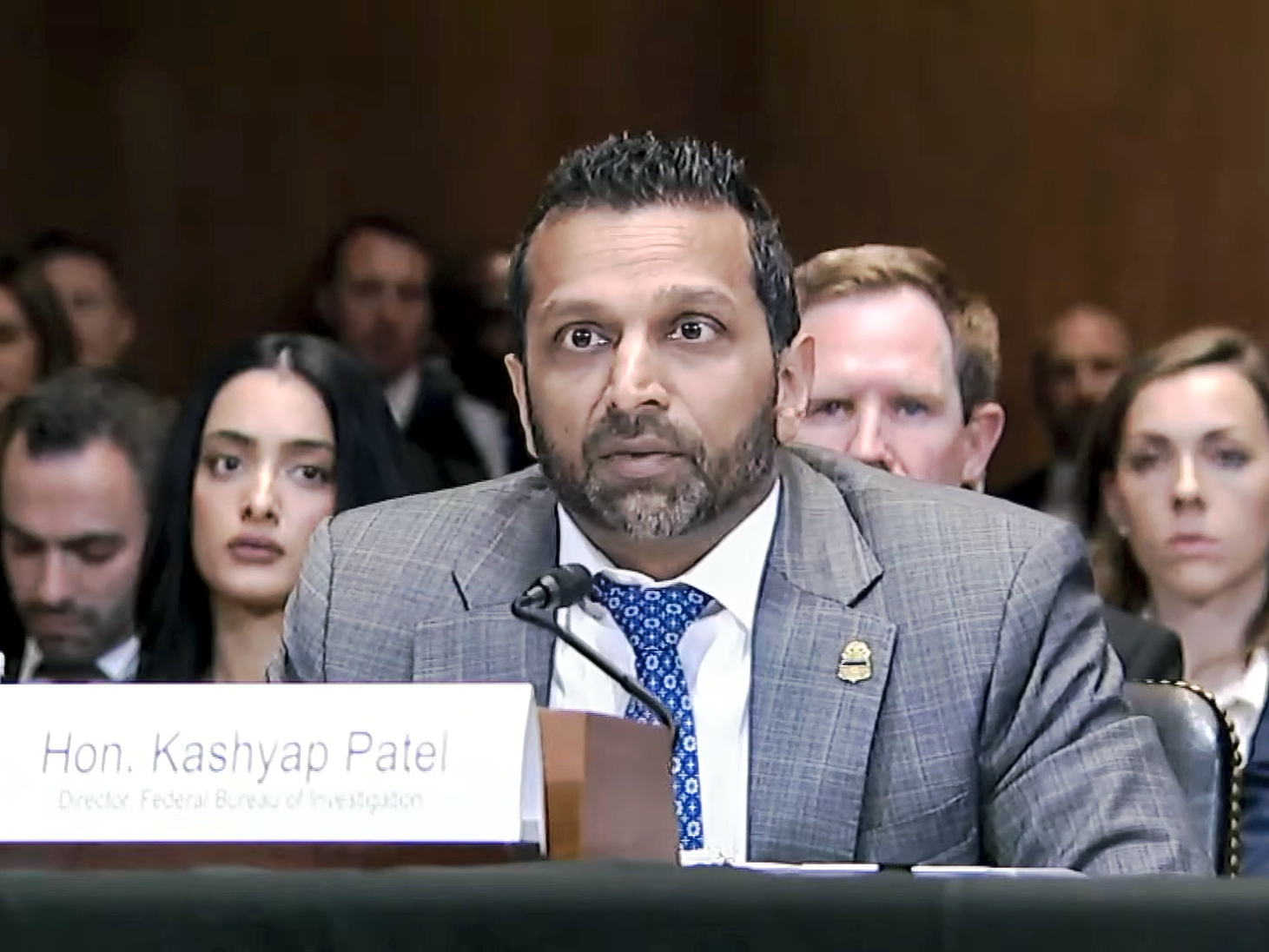
Kash Patel denying allegations of intoxication and absences from his job. Screen shot: apnews/YouTube
For his comeback hearing before a Senate committee, Kash Patel attempted to be dapper, but came across as purposely sloppy. Unlike his previous appearances, he ditched his navy suit and red tie for styling that was akin to a salesman at the Fremont Motor Company. He replaced them with a grey suit that hinted at a glen plaid weave and a rather gaudily patterned blue tie. The suit-jacket was of a conservative cut with notched lapels, which gave away that it was off-the-rack. When the camera focused on the seated FB I director, the jacket’s rear humped below the collar, forcing the roll to curl upwards—a tell-tale sign of a mismatch between the jacket’s structure and the body’s, specifically where the shoulders, neck, and upper back meet. Mr. Patel has long curated the image of an athlete’s physique, such as an ice hockey player’s. He also happens to be a fashion retailer. It is, therefore, surprising that for someone whose image is vital to his persona, he did not consider that his body might require special attention when it comes to a suit. Perhaps, that was simply a visual shrug towards the US$12.5 billion budget he was there to request for the FBI—the look of a man who knows the check will clear regardless of his conduct.
Under that surprisingly casual jacket was a white shirt and a flashy tie, like one of those a fresh graduate might wear to his first job interview, thinking that the visual showiness might impress. It’s why many men are encouraged to wear contrasting socks to show that they have ‘style’. But the poor tie lost its grip on the neck, becoming a loose noose to better coordinate with the undone top button of his standard business shirt. Mr Patel may not have a wife to ensure that he looked immaculate, but perhaps that was not necessary. There is, however, a special irony in this: he knew he would have to answer questions about his alleged over-drinking, so much so that, according to one The Atlantic report, a security detail had to request for forcible entry tools so they could reach him to wake him, yet he chose a look that leaned into the rumpled energy of a man who had just rolled out of bed. Or, the private Washington D.C. establishment, Ned’s Club. Presumably, if he was going to be accused, why bother looking buttoned-up, sober, and alert? It was undeniably a visual taunt: He wasn’t just going to deny the morning-after rumours; he was cosplaying them to show that he does not give a fuck.
Under that surprisingly casual jacket was a white shirt and a flashy tie, like one of those a fresh graduate might wear to his first job interview, thinking that the visual showiness might impress
Having verified that his admirable morning-after aesthetic was, in fact, less a rumour and more a cautionary tale, he treated the committee to the rhetorical equivalent of a spilled drink: the long-buried, and frankly embarrassing, ghost of what is now dubbed “Margarita-gate.” The hit-back was a textbook tu quoque—the logical fallacy of the schoolyard bully: You too. When Senator Chris Van Hollen pressed Mr Patel on The Atlantic’s detailed reporting—specifically the allegation that his security detail once requested “Swat-level breaching equipment” to rouse him—Mr Patel quickly pivoted to a 2025 incident in El Salvador, shouting that Mr Van Hollen was “caught on camera drinking margaritas in El Salvador on the taxpayer dollar.” That has already been debunked as a staged photo op, with cocktail glasses to fake a tropical paradise backdrop for a meeting with a wrongfully deported constituent. In furious, rapid-fire fashion, he also accused Mr Van Hollen of running up a “$7,000 bar tab” in D.C., which the Senator had clarified was a catering expense for a campaign event. Mr Patel was ready to humiliate, proving he possesses the singular talent of deftly painting everyone in the room with the same broad, inebriated brush. We acknowledge the strategy that ensures if the director is going down for his morning-after habits, he’ll make sure the committee looks like they’re sharing the tab.
Mr Patel’s rumour-fed machine gun recalled Karoline Leavitt’s verbal shrapnel that Donald Trump admires when he gleefully compared her lips to, well, “a machine gun”, too. But the director also mimicked someone else: Pam Bondi, his former boss. He used the index figure as effectively as she did, pointing and wagging and quivering to accompany the “you” that he desired to humiliate. This percussive digit was the physical punctuation for his bold legal gambit: a US$250 million defamation lawsuit against The Atlantic. While the figure is suitably dandy as his suit—designed to generate headlines and intimidate sources—it remains legally anaemic. To win, he has to navigate the “actual malice” loophole: proving the magazine didn’t just lie, but that they didn’t even bother to make the lie believable. Given that his own security detail reportedly documented the beautiful “breaching equipment incident”, Kash Patel is essentially suing the mirror for reflecting his own cock-eyed disarray. The lawsuit isn’t a search for the truth about someone so drunk that the door to where he was waiting for his liver to finally clock back in that a security detail was needed to rouse the remains. Rather, it is a marketing expense—the final, flashy accessory to a suit that, much like his defense, simply doesn’t fit.

