In a spectacularly aggressive Facebook post, Malaysian designer Douglas Chew displayed a flair for the loud and the reductive when he compared the Saint Laurent outfit Hailey Bieber wore to the Met Gala to his own designs from 1992. It’s a bold strategy, pitching oneself against the veritable initiator of French prêt-à-porter. It’s peak tortured artist
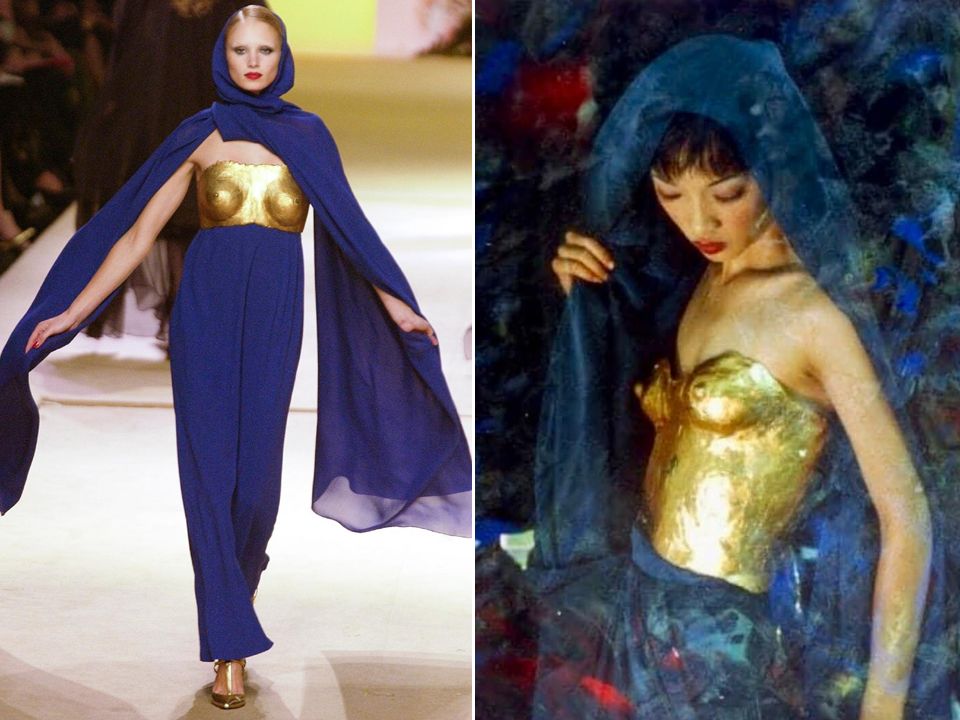
Which came first? (Left): Yves Saint Laurent in 1969. (Right): Douglas Chew in 1992. Photos: Getty Images and douglaschew/Instagram respectively
Moments ago, old-guard Malaysian designer Douglas Chew (周道根, Zhou Daogen) posted on Facebook a somewhat operatic exercise in public indignation: “Bitch stole my look from 1992 photographed on Ling Tan”. Below that textual histrionics was a pair of photographs: one of Hailey Bieber in a Saint Laurent outfit that she wore to the recent Met Gala; the other, a similar version presumably designed by Mr Chew. We presume because he was deliberate in saying that his “look” was ‘stolen’, not his design. It is possible that this was an output from a styling exercise. The distinction is a skillful navigation of the gap between a legal claim and a social one, and executed with the kind of soul-crushing, surgical precision that would make a songket weaver weep—even if we’re all privately nursing the suspicion that it was tantrum rather than tangent behind that inelegant blare. Do we sense a whiff of desperation? Some people need a reason to cast aside control, some, as it were, just to lure an audience.
But history, unlike a Facebook feed, has a long and inconvenient memory. Mr Chew pointed to 1992. It was the year the slogan “Malaysia Boleh” was introduced, symbolising national pride and achievement. He did not, however, say from which of his collections, assuming he was producing them seasonally, came the source of the pilfer. He compared his “Gold Leaf Sculpted bustier and chiffon ensemble” that he ”did” that year to what Mrs Bieber wore, which was created this year in homage to Yves Saint Laurent’s collaboration with the French sculptor Claude Lalanne for the autumn/winter season of 1969. Mr Chew, it seems, was busy looking for the santan (coconut milk) when he hasn’t even found the kelapa (coconut). To suggest that Anthony Vaccarello—a designer whose current tenure is a literal forensic study of the YSL archives—would look to a 1992 Malaysian collection for inspiration assumes the echo is louder than the voice that created it. One senses that there is professional delusion at play here.
Mr Chew, it seems, was busy looking for the santan (coconut milk) when he hasn’t even found the kelapa (coconut)
That original Yves Saint Laurent collection, loosely known as the Lalanne collection (officially, Empreinte or Impression) was seminal because it marked the first time haute couture truly merged with sculpture through the use of a process that turned the human body into a literal mold. There is a real gulf between revolutionary invention and a decorative interpretation, which Mr Chew may have overlooked. If it was a “look” stolen, perhaps it was not the material composition or the technical strength that were nicked. Ms Lalanne did not simply shape these bustiers as one might with paper-mache or, as in Mr Chew’s “look”, gold-leafing; she used galvanoplasty (electroplating) that resulted in a fine layer of copper, electronically fused onto the mold, cast directly on the models. It created a second skin of metal that perfectly mirrored every anatomical detail—from the collarbones to the navel of two of Mr Saint Laurent’s chosen models. One of them was Veruschka.
Mr Chew had his contemporary model too, the Malaysian “super”, Ling Tan (陈曼龄, Chen Manling). Considered the quintessential mannequin of 1990s Malaysia, who graced the runways of Paris and Milan, including, ironically, for the presentations of Yves Saint Laurent, including his final haute couture show in 2002. Ms Tan has been designated a muse to Mr Chew, the way ex-model Amber Chia (谢丽萍, Xie Liping), with a similar trajectory to Ms Tan’s, is to Behati’s Tan Kel Wen (陳楷文, Chen Kaiwen) now. Both designers leaned on the apparent gravitas such “international models” bring to their brand. To many Malaysians and the local designers of the time, Ling Tan was not just a model, she was the very validation of the Malaysia Boleh era. Perhaps, more importantly, she imbued in Mr Chew’s designs a ‘Saint Laurent-esque’ interpretation that could bring legitimacy to his work on a global scale.
If it was a “look” stolen, perhaps it was not the material composition or the technical strength that were nicked
That could explain the social seizure he staged on Facebook, a performance with all the intellectual dignity of crows fighting over stray crumbs of roti canai. When Mr Chew invoked her name now—“photographed on Ling Tan”—he was taking advantage of her past international stardom to retroactively validate his 1992 design. Despite the bluster, he was not talking about design but more like taking a hostage. Using a model’s name to claim ownership of a design “look” moves in shaky tandem with the spectacle economy. It assumes that because the image was iconic, the design must be original. It can’t get more artful than that: using a model who became a part of the Saint Laurent archive to attack Saint Laurent for using its own archive.
Ling Tan responded to her inspirer’s FB entry with the comment: “I remember this one (sic) of my first photoshoot (sic), looks like you’re a trendsetter from way back!” The nostalgia is that thick. This truly exposes the sartorial amnesia required on both sides for the designer to make the foolhardy post. It is exactly the kind of irony upon which social media depends to draw its audience. Mr Chew was trained in the rigours of London’s art education—specifically Harrow School of Art and its British art-school tradition in an era when so many Asian students pursuing fashion studies overseas adored (some say “mad about”) Yves Saint Laurent, among them Mr Chew’s other contemporary, Singapore’s Andrew Gn, who went to Saint Martin’s School of Art (now Central Saint Martins College of Art and Design). This could be a fan-boy who got mad when the idol he admired decided to play their own greatest hits. He now attempts to litigate against the very source he once loved, all for the sake of a digital audience that can’t tell the difference between a pattern—his mother was once his pattern-maker—and a post. To prove he can still trend, while forgetting that a ‘like’ has never once held a seam together.

