The most ‘important’ first Monday of May is crash-tumbling our way. But even before a sliver of red carpet is unrolled for the night, exhaustion has totally set in
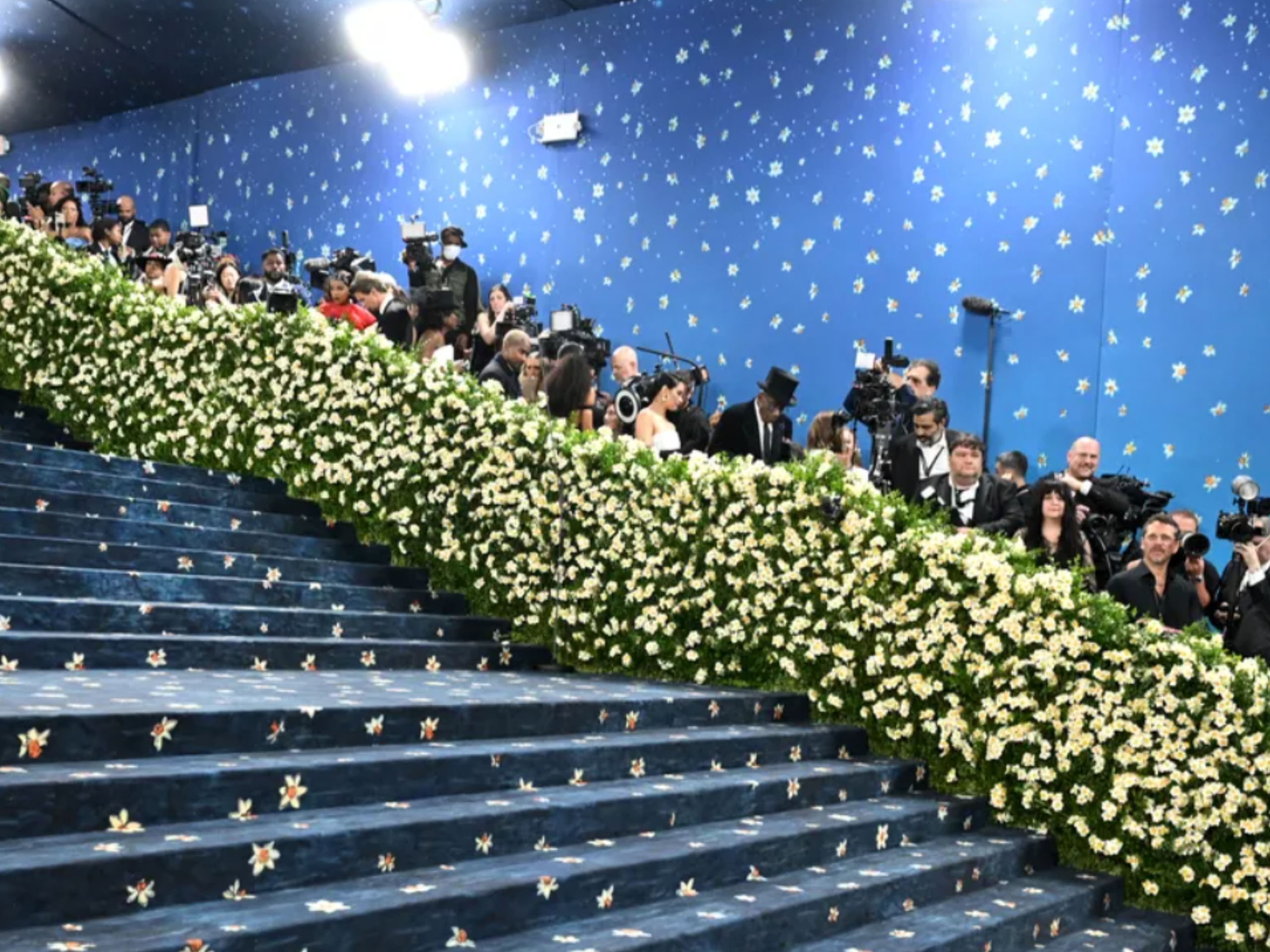
The ‘red’ carpet and the stairway to fashion heaven of the Met Gala 2025. Photo: Getty Images
These days, we do not necessarily choose what we like to read or browse, or scroll. Most of the time, we are fed. And nearly always with content we had not asked for. There is a very real colonisation of our personal news feed. A commercial engine is at work here, of course. Things have to be sold, even news or what appears to be. Increasingly, the volume of exposure is more important than what is relevant to the user. We have been warned of the over-reach of the algorithm, yet people have totally surrendered to it. But we do not, ultimately, have a real choice. We are being force-fed and some of us are starting to gag. This is how the teasing of the approaching Met Gala has been for us: nauseating. We have never Googled the ‘Met Gala 2026’, but it always appears on our news feed, like a parental nag. By the time the red carpet is unrolled on Monday evening (or Tuesday morning, our time), the event is already dead because the discourse surrounding it has been exhausted by its own flagrant, high-handed hyper-saturation.
We are curious to know if Anna Wintour receives the same entries in her news feed and if she would consequently be delighted that the industry is talking so fervently about her pet project that has gone from a niche, industry-focused gathering to a globalized commercial engine, or “fashion’s Oscars”, a title that ironically cements its role as the industry’s most vapid, self-congratulatory mirror. From WWD telling us what “creative and ornate shoes are worthy of” the Gala to Harper’s Bazaar informing what “runway looks” they hope to see (again, at the Gala) to Condé Nast’s own Teen Vogue announcing via video what they think the celebs would be wearing (not on-theme, of course) to the urgent social media poser of the past two months: “will BTS attend the Met Gala?” Three out of the first ten entries in our Google Discover just this morning were all about the event. That is basically 30 percent of the dynamic, real-time feed, with hourly updates, based on a daily cycle. We are doomed to be scrolling past inane ‘cards’ until way after the post-event reporting ends. The Met Gala is not a mere Monday event; it is an over-lengthened litany of well-funded wreckage for the scrolling masses.
By the time the red carpet is unrolled, the event is already dead; the discourse surrounding it has been exhausted by its own flagrant, high-handed hyper-saturation
The Met Gala has officially succumbed to the spectacle economy—and frankly, it seems quite happy to be the victim. The theme itself has increasingly become the spectacle itself, if only because so few attendees actually adhere to it or even pretend to understand it for the duration of the evening, or just three hours. It is sold as a fashion event, but it’s an annual ritual where the wealthy pay a premium to dress horribly, pretending the event is not a skillfully curated descent into vapidity. The commitment to this is admirable. It’s not just selling its soul, it’s charging admission for the privilege of watching it happen in really time. To be certain, Ms Wintour was hardly the inaugural disruptor to rattle the institution’s dusty bones, though she undoubtedly did it with the most profitable results. It was Diana Vreeland (interestingly also once a Vogue editor) who fundamentally revolutionised the Met’s Costume Institute by transforming it from a quiet, academic archive into a high-fashion, theatrical spectacle after joining as a special consultant in 1972. But back then, the Gala was still largely an industry event that mattered only to a small informed group.
The event has, without doubt, mutated from a fundraising dinner into a kind of gladiatorial arena for invitees to out-dress each other, not necessarily out-inteprete the theme. The Gala was started in 1948 by the fashion publicist and founder of CFDA Eleanor Lambert as a relatively insular event. A society fundraiser for the Costume Institute, it was mostly where couture was worn to be seen by peers (Ms Vreeland was herself one of the guests). Now, under the watch of Ms Wintour, it’s a global broadcast, engineered for virality, where the red carpet itself is the main stage and the museum exhibition almost feels like an afterthought. It is a feedback loop of extreme visibility: celebrities, influencers, and brands use it to amplify themselves, while the event gleefully thrives on the amplification. The outfits worn—ironically. rather than exhibited—are not just fashion statements, they are programmed as data packets of content fodder, optimized to trigger the algorithm’s reward centers before the wearer has even reached the top of the treacherous stairs. The looks dominate timelines for days, not because of their artistry alone (or lack of), but because they’re optimized for shareability.
Under the watch of Ms Wintour, it’s a global broadcast, engineered for virality, where the red carpet itself is the main stage and the museum exhibition almost feels like an afterthought
Back in the late ’40s, the spectacle was there—though because the audience rarely extended beyond the doors of the ballroom of the Waldorf Astoria, there was the dignity to call it formality. But the panoply was, perhaps, always there. Elsa Schiaparelli was staging her own proto-Met Gala spectacles in the ’30s and ’40s. Her work was couture as surrealist theater: lobster dresses painted by Dalí, shoe hats, jackets embroidered with constellations. These weren’t just garments; they were provocations, designed to collapse the boundary between art and fashion. Sounds familiar? What’s striking is how much her designs anticipated the logic of Ms Wintour’s Met Gala. Ms Schiaparelli understood that fashion could be a performance, a tableau, a headline. Even before the Waldorf Astoria dinners, she was orchestrating moments that demanded attention and reaction—but again, contained within the certain circles in New York or Paris or, inevitably, the pages of Vogue. The spectacle was there, but it was framed as avant-garde art rather than mass entertainment.
Today’s Met Gala, by contrast, has become global in reach. They have evolved from theatre as an act of subversion to spectacle as an act of algorithmic submission. We are looking less at avant-garde provocations and more at optimized content, designed to be consumed by the very machines that are currently draining the life out of the craft. Algorithms are trained to recognize high-engagement topics. Because so many people are clicking on the articles about the Met Gala, the algorithm observes a massive spike in general engagement and interprets this as a signal of importance. It then assumes—erroneously in our case—that because the population is interested, we should be as well. But do we really need to concern ourselves with “Everything to know about the Met Gala 2026”, multiple times? It is, interestingly and annoyingly, a headline shared by more thanVogue. There is Time, Refinery 29, ABC News and so many more. When will the hype cycle hit a point of diminishing returns before we can go back to some semblance of reality? Or editorial respect? By now, some of us prefer to treat the event not as a tragedy, but as an optional scheduling conflict we’ve gracefully declined to watch, online or off.

