Nothing is that true to life in the social media world. And one Chinese influencer knows that really well, showing a front side of her online that is totally different from the face her mother would immediately recognise. Apparently that’s the best way to beat the trolls

On that fateful Air Asia flight departing Chongqing for Kuala Lumpur last week, the angry “China” woman in the centre of an high-octane hissy fit looked worlds apart from the images in her posts and livestreams on 抖音 (douyin). In the video that has gone viral, when she turned around to face at least half a load of passengers just before being led away by security personnel, she looked like an auntie from the neighborhood senior citizen club leading a group to tour the northern Chinese city. After she was released by the airport authorities and had signed a “保证书 (baozhengshu) or guarantee”, and was allowed to resume her journey to Malaysia, she went straight to her 直播 (zhibo) or livestream. When images from that session—unrepentantly defending her in-flight behaviour—was shared on social media, users were shocked that she looked nothing like that 大妈 (dama, elderly woman) that by now at least half the world has seen, in horror. It is impressive. Most people use a filter and it’s common, but she has opted for a full-scale structural overhaul that goes beyond a mere edit. This is a witness protection program. Understandable. After that in-cabin fiasco, she needs it.
Chinese and Malaysian Netizens are now quoting her, as they express concern over her presenting a digital façade so aggressively filtered it would astound her own DNA: “Are you okay?” It was her only full sentence in English known to her fellow travellers after the hybrid “我是 (woshi, I am) China”. (While she claimed to speak only Chinese, her written command of the language is something else altogether. In that “guarantee”, she described how things had escalated and turned into a “人生攻击 [lifelong attack]” when she probably meant 人身攻击 [personal attack].) While leveled-up aesthetics are basically the standard online, going to this extreme is definitely a rare move. Or a twisted instinct. She did not just smoothen her skin or make her lips more luscious; she was out there rocking a new version of herself while the rest of us were (and are) still stuck in that Air Asia aisle. Her jawline did not just enjoy a touch-up. It traded the original boxy architecture for something so sharp now that you could probably use it to slice through a conversation—or at least the tension in that doomed flight cabin. To the fascination of the burgeoning Netizens tracking her, she’s managed the rare feat of looking more frightening in repose than most people do mid-tantrum. There is something to be said of fine-tuning so intense that she has reached that chilling stage of facial excellence, looking far more menacing than she did when she was merely shouting and demanding that unless the airline spelled out the compensation she deserved, no one flew.
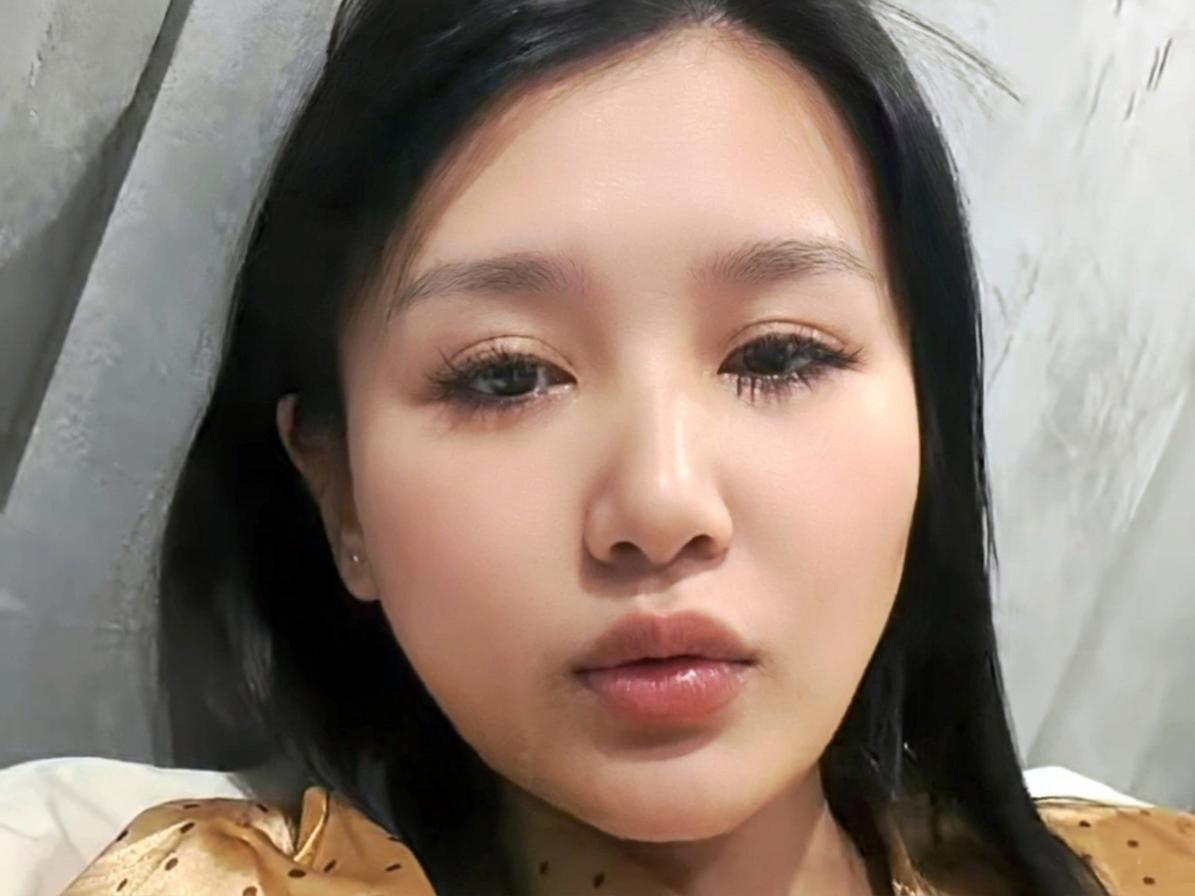
Without doubt she mastered the two pillars of modern relevance better than most: losing your mind in 4K and finding your jawline in an app. But in one post, accompanied by images of her at tourist sights in Kuala Lumpur, she said gleefully: “黑红也是红,既然别人一直让我红, 我何必自己让自己红 (Being infamous is still fame. Since others keep making me famous, why should I make myself famous?)” She is indeed more aware than most of us. Infamy is truly fame too, just better outsourced. Haters can surely be used as efficiently as fans. In the same post, she concluded with cocky certainty, continuing to hail the “black-red” online reach: “我想得很简单啊. 那, 与其让你发 与其让你黑我,我不如我自己黑我 (My thinking is simple: rather than you post it, rather than you blacken me, I’d rather blacken myself),” all said with a face that could have been love-plastered by 三凤海棠粉 (Hong Kong’s famous Three Winds Begonia Powder). Personal branding can’t come neater than this: why bother with the labour of being liked when the world will do the heavy lifting of making you known for free? Hard to argue with that. It’s always more efficient when the trash takes itself out.
Throughout that post (as well as others), she kept using the phrase “作品 (zuopin)” or works. This could refer to her ‘content’ or her complexion, but likely the latter. Our fascination cannot be overstated: She has stopped viewing her face as a biological reality and started seeing it as a curated output. It’s no longer an organ of expression, but a canvas of retaliation. If the public has vandalised her reputation by “dragging her private photos into the mud of the Douyin comment section”, as she claimed, she responds by over-painting herself with digital tools. This is a 作品, a work, rather than a mere angle. Beyond her online output, who is this woman only known by her surname “李 (Li)”? She can curate her pixels, but she cannot sanitise her paper trail. Clever online sleuths, studying the scribble of a signature on that “guarantee” that she happily shared online as soon she was freed from the interrogation, made it out to be 李友东 (Li Youdong). The digital ghost of a face is a person with a name. Her moniker could mean ‘eastern friend’ or ‘friend of the east’. If she insists that her own “讲中文 (jiangzhongwen), speak Mandarin” borders should expand to cover every altitude and latitude, she is no friend of the east; she’s acting as the 老板娘, the female proprietor, and a terribly frightening one. Too bad, Air Asia is not 龙门客栈. The Dragon Gate Inn.
Screen shots: Douyin

