Why were so many Swifties showing their ugly side for a chance to see a supposed beauty performing?

Many people here (and, for sure, in the region) are helping Taylor Swift become richer and on track to achieve, as CNBC projected, “US$1billion or more” in ticket sales for her massive The Eras Tour. Or, since tickets were reportedly sold out in less than 8 hours, US$13 million per performance, as Bloomberg Television reported, times six to add to her riches. Our city-state is her only stop in Southeast Asia and the second in Asia after Japan. Proud Swifties have proved that they can move with great velocity when it came to securing tickets and made it visibly clear that they would rather lose more than a night’s sleep than not join the frenzy in getting the tickets. Videos shared on social media showed the kind of ferocious dash and rush usually seen in cities where refugees scramble for UNHCR aid, or people escape a burning building, or, if citing examples found in the U.S. might be more graphic, escaping mass shooting.
In one reel, ticket buyers at Northpoint City in Yishun were seen sprinting up two parallel escalators the minute they were allowed access to, presumably, a Singpost outlet somewhere above, with girls screaming in excitement amid male voices shouting “don’t push”, all as if fleeing police arrest from aggressive public disturbances. Another video filmed at ION Orchard showed a shutter being raised, but before it reached the half-way mark, those waiting outside were seen lowering their bodies to crawl-dash inside, like four-legged creatures finally freed from captivity. Yesterday’s one-o’clock Mandarin news report featured two girls crying when they learned that each had successfully scored the tickets they were desperate to cop, as if they were mourning the demise of a beloved pet. How did one Pennsylvania-born lass with a start in country music, even if a capable singer/songwriter, come to effect such intense and insane emotions in this part of the world?
Videos shared on social media show the kind of dash and rush usually seen in towns where refugees scramble for UNHCR aid, or people escape a burning building
Those who were unsuccessful online (or gave up) and who chose to queue to purchase their tickets at Singpost outlets formed lines—more than 24 hours earlier than the tickets were available for sale—in the open and along corridors that often looked like the beginning of relief camps for disaster evacuees. One photograph published in The Straits Times laid bare how those in line at Toa Payoh North made themselves comfortable in what was clearly a very public space. Spread in the open, they set themselves on the ground, with umbrellas to shield against the sun. Two women in the middle of the photograph were totally horizontal, taking a snooze, as if after a day of punishing field work, while those around them were ready with chairs of assorted sizes to sit out the self-chosen, uncertain wait.
Other photographs shared on social media depicted scenes of startlingly long lines in various states of disorder, with many making the occasion a veritable picnic, complete with mats (which meant footwear was off) that are usually seen on the beach or Instana gardens on days of their open house, happily chomping away, surrounded by packets of food (some opened, half-finished) and bottles of water or cans of energy drinks. There are those queuing outside malls who reportedly had friends stand in for them while they took naps at the waiting areas of the hotpot restaurant Haidilao, where there are tables and chairs, usually for diners. No one appeared to care how they would appear to the detailed capture of the smartphone camera. Or, if potential Bad Blood was worth the trouble and stress.
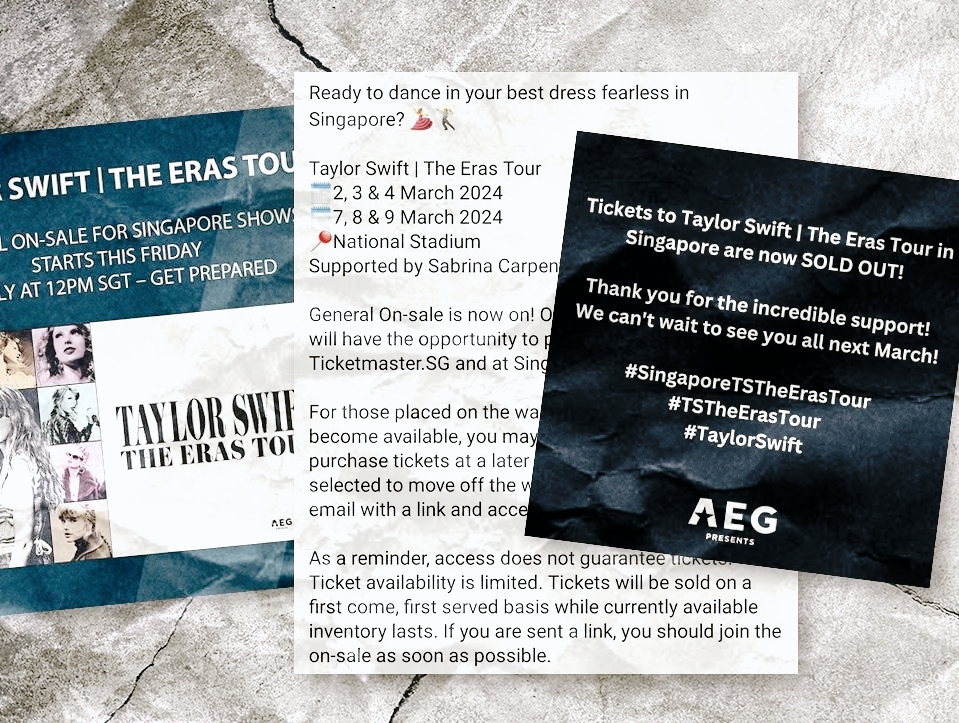
Facebook notices on concert promoter AEG Presents Asia’s page
Those operating indoors showed that they were out to get the concert tickets, whatever it took, however awkward the plan, or ungainly the set-up. As one ST reporter Charmaine Lim proudly shared on the paper’s YouTube channel, a report titled, in full caps, “HOW I FOUGHT THE GREAT WAR (FOR TAYLOR SWIFT TICKETS)”, keyboard fighters engaged in the battle of their lives were mostly equipped with a minimum of two devices (three was not unheard of). The idea was to “maximise the possibilities to get tickets”, as Ms Lim explained, which was easily the euphemistic longhand for being kiasu (惊输) or Hokkien for fear of losing out. It took several hours—and the minimising of fluid intake to strain the bladder into bending to her will, as well as lunch served in a buy-a-pack-of-Oreos-and-get-a-freebie bowl—before she excitedly confirmed she had her tickets, admitting, with pride, that “that was so stressful and incredibly nerve-wrecking.” She was among the lucky ones in the virtual queue of reportedly more than one million buyers.
It is not clear how what was shown these past days could debunk what Professor Tommy Koh once said in 2019 about Singapore being “a first world country with third world citizens”, as an ST headline that year went. Defenders of the behaviors we have seen these past days called them “normal”, such as those of concert-goers buying tickets for the Jay Chou show in December last year and the upcoming Jacky Cheung gigs, as well as of those in the lines seen at McDonald’s when Hello Kitty toys were up for grabs, or the fiasco that resulted when too many buyers met too few merchandise at the launch of the Swatch X Omega Moonswatch last year, which resulted in a deplorable scene, with one guy challenging the police to shoot him. Since, we’re listing, let’s add the crowd at Foot Locker desperate to cop a pair of Yeezy in 2020, during the height of the pandemic, that warranted the call of the riot police. Nothing extreme emerged in the lines to score the Taylor Swift tickets, but there were enough questionable behaviours (not to mention the methods of the scalpers, and their audacious greediness) to raise one question: Has indecorous demeanour really become the norm or, to choose a word we love, the ‘pattern’ that we have to accept without alarm, dread, or question?
The idea was to “maximise the possibilities to get tickets”, which was easily the euphemistic longhand for being kiasu
And how has the conduct witnessed these past days been consistent with the ruling powers and corporate entities wanting this island to be “a top tour stop”, as reported in The Business Times a week ago? Or is the “tense situation”, as the BBC described the online and offline madness, the mark of such a great destination? That Swifties were able to show their fervid loyalty to their deity-star is largely due to the considerable efforts of the relevant government agencies and the concert organisers. One of the key parties is Kallang Alive Sports Management (KASM), “the corporate entity established by the Ministry of Culture, Community and Youth”, set up to manage Singapore Sports Hub. They wooed Taylor Swift and her team. That perhaps explains why minister Edwin Tong took to the Singapore Sports Hub Facebook page a month ago to urge Swifties to “drop everything now, get your tickets”. And, later, they heeded his encouragement, with students proudly skipping classes to join the queues. As one SOTD reader said to us, “We are only first world because we have money.”
Part of the problem, as many have highlighted, was due in no small part to the American ticket sales platform Ticketmaster’s still-wonky system. A view of their Facebook page showed that ticket buyers were met with frustrating, persistent hiccups online, from repeated error messages to unusable access codes. Even those queuing to buy their tickets at Singpost outlets were not spared, with reports stating that some transactions took up to 30 minutes to complete, and Singpost staff insisting that it had nothing to do with the system on their end. In the U.S., Ticketmaster, “the world’s leading ticket platform”, received immense criticism last year for the handling of the sales for the very same concert, with several Swifties so deeply unhappy with the service they received and the the stresses they were put through that they sued Ticketmaster for various alleged commercial breeches, including price fixing and antitrust violations. Ticketmaster had all the time to correct whatever technical faults fans in the U.S. had to face. Back then, with added media pressure, Ticketmaster claimed that the madness and resultant chaos was due to “historically unprecedented demand” that overwhelmed their website. Eight months later, we doubt fans want to hear them sing the same song, especially if they are not Taylor Swift’s, from The Vault or not.
Photo illustration (top): Just So.


[…] anticipated concert tickets, every fan knows the struggle of competing with the masses during the frenzied ticket sale rush. However, in the world of live events, there’s a secret weapon that can give you an edge over […]
LikeLike