By turning a fatal shooting and a CEO’s personal humiliation into a crude Truth Social meme, Donald Trump didn’t just cross a line—he scraped the gutter
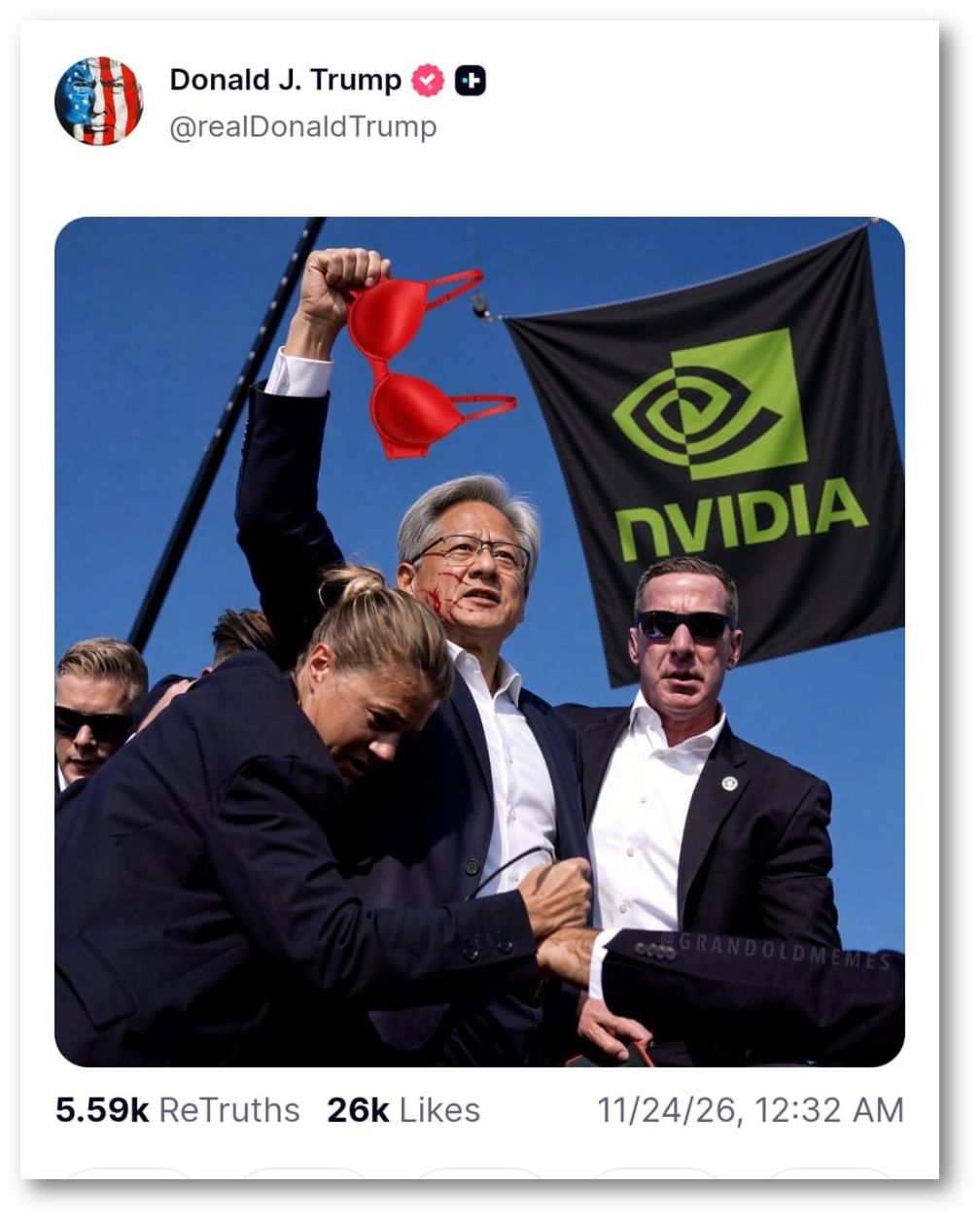
Low is no longer low enough to describe the actions of Donald Trump. “A new low” has been parroted into oblivion by the Stateside media, yet it is still an aggressive affront to the Mariana Trench. Hours after Jensen Huang returned to the Nvidia headquarters to a rousing welcome, Mr Trump shared on Truth Social a post so devoid of basic discernment that even an 18-year-old would be denied the defence of youth. Or the madness of American spring break. Unaccompanied by text, which leaves the entry stripped of policy messaging, the AI-aided image reprised the July 2024 assassination attempt of the then-presumptive Republican nominee in Butler, Pennsylvania, but now sporting Mr Huang’s face—also bloodied—and body, defiantly and triumphantly holding up a red bra. All that is on offer here is a deplorable exercise in cheap insinuation. To call this low implies there’s still a bottom left to scrape.
When the Nvidia executive returned to work that Monday morning to the chagrin of the American political class, he told the staff who had gathered at the lobby to clap and cheer: “I’m going to be a better CEO the second time around.” There is a touch of humility in that, especially coming from a founder who has led the company for over three decades without interruption. He also apologised for causing difficulties and acknowledged making serious mistakes. In East Asian and Chinese-heritage business culture, public atonement hinges on 脸 (lian) and 面子 (mianzi)—moral dignity and social face. When a leader brings shame upon their family or institution, redemption—as convention dictates—includes restraint, humility, and even silence, which could be why Mr Huang swapped his trademark leather jacket for a penitent navy one, thanked his family for their support, and sought to restore trust.
When a leader brings shame upon their family or institution, redemption—as convention dictates—includes restraint, humility, and even silence
In America, however, presidential behaviour must bend to quiet cultural correction. Mr Huang’s initial response after the scandal fit a recognisable script of repair through restraint. Whether he was sincere or being strategic is not the point. The action itself was culturally intelligible. It was clear for us to see. Then came Mr Trump’s strident red bra. Whatever the Americans consider the brassiere to be, throughout Asia, it is still 内衣 (neiyi) or undergarments, specifically intimate wear. It carries an implicit spatial order: interior. The distinction is not merely practical, it is moral and symbolic. Traditional Chinese culture places enormous weight on the management of boundaries. We distinguish not only 内 (nei, inside) and 外 (wai, outside), but also 家 (jia, family) and 国 (guo, state), and 私 (si, private) and 公 (gong, public). To expose what belongs inside is often felt as a disturbance of order. Mr Trump’s frat-house meme is, therefore, shocking because it does the exact opposite of what a face-saving culture would prescribe. The undergarment is not concealed, but elevated. It is not merely acknowledged, but hoisted like a 旗帜 (qizhi)—flag.
What should have been a 凯旋而归 (kaixuan ergui) or return in triumph was grotesquely twisted into a callous meme, laying bare a delighted disregard for cultural sensitivities. What is even more disturbing is that Mr Trump had just returned from Shenzhen, China, where protocol and face were meticulously choreographed on the world stage. Perhaps, if he had a more aware secretary of state, he would have learned that in China and, by extension, the states of its neighbours, this outward display of what should remain inside is not just cavalier, but sullen bad manners. Non-American societies are constantly coaxed to understand American irony, American transgression, American humour, and American free-speech norms. This is not simply a president making a joke. Others have and many still do. This is one president, dubbed “the most powerful man in the world”, who takes what should have been a reinstatement marked by restored dignity, and reframed it through the symbolism of a woman’s undergarment. In the U.S., where the Victoria’s Secret Fashion Show is a “cultural event”, Americans read their POTUS’s re-post as a mere “joke”. For many Asians, it was clearly 不得体 (budeti)—not just improper, but totally out of line.
American political culture has been so insulated by its own power—actual or assumed—that it keeps mistaking plain vulgarity for brute strength. Nothing is too sacred to mock, nothing too sensitive to deride. Our modest effort to puncture the pompousness does not suggest Asians are chronically humourless, nor are we strangers to the vulgar. But we understand that cultural context, symbolism, and taboo remain stubbornly relevant in a world turned inside out. No man in Asia—least of all one measured by immense success—would ever brandish a brassiere over his head. In Chinese culture, the 吉祥物 (jixiangwu), or an auspicious article, is essential for anchoring good fortune and setting the proper tone for any celebration or major milestone. A bra, in whatever colour, is not that item. In fact, bra-waving is hardly a Chinese preoccupation; in America, by contrast, it brings to mind their ’60s bra-burning and “women’s lib”—now repurposed by one man for rather less noble ends.
By placing a symbol traditionally associated with feminist protest into the hands of a male CEO accused of workplace misconduct, the meme completely inverts the significance of the gesture. And, in a development that adds its own disturbing layer, the bra is now in the hands of an Asian man. On the MRT train earlier, a woman who saw that image in a news flash on her phone, yelped: “啋 (choi)”—an instant reaction to something inauspicious. One male bank officer told us, when we showed him the same photo: “I am in the business of wealth management; I don’t walk under laundry hung overhead to dry. Period.” Not just men, many older folks navigating ground-level walkways beneath HDB blocks take a wide detour rather than amble directly underneath laundry hung on bamboo poles, especially if undergarments are there. We suspect quite a few Britons, Frenchmen, Germans, and Italians would quietly understand that reaction too. They might not invoke 内外之分 (neiwai zhifen), or the distinction between inside and outside, but they would recognise the nuance. In culturally fraught moments, the American presidency needs to be larger than the joke.
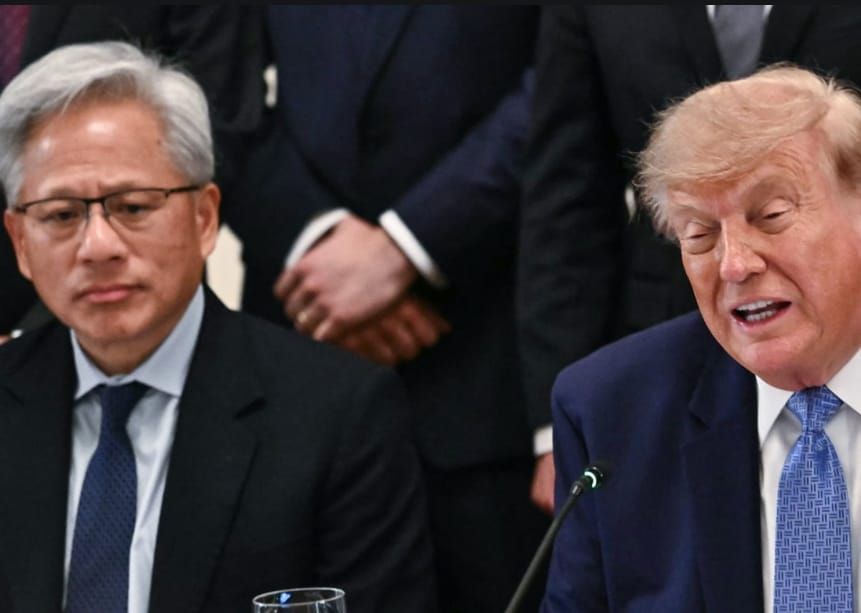
Screen shots: realdonaldtrump/TruthSocial and bbc.com, respectively

