In 2026, sensationalism lives not only in the heading, but the standfirst too. These days, they are not used to shock our prurient interests. Rather, they target our conscience. Progress, perhaps?
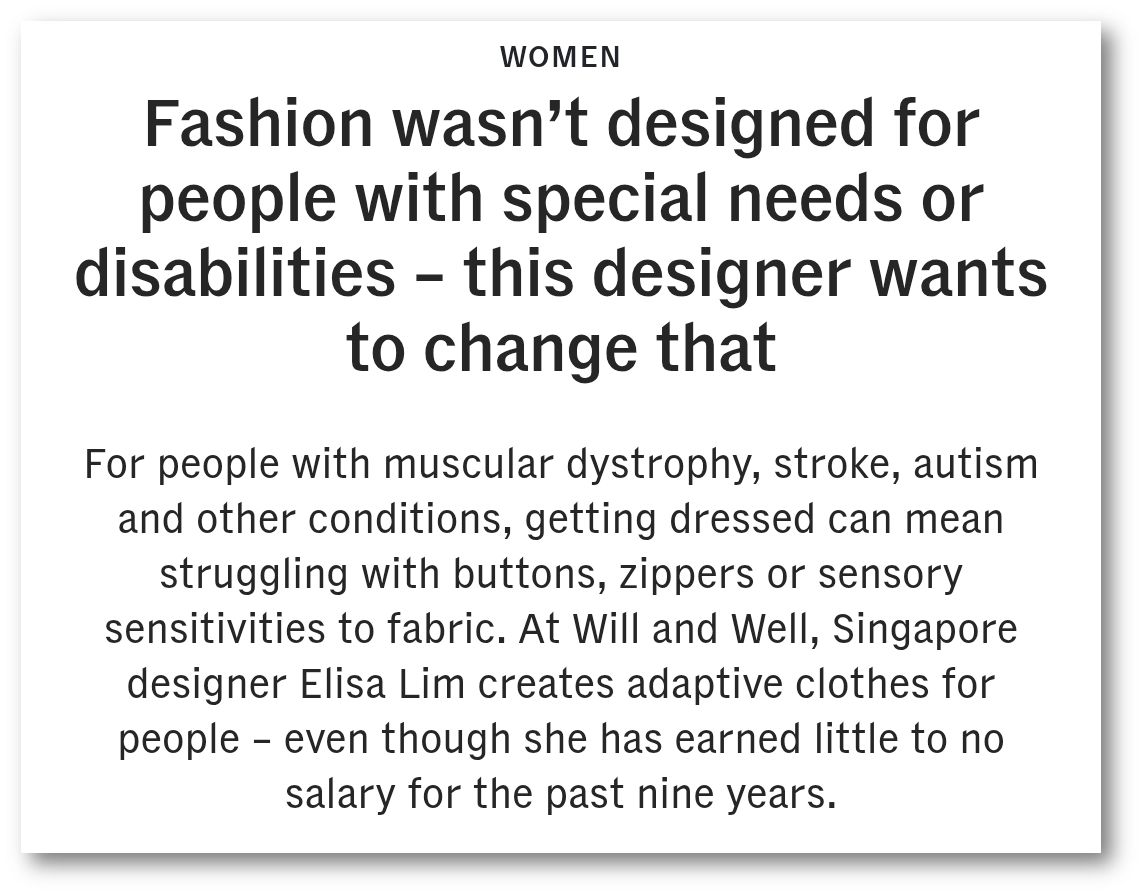
As with most news these days, we spotted this CNA report on Google Discovery. The headline stood out as a Card not because of compelling design, but because of its length. The opener “fashion wasn’t designed…” set up a stunningly sweeping negation, while the clause “not for people with special needs or disabilities” immediately reframed it as a moral indictment. Essentially, the seams were tight, the empathy not. It posited that fashion’s default state was meant to encompass everyone—‘Fashion for All’, as the DORS rallying call goes—and then positioned exclusion as a deviation, a failure. Historically, fashion is always selective, coded, and exclusionary, predicated on class, gender, body type, geography. The headline demanded fashion to be what it never was—a universal design system—while condemning it for failing to meet that impossible standard. Exclusion became scandalous. And then, to complete the absorbing comic-book trope: a superhero to the rescue.
The narrative of the sartorially disregarded naturally required a defender of the universe, except that this cape-less crusader did something grander: for her altruistic services, she “earned little to no salary for the past nine years”. What could enhance the resonance of the article more than a near-decade of sacrifice? During a time of economic uncertainty and rising prices, “no salary” is financial fasting that should be rewarded with sainthood. By placing the martyrdom economics in the subhead, the editors cunningly elevated what should have been a contextual detail into a defining credential. The phrase is stark, almost brutal in its brevity. “Nine years” clearly added duration, turning hardship into endurance. As it appeared, creating adaptive clothing was not a passing struggle; it was a saga. And just like disabled people who “struggled with buttons” and other fastenings, our hero coped with no remuneration. It was, simply put, pity porn.
During a time of economic uncertainty and rising prices, “no salary” is financial fasting that should be rewarded with sainthood
What the headline really needed to say was clothing has largely failed to include the practical needs of a certain group of people. That, however, would lack the accusatory tone and, crucially, the sting of fashion as culprit. Moreover, they needed to frame exclusion as betrayal. In a media climate dominated by podcasts and TikTok proclamations, it is understandable that editors choose the accusatory frame. Nuance is a luxury contemporary institutions cannot afford; survival requires the far more profitable alchemy of outrage and clicks. Instead of centring the systemic absence of adaptive fashion, the piece dramatises one designer’s sacrifice as the emotional climax. The media enjoys romanticising the starving artist or the selfless advocate, but drawing a salary of “little to no salary for nine years”, frankly, isn’t a badge of honour—it’s a systemic failure. By framing her lack of financial viability as a moving sacrifice, CNA is subtly validating the idea that designing for disabled people is inherently charity work, rather than a legitimate, viable commercial market that deserves serious investment and infrastructure. Adaptive clothing is not a high-quality, desirable product that consumers want to buy because it’s excellent, but a subsidised social service kept alive by the sheer, uncompensated willpower of a non-disabled saviour.
We should have long evolved past this style of reporting, but one of our national broadcasters seems fiercely determined to prove that they are left behind. New, therefore, this reporting is distinctly not. It’s rather in classic Wong Kim Hoh style. A veteran at The Straits Times, Mr Wong patented the gold standard for Singaporean secular-hagiographic journalism. It is a deeply specific genre of local writing that relies on a very recognisable toolkit: take a subject, find their absolute lowest rock-bottom moment of personal trauma or financial ruin, and then chart an agonising path to redemption fueled by sheer, uncompensated local grit. Similarly, in the CNA piece, we were treated to drama (the interview took place and soon after, the subject had to go to a wake because the person she had been dressing died) and the canonisation of suffering (unpaid for nine years as wandering the wilderness). Profile-of-resilience style writing might have served a purpose in print journalism twenty years ago, but applying it to a technical, material discipline like adaptive fashion in 2026 is anachronistic. It treats commercial fashion design like an episode of Growing Up.

