The reaction to the scrubbing of Marcus Pang’s walkway art serves as a clarifying moment: the public can distinguish between a mess and a gift. It is time the authorities learn to do the same
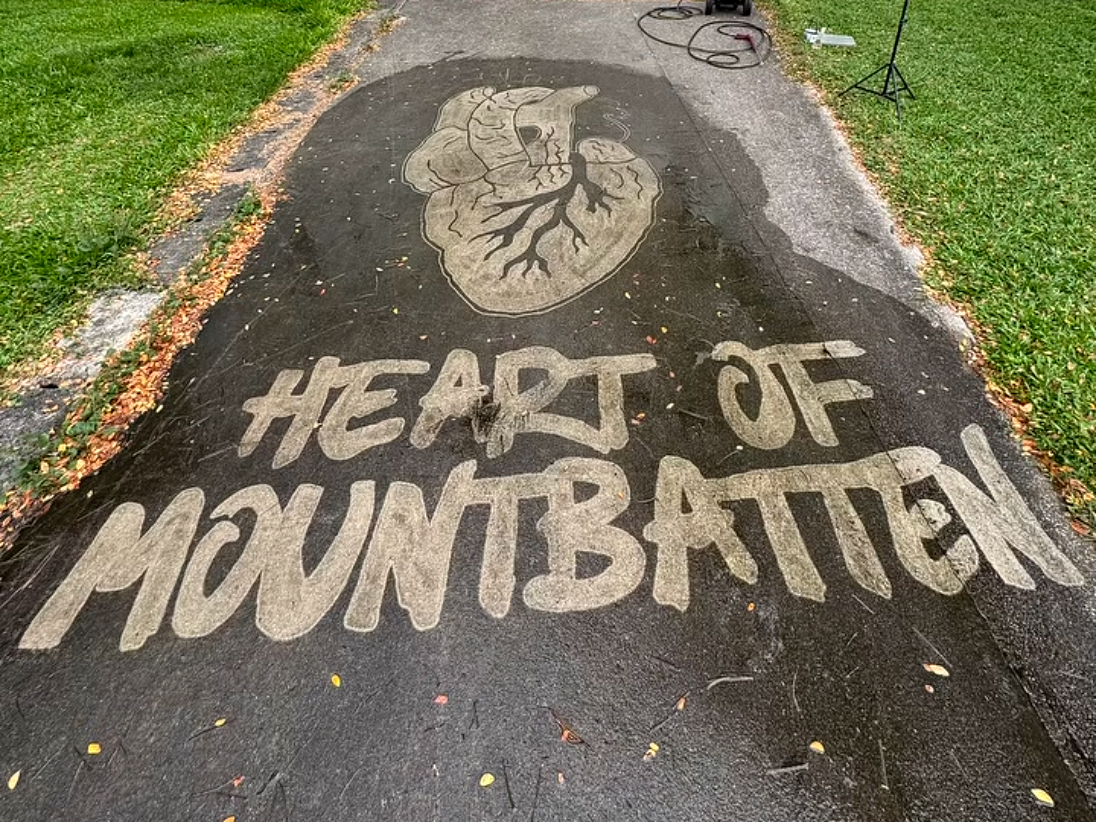
The art before it was fully completed and then quickly erased. Screen shot: gazing.pw/Instagram
On our island, we have a utilitarian approach to creating public pavements. The city’s uncomplaining, horizontally flat biographer, a gray scroll of concrete that has memorised every footprint, spilled kopi-O, and discarded chewing gum in history must remain so and not tainted even with the lightest touch of art. Last Friday, Marcus Pang, who calls himself a “reverse graffiti artist”, shared a reel on Instagram that showed a portion of a pavement power-washed to reveal a graphic motif totally removed after the nearby Mountbatten MRT staff, who had objected to Mr Pang’s work, decided to curate the situation on their own. Despite the police, called by the station operator to address the situation, granting him the divine mandate to continue his pavement prettying, the street artist returned the next day to find his art completely scrubbed to a baseline clean. And how quaintly predictable. The very high-pressure jet wash tasked with scouring the unsightly grime from our void decks—the very banal, utilitarian implement of town council hygiene used by Mr Pang for his art—is also used to obliterate his drawing. The glaring white patch on the walkway, it seems, is deemed vastly superior to Mr Pang’s pedestrian-friendly handiwork.
Apparently, our definition of public art is limited to whatever corporate tax write-off happens to decorate the surroundings of a bank. It’s usually very tasteful and necessarily oversized, such as Fernando Botero’s rather rotund Bird (I990), perched prominently outdoors along the Singapore River. It is a mascot for UOB Plaza and you can almost hear it warble: Your savings are safe with us, but my hourly fee is higher than your annual interest rate, and I’m frankly too hot to be bothered by your overdraft. You see, any art that touches public space without a balance sheet to back it is dismissed as vandalism. Mr. Pang did not use destructive materials; he caused no permanent damage to the concrete or stonework. His medium is entirely devoid of pigments. He uses water jets—rainwater, not the “chemicals” the original complainant asserted—to clean dirt selectively, leaving images on the pavement. But this will not do; even when Mr. Pang’s work is a creative act performed in the public interest to make our walkways cheery, it remains impermissible. His only setback: he should have worked with bronze.
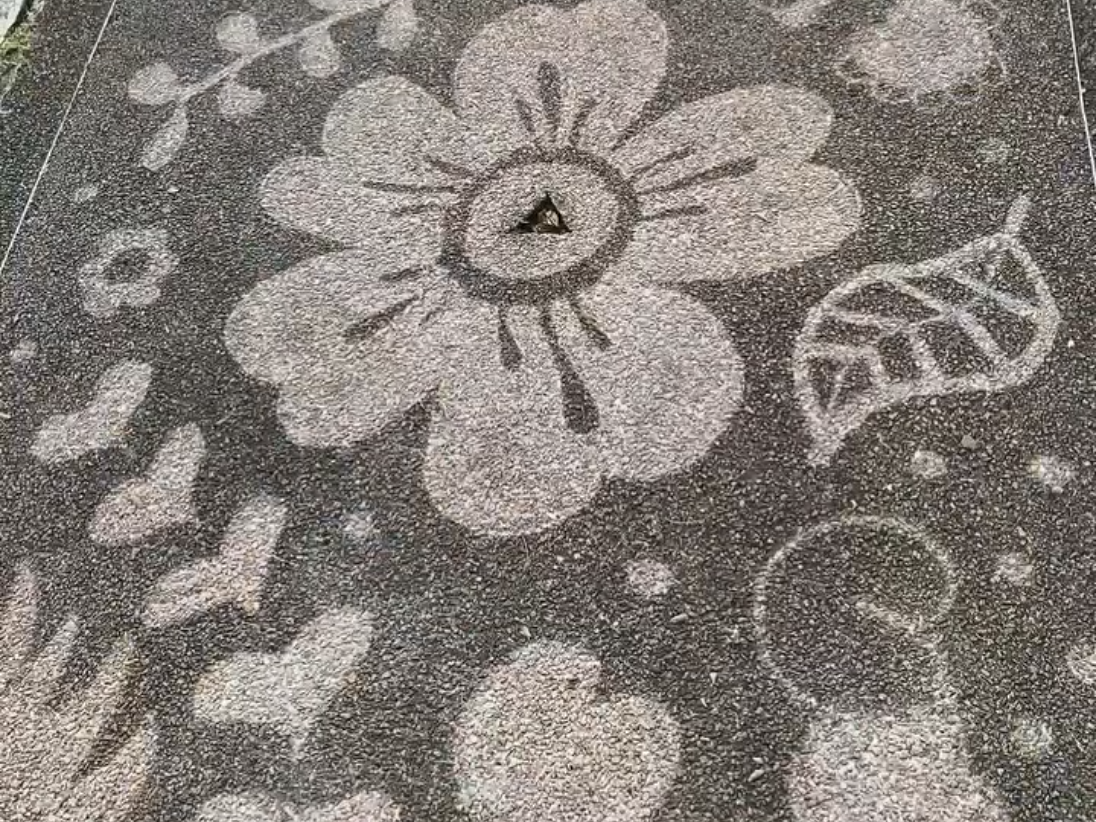
Marcus Pang’s work on Jalan Tembusu. Screen shot: gazing_marcus/Instagram
Making urban spaces, especially horizontal planes, more engaging is not a recent city fascination or, in some cases, mission. For many years in Tokyo, some streets are punctuated with manhole covers that are veritable works of art or discs that Pokemon fans would eagerly pose with. But here, we recoil from such expressions underfoot. Our urban planners have negligible interest in shifting the focus from mere utility to sensory, social, and functional activation. We do not use our walkways as a narrative medium. We do not allow it to tell stories about ourselves, to identify the neighborhood, to anchor our history. It is left to urban planning orthodoxy, but it treats the ground as purely logistical, not communicative. And it is not for a lack of money (never is, is it?), but a lack of imagination. Mr Pang’s rain‑washed heart at Mountbatten was treated not as enrichment but as contamination. When these surfaces are treated as static voids, as that Mountbatten patch was turned back to, they become dead zones. When they are treated as infrastructure for experience, they become destinations.
The result of Mr. Pang’s “reverse graffiti” is a subtle rejuvenation of the pavement. His designs are monochromatic and entirely non-intrusive. Through the subtraction of dirt, he created a quiet refresh rather than a loud imposition. In some instances, his floral motifs even complemented our fiery reminders that we are a self-anointed Garden City—yet they remained restrained. The same, however, cannot be said for the walls of our HDB flats, which have become the unfortunate victims of a desperate attempt at vibrancy. Surely, if we can obsess over the exact shade of grime-grey for a walkway, we can exercise similar caution with our vertical façades. But the HDB prefers overzealous colour combinations. Walk through any estate and one sees how bold primaries, clashing tones, and rainbow schemes dominate. HDB’s colourists have clearly convinced themselves that vibrancy can be manufactured by saturation alone. The pavement must be silenced because it is unauthorized; the walls must shout because they are commanded to. There is a term for this lovely cheer: kampung spirit.

