What’s behind Private Era’s registration wall?
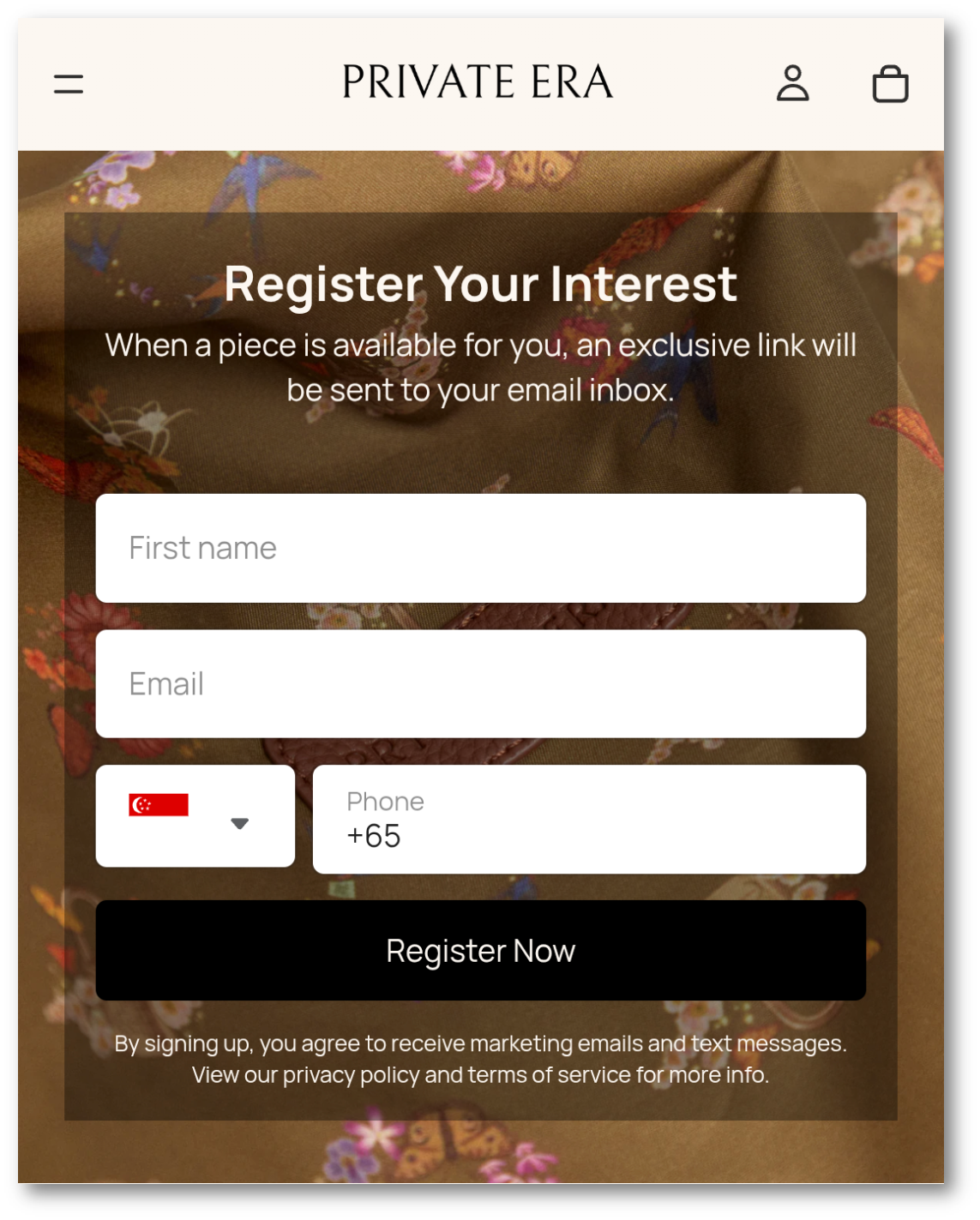
What a wall. Screen shot: privateera.com
For a totally new brand, Private Era has implemented an unusually restrictive mechanism of acquisition. Blogger extraordinaire Vivy Yusof launched her debut bag label a week ago with a tiered barrier to entry. To score an invitation to the event, you have to be a paid subscriber of her blog site Sincerely, Vivy. For non-subscribers hoping to first have a look at what Private Era has to offer, the brand’s website serves as a perfectly curated dead end. You are granted a glimpse of the foyer, but the doors to the stockroom remain firmly bolted. Should you insist on breaching the sanctum, the requirements are predictably onerous: You have to register, handing over personal data in exchange for the mere possibility of viewing the collection. Even leading luxury brands like Dior and Chanel allow browsing without forcing a sign-up. “Open Sesame” is an insufficient invocation for Private Era’s guarded threshold.
There is perverse genius in a brand that decides the ultimate pinnacle of retail strategy is to gatekeep its own existence behind a registration wall. You are greeted by the prominent command: “Register Your Interest”. Nothing, of course, relays hospitality quite like a digital velvet rope that demands your contact info just to prove you’re worthy of being spammed. It’s the digital equivalent of being invited to a party only to find out you have to fill out a credit check and provide three character references before the host will even unlock the front door. Above the web form, the brand dictates that “when a piece is available for you, an exclusive link will be sent to your email.” The failure’s on you if you’re not charmed yet. If you are not seduced by the exclusivity, it is not for lack of merit in the brand’s offerings, but a tragic failure of your own imagination.
There is perverse genius in a brand that decides the ultimate pinnacle of retail strategy is to gatekeep its own existence behind a registration wall
There is striking clarity in the jarring dissonance between the brand’s supposed “exclusivity” and the reality of the user experience. You will be stumped. For starters, there is the glaring passive voice: “When a piece is available for you…” It suggests a pre-ordained selection process, as if the product is being curated specifically for your aesthetic profile. And “for you” rather than to you? It is a calculated, albeit clumsy, attempt to reframe a transactional event as a personal destiny. They are not just selling a bag; they are selling the fantasy of being selected. And, describing a link as “exclusive” is a rather clever bit of semantic swagger: If we need to be told of its exclusivity, then it lacks it. A link, by its inherent nature, is accessible to all. Why a digital shortcut has to be exclusive is deeply puzzling. Moreover, by placing this message above the registration box, they aren’t just inviting you to shop; they are framing the registration itself as an application for status.
A Private Era requiring a private club membership for access to its product is, if nothing else, inspired. With no access to the webpage, you can’t decide whether if there’s a bag for you, and yet Private Era can. There is a rebalancing of purchasing power here and a clear goal of neutralising the critic. You cannot review a bag you cannot see. The brand has effectively silenced the rational, analytical observer by removing the object of analysis entirely. Take a deep breath and take in the scent of the arrogance. When a brand decides to withhold the product—the very thing the consumer is there to see—they are essentially telling the audience that the brand’s time and exclusivity are more valuable than the consumer’s convenience. In one of Vivy Yusof’s Instagram posts prior to the launch of her bag brand, she wrote another pantun: “Butterflies lead where you can’t see/They teach a softer kind of bravery/It won’t be launched for all to see/Chapter One arrives, if it’s meant to be”. If you didn’t get a link, the flitting rama-rama simply gave you a miss.

