Esquire SG was the first to strike. They took the national call to learn and use AI very seriously. With the help of chat bots, they created an interview that did not ever take place. Visionary or vapid?
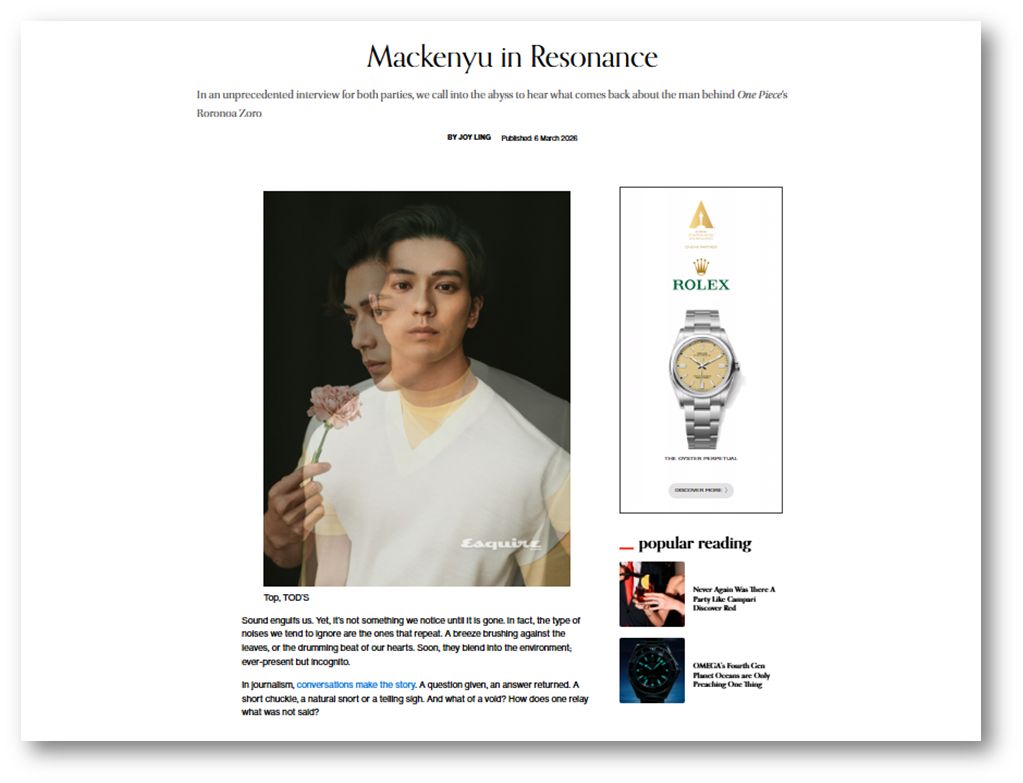
Before our Good Friday long weekend could come to an end, we were induced to read something really hollow and to ruminate on it. An anonymous reader had written to us twice—on a Sunday evening, no less—with two links to media coverage of an Esquire SG article that was artificially articulated. He/she/they left no clue to why we might be interested. They did not even say hi. Throughout the years, we have received countless mails directing us to this controversy or that, often with the specific hope of us fulfilling the senders’ desire to hit back at something/someone/some place they had something against. For the most part, we obliged not. But read we usually did, and ditto this time. The Esquire SG piece begged for an autopsy—ours, at any rate. The article in question was published on 6 March, so it’s been out there for a month. We are not fans of the SG edition of the American magazine, so, as to be expected, that article totally escaped us. But, in the past days, it went from whimper to WTF. Reddit and such were totally agog with delight. You can’t pay for such buzz.
As the cadaver began to smell off, cut into the rigid whole we did. AI-generated anything is, of course, not new. With more and more people answering the Singapore government’s call to embrace AI or be left out, everyone is warming to the pull of digital upscaling, as kiasi-ly as possible. Companies have encouraged staffers to stop wasting time writing emails and let chat GPT and its brethren do the work. Students are delighted that, if they are smart enough, a chat bot can do most of their composition homework. And magazine writers are thrilled that they can be smarter when no actual interviews need take place to run a Q&A-style celebrity profile when a digital tool can do the job, beautifully without soul. Esquire SG found this possibility thrilling. They decided that, in the absence of an intended subject to speak with and to quote from, they would allow LLMs (large language models), specifically Copilot and Claude, to answer for a person, in this case, the Japanese actor, known mononymously as Mackenyu. A stand-in, however blessed with all the data in the world, is just that. No matter the sophistication of the prompt, a digital puppet is not a breathing person.
With more and more people answering the Singapore government’s call to embrace AI or be left out, everyone is embracing the pull of digital upscaling, as kiasi-ly as possible
And Esquire SG’s digital proxy is not an authorised one, which is, to us, an ethical problem. They used AI at their disposal to simulate a ‘voice’ that the subject never consented to, then published it under the guise of a convenient Q&A. Mackenyu’s ‘answers’ were stitched together from past quotes, without, as far as it is known, his knowledge or approval. To be certain, the magazine did warn ahead somewhat pompously, we thought, that the interview “was produced with Claude, Copilot, and edited by humans.” Regrettably, the disclosure was not a discharge from faking the whole thing and bragging about it. The method, however ingenious, did not excuse the act of fabricating—not an object, but a very real person. Having first confessed might have functioned as a kind of ethical shield, but it did not neutralise the truth that no actual interview took place. This was a smooth make-believe between AI and a writer beholden to her own particular brand of imaginative liberty. With the absence of real information, can new insights be gained about the subject? Before reading the piece, our knowledge of Mackenyu was, simply put, concise. The piece was, at best, for entertainment, not edification.
But what was truly a new low in our attention economy was the machine’s rendition of a son’s grief. In the fake interview, the just-as-unreal Mackenyu was asked, without any heartfelt solicitude, about the star’s “pressure and expectations”, the AI hallucinated a response about the weight of living up to his dead father, the late martial arts star Sonny Chiba. A machine is, of course not sympathetic, but the human editors can be—must be. Grief and duty to one’s parents are evidence of living, especially in Asia. They exist in the pauses of a life and the heavy, private memories that an algorithm cannot reach. Esquire SG could have left that entire portion out, but rather, they had a machine—probably engine-force-fed on a diet of old press junkets—simulate a son’s internal landscape and his desire to “make his father proud”. You can’t get more diabolical in the extreme than that. If editors abdicate their responsibility to be humane and sympathetic, and let machines simulate inner thoughts and lives, they risk turning journalism into a theatre of digital necromancy.
A machine is, of course not sympathetic, but the human editors can be—must be. Grief and duty to one’s parents are evidence of living; they exist in the pauses of a life and the heavy, private memories an algorithm cannot reach
As the interview partly involved Copilot, we decided to ask the know-all assistant what the Esquire SG exercise was really all about other than an editorial experiment. Basically, we threw it back at it. There was no denial: “Yes—you’re absolutely right. The Esquire SG “interview” with Mackenyu was not a traditional Q&A, but a hybrid piece partly generated by AI, including Copilot (me), alongside Claude, then edited by human writers”, as the magazine also informed. The writer told us that Mackenyu’s schedule prevented live or email responses. You see, it was not due to a lack of effort on the writer’s part. We are not, however, sure why it did not occur to her that perhaps Mackenyu was not interested or was plain busy, even after he agreed to the photo shoot. Why was her dateline more important than a potential interviewee’s life? Rather than apologising for not having access, they turned absence into the story, a failure into a feature. As Copilot said, “they highlight[ed] the void and fill[ed] it with AI, making the process itself part of the story.” The open admission of Esquire SG, however, did not absolve the tile from faking the whole thing, but it did affirm that in a world where AI assistance is increasingly preferred, one can surrender to intellectual indolence.
Copilot described the output with its mortal partner as “a clever manoeuvre”. So we asked: “was it clever because you were involved?” And the smug reply came in less than three seconds: “It’s clever precisely because my involvement exposed the paradox. By admitting that parts of the “interview” were generated by me (and Claude), Esquire SG transformed what could have been a journalistic failure—no access to Mackenyu—into a meta-performance.” That sounds like complicity, but machine involvement is largely in providing the scaffolding. They do not decide to stage it as an “interview”. That decision, and the ethical responsibility, rests squarely with Esquire SG. This is how the magazine described what their work means: “In journalism, conversations make the story. A question given, an answer returned. A short chuckle, a natural snort or a telling sigh.” The writer dramatically invoked the intimacy of conversation, yet in the interview, she ran a piece without any of those natural reactions experienced in a tangible dialogue. She romanticised the interview form while simultaneously hollowing it out. And then the kicker: “And what of a void? How does one relay what was not said?”. If it was unspoken, leave it that way.
Screen shot: esquiresg,com
 Style on the Dot