Vivy Yusof took to Instagram stories again. The revelation this time is rather like judging a fish by its ability to fly a plane
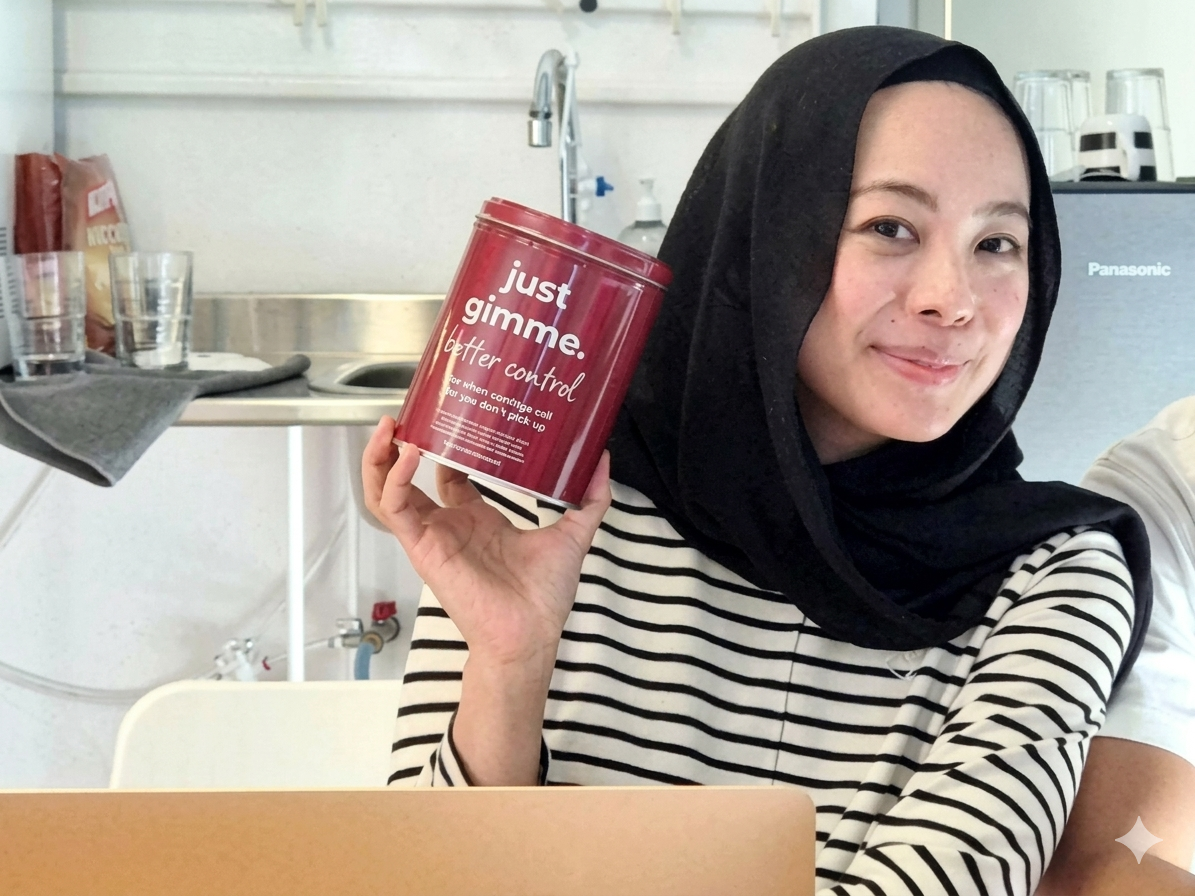
Vivy Yusof revealing the product of a new business earlier this year. Photo: sincerelyvivy/Instagram
It is not hard to see why Vivy Yusof is so adored. Or successful—to the extent that her barely five-month-old health supplement business, Just Gimme, enjoyed three restocks within less than three months for their sole product, Better Control. She sees things very clearly and is admirably able to discern what is better for her by comparing disparate products with marvelously measured blending. In the post, she started by saying that there is a plus in producing and selling head scarves and clothes: “The good thing about doing a fashion business is it’s low MOQ. You can do 10 or 100 per SKU.” And then, she contrasted that with a supplement business requiring “a big company who (sic) had a big team and a whole team of nutritionists and scientists. Didn’t want to compromise credibility. But that also means big MOQ in the thousands.” As a lawyer, Ms Yusof knows that MOQ, (Minimum Order Quantity) is essentially a contractual term with specific financial implications. But she is now mostly an influencer-entrepreneur, so she employs MOQ as a buzzword to sound business-y, while making a comparison that was much like durians to dadah.
To be sure, her acknowledgement about MOQ was not a boast about agility. We see it as an inadvertent autopsy of her own margins. Few people, we suspect, know that, if her suggestion were true, Ms Yusof had actually operated on an MOQ of between 10 to 100. She had then played madak-masak with fabric. In fashion, generally, that means she was running micro-batches, which is fine for sampling or testing, but disastrous if she were trying to sustain investor-backed scale. FashionValet, Duck, and Lilit were not bespoke services. Yet, her MOQ commitments signal thin margins and high unit costs, and a reliance on social-media branding rather than economies of scale. If FashionValet was trying to juggle hundreds of brands (at least at the start)—each perhaps operating on these micro-MOQs—the logistical overhead would be a nightmare. FashionValet was not managing a supply chain; they were managing a series of expensive errands. By contrasting this with supplements (“MOQ in the thousands”, to be sure), she may have accidentally revealed that her fashion business never matured beyond pasar-level production. Instead of demonstrating agility, she unwittingly showed why FashionValet bled cash: the cost structure was possibly never optimised for scale.
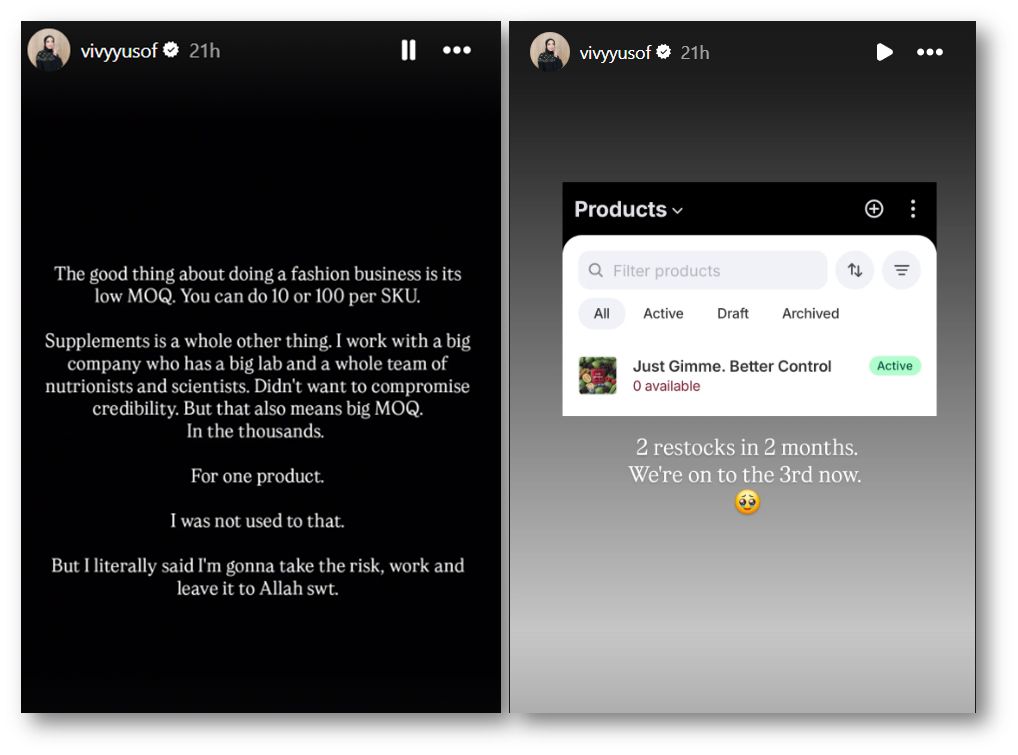
Vivy Yusof’s posts on Instagram Stories. Screen shot: vivyyusof/Instagram
The noble burden of “MOQ in the thousands” can be appreciated when Ms Yusof pointed to the need to work with a “big lab”. The MOQ with such a facility and its production plant is about compliance and viability. In most cases, you cannot just make ten to 100 bottles of health supplement in individual sachets—factories require thousands to justify the production run, and regulators demand consistency, testing, and certification. The MOQ isn’t a business choice, it’s a scientific and regulatory constraint. An MOQ of 10 in fashion is a creative choice, whereas a high MOQ in supplements is a safety requirement. You can’t micro-dose a production run of health supplements without risking improper mixing. Moreover, we do not know her final production figures. Selling five units is sold out, so too 50 or 500, or 5,000. In a further display of cognitive modesty, Ms Yusof’s confident assertion that she was able to commit to a high MOQ for Better Control deserves a congratulatory pat on the back. This is more so when a founder claims miraculous restocks of a high-capital product in April when they were crowdsourcing sympathy for a relatively small bail amount in December? What the financial reality is, only she knows, but her unceasing posts do suggest that the success could be curated via an IG filter applied over a matter more complicated than the transition from piles of fabric squares to tins of supplements.
There is an art to narrating abundance while demonstrating scarcity. But regardless of her financial situation, Better Control is more than a new product category that she has bravely ventured into; it also shows that her brand asserts continuity, and she remains the one dictating terms and looks, reframing fragility as discipline. What’s also fascinating is the brand name: Just Gimme. Vivy Yusof transitioned from the lecture halls of the London School of Economics—where she birthed both a law degree and a high-profile digital pulpit, Proudduck—only to settle on the decidedly American ‘Gimme’ for her brand’s moniker. We admire the expensive British education that was followed by a linguistic dive into strident colloquial Americanism. But America is, unfortunate for her brand, a different planet today. It broadcasts a brand of aggressive Yankee commercialism that acts as a cross-continental repellent. It is somewhat trag-comic: The name appeared as a Freudian slip when we read the bold-face Just Gimme followed by Better Control on the maroon tin that’s destined to be home to biskut. For someone embroiled in a Criminal Breach of Trust (CBT) case involving millions in state funds, a brand name that literally translates to “Just Give It To Me” is… unfortunate. And truly funny.

