Fitspo influencer Novita Lam went all the way—10 kilometres of it, turning two nations at war into a cardio joke, sickeningly reducing war, displacement, and civilian deaths into a punchline about sore legs

Novita Lam enjoying a scenic run and a lazy pun. Screen shot: novitalam/Instagram
Influencers do say the most extraordinary things. And one showed that she has high-speed legs, buw lot-resolution awareness. Fitspo Instagrammer/TikToker Novita Lam (no, she is not the founder of the local home appliance brand, just someone with a camera-phone and a pun), shared a stunning reel on IG of her scenic run and gave it a caption that showed off her flair for wordplay. In what at that moment must have been immensely inspired, she wrote: ‘“Iran this. Israel that.” IRAN 5km and the pain ISREAL.’ World conflict is just a set, it seemed. Some Netizens, impressed with her athleticism or fuchsia running wear, think that she was being “poetic”, except that poetry implies soul, depth, and a connection to the human condition. There is a special kind of sickness about someone using the names of nations in turmoil as oil for their personal engagement metrics. It turns the ‘fitspo’ (fitness inspiration) tag into something shallow and self-serving. She out-ran her reputation, but she’ll never out-run that caption.
With just three short sentences, Ms Lam revealed more about herself than her entire sexy life on the grid. We know she is an avid sportswoman, but one who succumbs to pain after a 5-km run, even if she proclaimed to be a Hyrox participant. To equate the “pain” of a brisk jog to a war zone isn’t just tone-deaf, it’s hyper-dramatic and pseudo-profound, It shows that she was just hunting for a reason to use the pun, regardless of how minor the actual achievement actually was. It was an excess of cleverness or what our mothers would call geh kiang (假勥, Hokkien for being too smart for one’s own good). She gave the first two sentences the Emerald Fennell treatment, although the latter used it in “Wuthering Heights” a stylistic choice for a title of a film. By contrast, Ms Lam used the quotation marks as a dismissive choice for a tragedy, to parrot headlines or mimick the way people talk, with a thick layer of irritation baked in. Adding quotation marks around phrases that don’t traditionally require them has become a ‘cool girl’ digital shorthand—a way to signal irony, detachment, or a “this and that” nonchalance. Or, even worse, laziness to engage with actual human suffering.
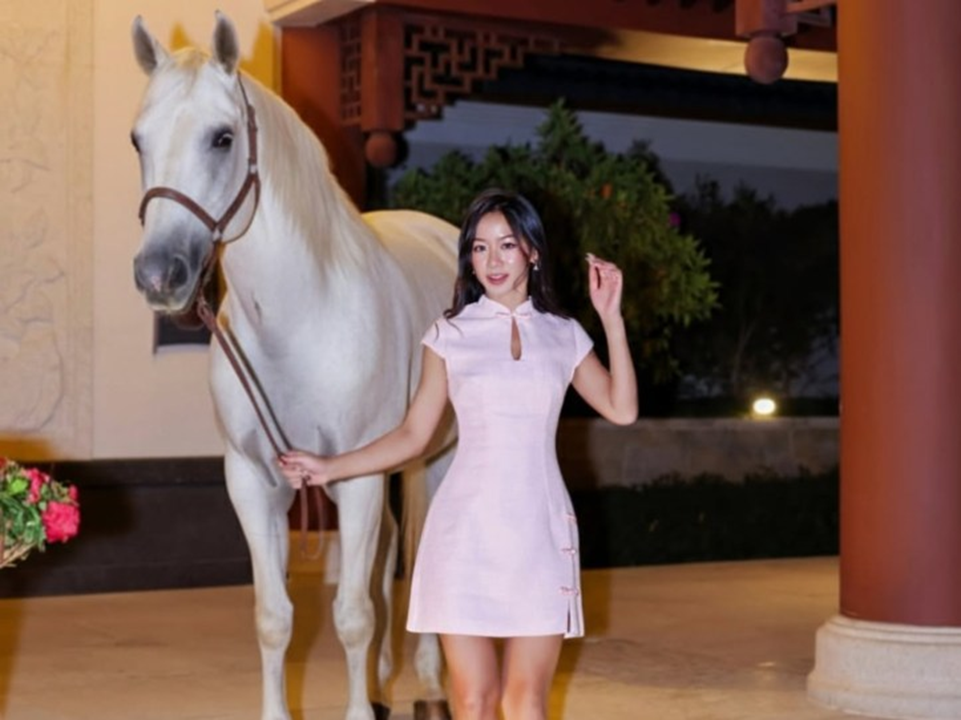
Novita Lam wasn’t just horsing around with an equine, she was doing the same with words. Photo: novitalam/Instagram
As trigger-happy she was with double inverted commas was her use of the amusingly Trumpian full-caps, specifically “IRAN” and ISREAL” (on Reddit, they prompted the cleverer comments: “Is she fucking syrias?” and “Yemen, she is”!) By making Iran pronounced as “I ran”, which is American, rather than the Farsi ‘ee-rahn’, Ms Lam seemed to prefer a U.S.-centric manner of assertion. The pun is entirely dependent on the American English pronunciation, not Iranian. Ironically, if she had pronounced it correctly, as we do, and the British and the Australians too, her clever pun would have fallen completely flat. And by spelling ‘is real’ as “ISREAL”—the ultimate geh kiang-nesss—she hijacked the name of a country in conflict to describe her own muscles in pain. (We bet she, as a linguistic tourist, pronounces Qatar as ‘kutter’, too.) The fact that it was only a 5-km run (roughly 25–30 minutes for someone of her fitness level) makes the “ISREAL” pain even more absurd. “Me, Me, Me” couldn’t be more strident. Or clearer.
Shortly after she shared the divisive post two days ago, she removed it. Then the apology arrived at the influencer’s preferred hour for damage control: midnight. Issued as a disappearing Instagram Story, it was a masterfully generic contrition. It came after the post had already circulated widely and sparked criticism across platforms, making it look reactive rather than reflective. She said she was “sincerely sorry” for sharing the story and acknowledged it was “insensitive and hurtful” and had “removed it as soon as I realise the mistake”. It was framed in generic influencer language without grappling with the deeper issue of trivialising war. Most glaring was how she was keen to use the names of those nations as a joke, but she couldn’t bring herself to name them when it came the time to take responsibility. She made no reference to her joke and by calling it “what is happening”, she continued the “Iran this, Israel that” dismissiveness. Most egregious, however, was her emphasis that “I removed it as soon as I realised my mistake. I am truly sorry for this.” The removal of the post*? Or, perhaps that it was the subconscious truth—that she was more sorry she had to delete her clever content than she was about the content itself?
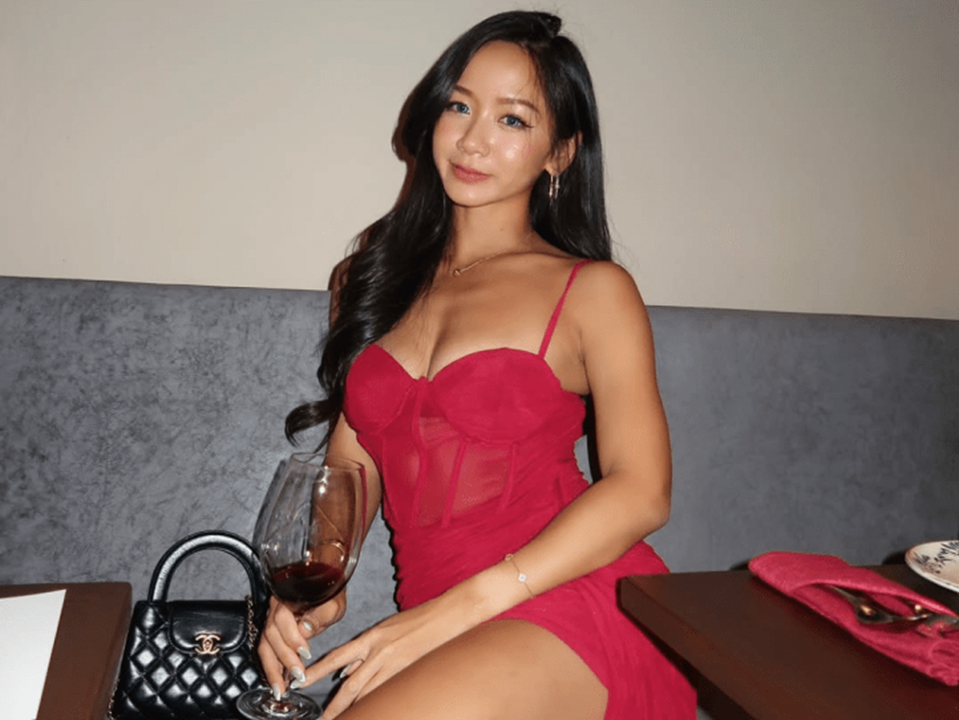
Explanation not required. You’re looking at it. Photo: novitalam/Instagram
It is surprising, but the NUS-trained Ms Lam should know that an apology without naming the victim isn’t an apology; it’s a press release, and a sloppy one. Is this what passes for public-facing communication of contrition now—a brand statement? Remarkably, when we did a TikTok search using her name, reels from another moniker were recommended: Grayce Tan. The ex-PropertyLimBrothers employee is the perfect companion to the Iran/“Isreal” runner because they share the same DNA: high academic credentials at NUS, a clean girl aesthetic after, and the love of performative selling of self. That should include dating guide creator Koh Boon Ki. The TikTok algorithm wasn’t just suggesting another person; it was identifying a personality type: the women who use the luxury and NUS shields to place them above the average influencer, certainly higher than the rest of us non-influencer folks. They spend all their energy on the framing—the dresses, the bags, the shoes—but are really luxury gift boxes containing nothing more than tissue paper.
Novita Lam was born in 1994 in Jakarta, and is of Chinese-Indonesians decent or what the locals call “Chindo”. She eventually moved to Singapore, but the year of the relocation is unclear. She is documented as having studied at the National University of Singapore, graduating with a Business Administration (Hons) degree. She joined Citi and then Bank of Singapore after she graduated. Her family background is kept private, and neither her Instagram nor TikTok posts, nor interviews or features, mention parents or siblings. She became famous when, in 2021, she was featured in an article in The Straits Times, covering Singapore’s Vaccinated Travel Lane (VTL) with Germany. Then a 27‑year‑old bank employee and Instagrammer, she had just arrived in Frankfurt under the scheme, for which she was criticised for traveling during COVID restrictions. While she has built a substantial following (over 440k on Instagram and 129k on TikTok), she also holds a professional role as head of partnerships & ecosystem at AWSt, a Singapore‑based Web3 startup founded in 2020 that helps businesses launch and integrate NFTs into the metaverse.
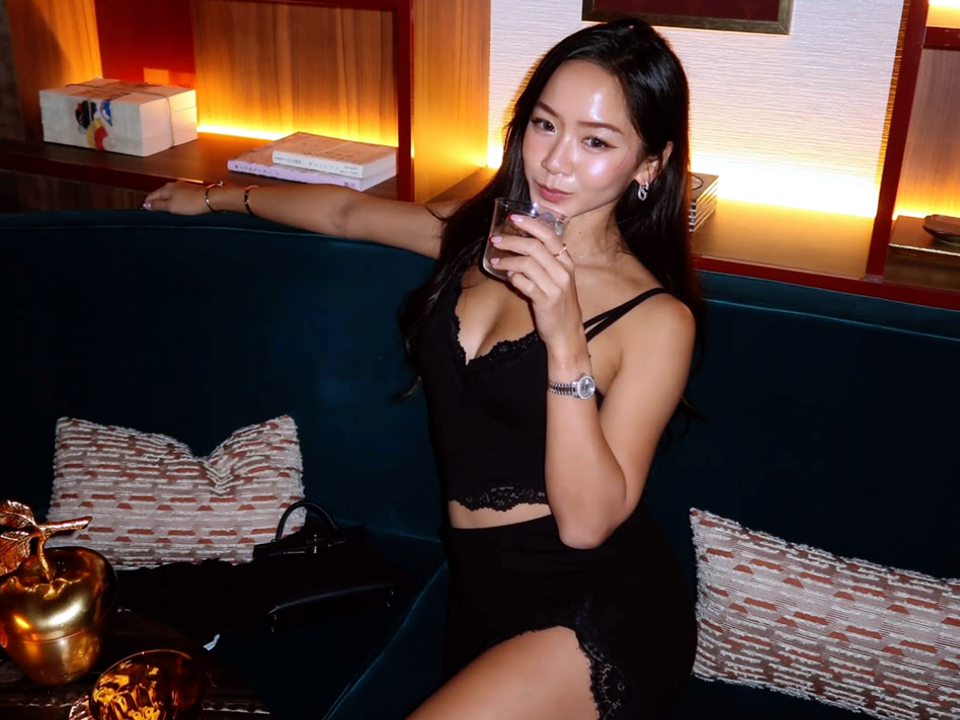
Cocktail and cleavage. Photo: novitalam/Instagram
Her résumé reads like the Singapore Dream template: NUS alum, corporate stability at Citi and Bank of Singapore, then a pivot into the “frontier” of Web3 and metaverse partnerships. On paper, it’s a narrative of upward mobility, prestige, and futurism. Yet her résumé is a LinkedIn fantasy while her reality is a cautionary tale. Whether she was catching the first VTL flight to Frankfurt during a pandemic or partnering with NFTs, Ms Lam seems to have mostly prioritised the scenic over the significant. Her professional role involves launching businesses into the metaverse, but her recent post proves she has already successfully launched herself out of the real world entirely. And she is in excellent form. There’s nothing like a brisk jog to keep the heart rate up while the global thermostat hits incinerate. It’s a recurring script in the Singaporean influencer scene, specifically among those who lead with their credentials as a form of moral and social armour. It’s not my world if I am not in there. The four Cs we knew so well are no longer relevant. For them, it’s currency (influence), curation (lifestyle), control (narrative), and commerce (revenues).
She first joined Instagram in 2012, with her earliest posts dating back to that year. Her account gradually shifted from casual personal updates to curated lifestyle and beauty content, especially after 2018 when she left banking and began building her influencer career. What struck us was her managing 14 years of her digital life with just one silhouette, to serve only one aesthetic function: show off her body. Every peripheral line of her threads meanders and traces every curve of her body. In a reel, “What I wore to the office this week” that, interestingly, included “Saturday, the best day” and “Sunday, the rest day”, her clothing choices compromise only the body-skimming. The wardrobe suggested to us was almost monolithic. It has nothing to do with fashion, but it doubles down on a static silhouette, on a signature look as brand identity. The clothes don’t diversify her persona; they reinforce one message: visibility through sexualised display.
“IRAN 5km and the pain ISREAL” is not neutral fitness commentary. Or helpful. Rather, it’s a pun that mirrors the provocative cut of her dress, the nod to asset allocation even if the outfit is already negligible. Just as the slaps and slits control how the eye traces her body, her caption marshals how the audience interprets her persona: indifference to the woes of the world, using the safety of Singapore to mock the dangers of the Middle East. When she spoke of her aesthetic pain (possibly the lactic acid build-up of the run—that a seasoned runner couldn’t bear?), she was equating it with the involuntary, terminal pain of war victims. The Chinese have a perfect saying for this: 哗众取宠 (huazhong quchong)—claptrap to please her audience. When she professed: “I will be more mindful moving forward”, it’s really not wisdom, not when so many influencers recite the same script when cornered. It’s a survival tactic in the look-at-me influencer economy, with a ring light. And a bad pun.
*In English, the pronoun ”this” refers to the nearest preceding action. By saying “I removed it… I am truly sorry for this”, she is linguistically apologising for the deletion, not the offence.
 Style on the Dot