Margot Robbie arrived at the Wuthering Heights Paris premiere not as Cathy Earnshaw, but as Barbie in Dickensian cosplay—playing doll on herself
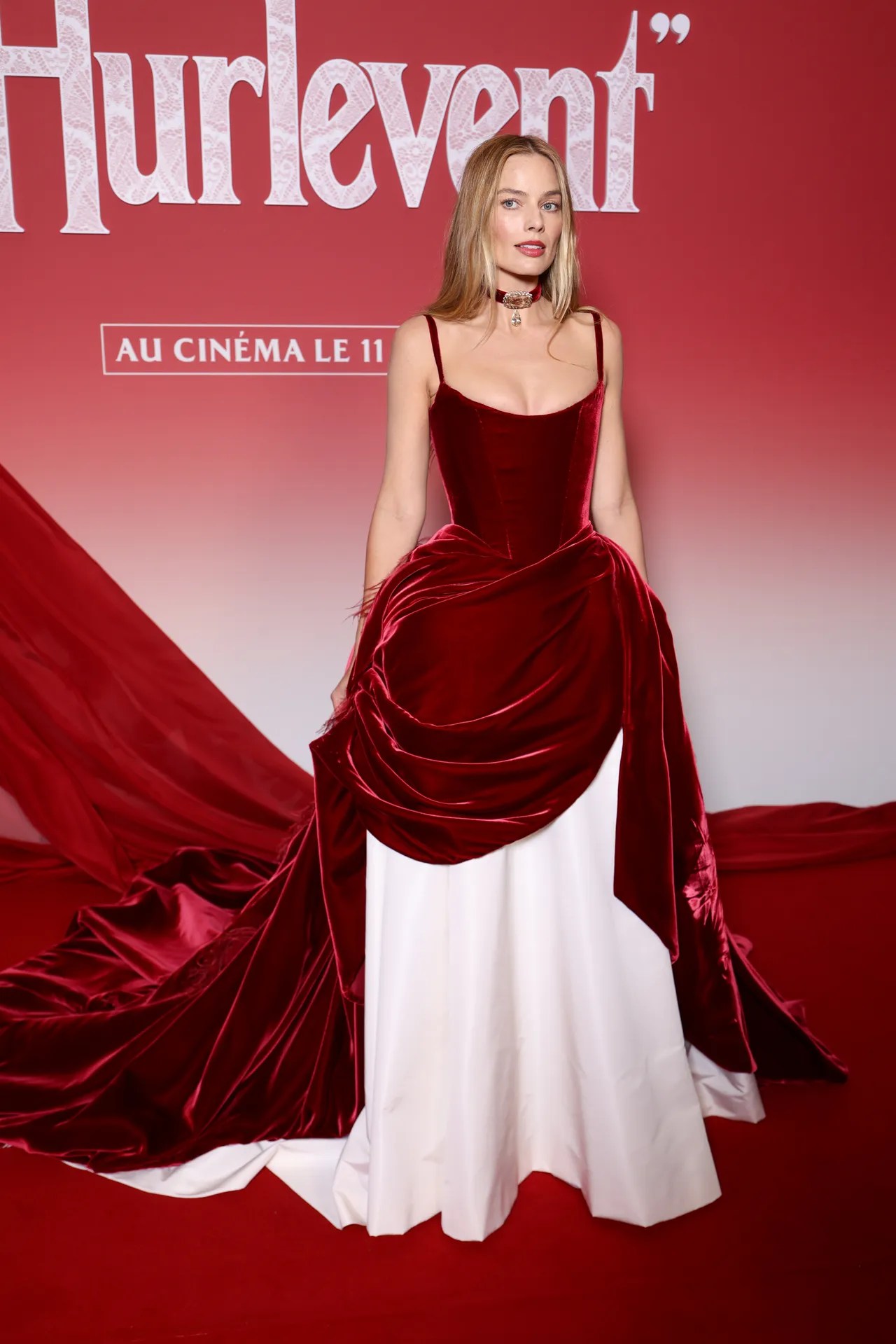
Margot Robbie in Chanel at the Paris premiere of Wuthering Heights. Photo: Getty Images
At the Le Grand Rex theatre in Paris yesterday, Margot Robbie attended the premiere of Wuthering Heights looking aggressively upholstery and swagged. She traipsed the red carpet with the serene obliviousness of a garden gnome forsaken on a windswept moor. Her self-assurance was the only thing more puffed up than her bell-shaped skirt. Ms Robbie was outfitted by Chanel, but you might, in a moment of charitable confusion, imagine that it came out of Warner Brothers’ costume unit. This was Chanel couture at its most un-Chanel. And Matthieu Blazy at his most uncharacteristic. These days, he has all the presence of a water-stain on a landscape painting; one knows something has happened there, but one can’t quite say what.
It is not clear why Ms Robbie needed to look like a set piece from a provincial theater production. Her gown was a stately composition of a fitted bodice with a pair of dispensable spaghetti straps. It sat on a parabolic top skirt with a valance across the lower half of body and a bustle in the rear, stuck with random feathers, as if to mimic an incompletely plucked chicken. The underskirt was plain white—all ‘period’ majesty on top and a freshly laundered hotel bed sheet beneath. This was akin to the late 19th-century ‘polonaise’ style. But, it suggested the frantic dressing of a Whitechapel prostitute who, in the haste of a uniform change, forgot to remove the stark white skirt of her day job as nurse. Vogue eagerly described her painless effort as “method dressing”, as if character were something one could simply winch into place. Mr Blazy told the magazine that what he designed for his star-client was a “Wuthering Heights–inspired look”. Since W reported that Ms Robbie was “leaning into Victorian glamour”, did the red carpet get-up take its inspiration from trends of 50 years later?
Vogue eagerly described her painless effort as “method dressing”, as if character were something one could simply winch into places
We occupy the unfortunate position of the uninitiated, staring in blunt stupidity at the question of ‘why’. At the risk of sounding pedantic, Wuthering Heights was published in 1847, but set in the late 18th century (roughly between1770 and 1801). By calling it “Victorian glamour”, the press was decades late. And designing a bustle (a bodily extension that didn’t peak until the 1870s/1880s) pointed to the new designer of a French house being nearly a century off from the book’s actual unglamorous setting. Did he get himself lost in some costume archive, not in his place of work? But who cares about timelines and timeliness these days? In taking in the revisionist “regal” (clothes for action that mainly took place in a drafty, weather-beaten farmhouse?), have we, too, taken liberties with the savage, dirt-streaked heart of the story Emily Brontë intended or romanticise an era she did not?
Some members of the press insisted that the Chanel gown borrowed Brontëan mood (or “references” that, according to W, were “easily identifiable”), but it looked to us clearly engineered for the flashbulbs, not the moors. In fact, to be more precise, it was a confusing, heavy-handed mess, only less boggy that the surrounding lands of Wuthering Heights. And deeply ironic, too. Gabrielle Chanel herself sought to turn away from that trussed-up silhouette. An entire legacy was rooted in the rejection of the Belle Époque excess and constriction. Yet, here on the red carpet now was an outfit to match the floor covering and an attempt to make Catherine Earnshaw look more like Rose Maylie (Oliver Twist), if she did not mind exposing her pale arms. Confining Ms Margot to this silhouette framed her in a gloomy London townhouse being told to sit still, whereas the real Cathy Earnshaw should look like she’s about to sprint into a thunderstorm. It would not be “a look of glamour” that helped her ensnare Heathcliff.
Could the parallel panels with a length discrepancy not be wider to accommodate the mammary magnitude?ear in the most extreme form, however pale it looks
To complete the image of Cathy the captive for a captive audience, Ms Robbie was fitted with a Lorraine Schwartz choker (a Victorian craze) to match her dress and carpet. It held over 100 carats of champagne diamonds, according to the media. An $8-million cherry on top of the upholstery of couture. And it was a literal collar, a shimmering shackle for the neck. The real Cathy would have thrown it into a peat bog. Her feral, moor-born chaos—the kind of soul that belongs to the wind—was now being passed off by Ms Robbie as sculptural poise, presumably conceived for an audience that spends more time on TikTok than at the cinema. A heroine of the moors reduced to a doll on display, collared and corseted. The red carpet continues to remind us that the world needs content, not characters.
Talking about dolls, Margot Robbie, if you remember, played one—Barbie. Back in 2023, during the obligatory press tour across the world, she was dressed as pinkly as the inoffensive blonde. And, similarly, the press described it as “method dressing”, or, seriously, cosplay with a couture budget and a willing couturier. In fact, when we first saw the repeated close-ups of Ms Robbie in the trailer of Wuthering Heights, we saw Barbie, just with bad makeup. Cathy Earnshaw by way of Sephora. Her face is indelibly branded by Mattel’s most famous doll. Come to think of it, her Cathy on that red carpet was Stereotypical Barbie forced to be Highland Barbie. If Emily Brontë were alive to see this $8-million-plus upholstery pretending to be her savage heroine, she wouldn’t be upfront at the red carpet watching the action. She’d be at the back of the theatre, setting fire to the velvet, without a tear.
 Style on the Dot