If the Grammy red carpet proved anything, it’s that Paris Haute Couture Week was a total waste of fabric. Why bother with a thousand hours of embroidery when a single, stressed-out thread will do? Or able nipple rings?
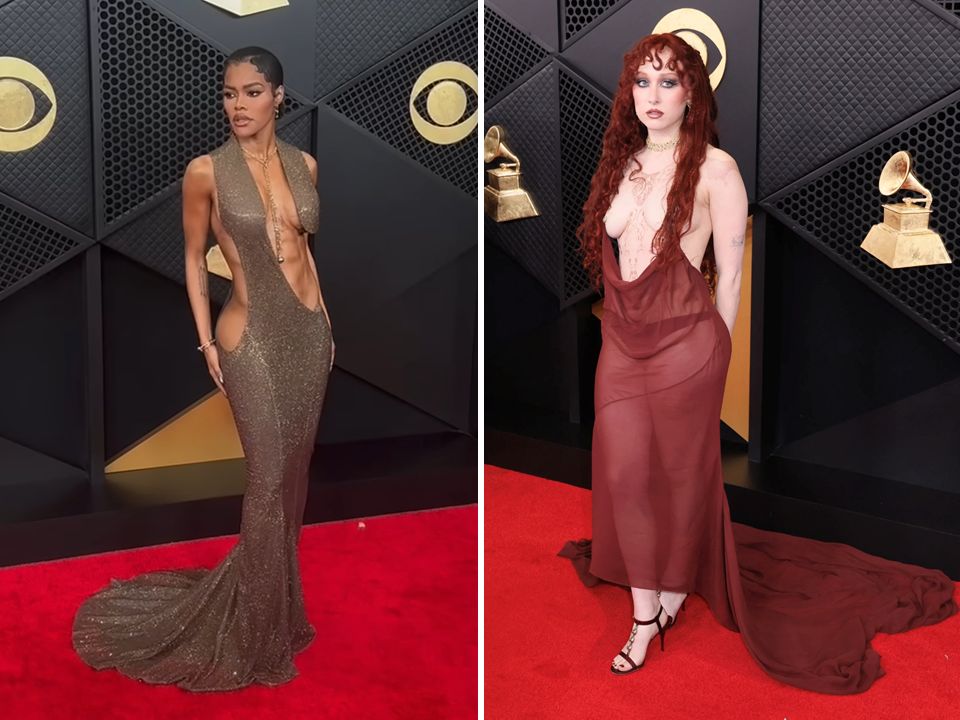
Silhouettes for an era of austerity? Left, Teyana Taylor in Tom Ford. Photo: Reuters. Right, Chappell Roan in Mugler. Photo: Getty Images
The just-concluded Paris Haute Couture Week may have been hailed as “a breath of fresh fantasy” by CNN and “where moguls and movie stars go for clothes” by The New York Times, but the Grammys red carpet told a rather different, but revealing story. Why bother with a thousand hours of hand-stitched heritage when a single, anemic thread can carry the entire burden of a PR stunt? Couture’s devotion to fabric excess and cocooning of the body looked almost quaint beside the Grammys’ flesh-it-out display, where pop stars turned well-measured exposure into the new craftsmanship. Moguls and movie stars may still have Paris, but pop spectacle has claimed the body as its raw atelier that has absorbed the codes of erotic labour—scant fabric and strategic exposure. We’ve traded the timelessness of the stitch for the shelf life of a snapshot.
This may explain why Teyana Taylor and Chappell Roan chose to enjoy the scantiness of a lap dancer, and the tension of what’s revealed versus what’s concealed. They turned it into a red carpet that functioned like a pop-up ad that was unwanted, distracting, and impossible to ignore. Ms Taylor, notably, also an actress, wore a custom Haider Ackermann-designed Tom Ford gown that looked like a deflated neck pillow with a bridge to a mermaid skirt. That the upper piece was able to stay in place despite the thoracic contours was admirable engineering of chain mail, reportedly the fibre of the dress, but that does not absolve Ms Taylor of textile anarchy. Could the parallel panels with a length discrepancy not be wider to accommodate the mammary magnitude? Or was her famous musculature more important than the dress? The Tom Ford label was known for its aggressive sex appeal, but never in an embrace of anatomical over-sharing.
Could the parallel panels with a length discrepancy not be wider to accommodate the mammary magnitude?ear in the most extreme form, however pale it looks
Chappell Roan’s Mugler dress was a whole other level of hinging on hardware. She walked onto the red carpet shrouded in a sheer cape that surprisingly revealed little, until she dropped it. The dress beneath was suspended from nipple rings, she was totally bare-breasted, save for the ‘mechanics’ of holding the top of the dress up. Ms Roan clearly valued her modesty to some degree. She wore her hair down in the front that served as unruly fringing so that ‘nipplegate’ would not transition from meme to a meme. The neckline had retreated to the waistline, leaving the torso to fend for itself, proving that in the current fashion climate, coverage is merely a suggestion. It is not clear how comfortable Ms Roan was, but judging by her posture, she was breathing with the caution of someone handling live explosives.
It is hard to apply ‘dress’ on what these women wore at the Grammys. The word dress is about 700 years old, dating back to the late 13th and early 14th centuries. It started as a verb that referred to the act of preparing, arranging, or making something straight. The meaning shifted to adorn, decorate, or put on clothing in the 17th century. In the 1600s, it was used to describe a general garment or set of garments and by 1630s, began life as a term to describe a woman’s garment consisting of a bodice and a skirt. But now, when both are used strategically rather than protectively, perhaps we need a new, more accurate word than stick to something this old-fashioned. Let couture concern itself with the dress. On the red carpet, it is the undress—not the act but the state—that will continue to rule. The era of the textile recession is here to stay. High fashion, as we have seen, simply cannot survive the naked demand for high visibility.

