Viewpoint | Another influencer flew too close to the sun, proving her curated life was more filter than fact. But these days, a glitch in the persona is hardly breaking news, yet it is. With Grayce Tan, the high cost of performative luxury and the low frequency of leaky walls collided

Grayce Tan shared on her socials Sunday lunch with a friend, days before the scandal broke. Photo: graycetan/Facebook
On 18 January, Grayce Tan shared ten photos of her lunching at an undisclosed alfresco spot. In clothes that could have come straight out of Brandy Melville, she held a glass of what appeared to be a cocktail of green vegetables juices, probably including kale. On her immediate right was what appeared to be a Celine Ava bag in Triomphe canvas. Behind that was a stack of two books: Essential Drucker by management guru Peter F. Drucker and, on top of it, Cleopatra and Frankenstein by British author Coco Mellor. In the same set of photos was one of a page from the novel. The 29-year-old shared a scene of the two titular characters in a kitchen after a meal the latter’s mother cooked, interestingly in a wok. ‘Frank’ had placed his hands around ‘Cleo’ and asked if she had done something to her hair. She replied: “I looked like a boiled egg with a wig.” Unwilling to accept the self-deprecation, he told her he wanted them to attempt something. He looked at her directly and said, “I’m going to say ‘You look pretty’ and you are going to say ‘Thank you.’” He insisted that there were to be no disparaging of self. Cleo submitted to his request: “I nod mutely.” As it turned out, it was a moment of curated silence that would, just one week later, be shattered by the very audible reality of a leaky office door.
Her employer, PropertyLimBrothers (PLB), announced recently that two of their key married staffers, but not to each other, had “resigned”—Ms Tan and her paramour Melvin Lin, presumably for the salacious scandal that launched a thousand group chats and Reddit memes. PLB initially maintained a level of silence so profound it was practically a religious experience. In less than a week, the one video that was reportedly first shared on Reddit and blew the cover open for her has now reached the kind of saturation level usually reserved for Pizza Hut ads. Ms Tan achieved a different apex of popularity when she was an ebullient property agent. She sold dream homes, but then forgot that the most important part of any room isn’t the floor—it’s the thickness of the walls—and doors. But the viral reel (reportedly filmed during the week of 19 January 2026) was anything but poetic. It featured a man proning on the floor to peep under a visible door gap. Delighted by his find through it, he told his companion/lookout, “Bro, confirm sex… they’re on the table.”
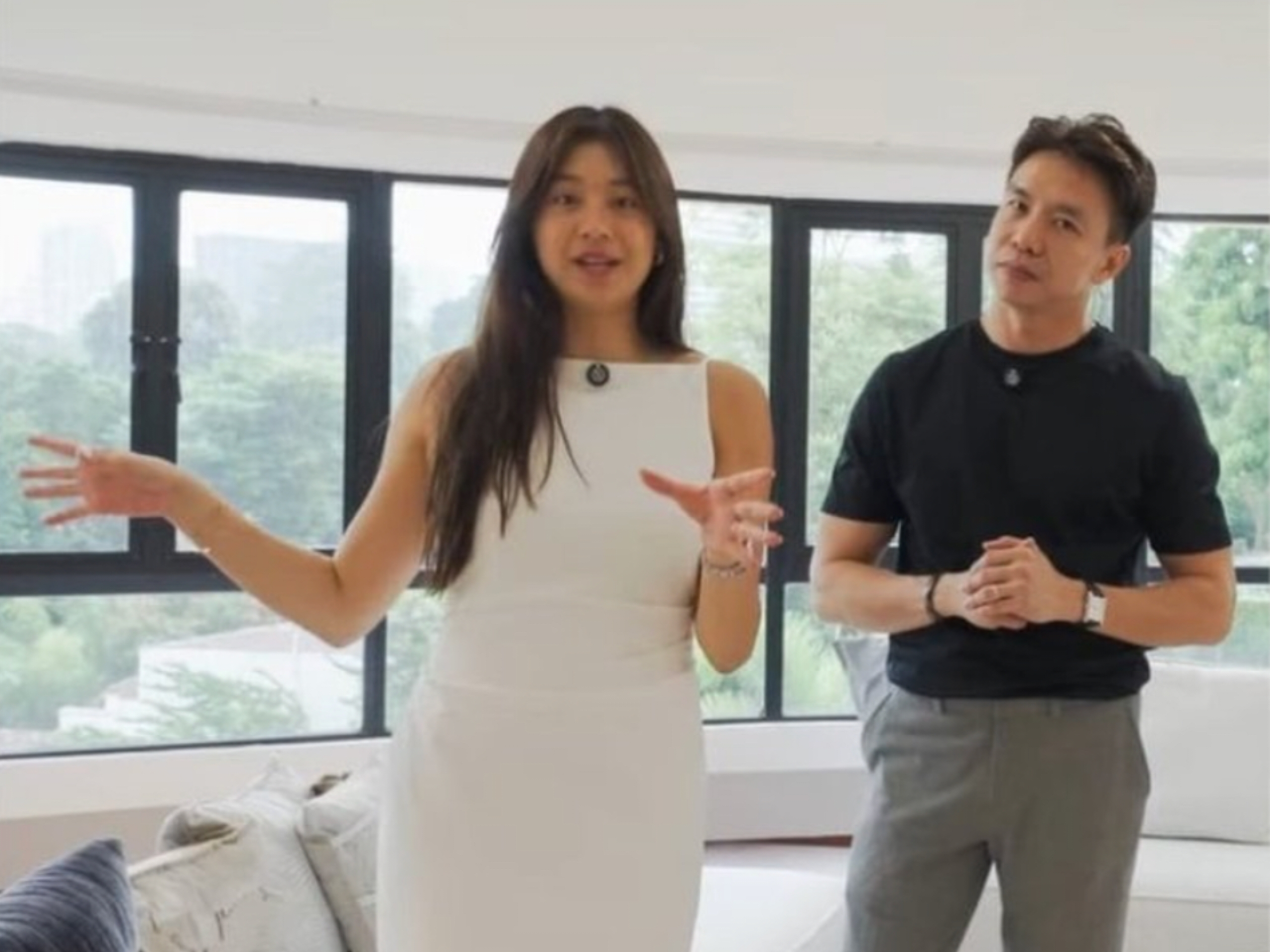
Grayce Tan and Melvin Lim selling an apartment on the PropertyLimBrothers YouTube page. Screen shot: propertylimbrothers/YouTube
What led to that investigation is where the ears actually perk up. In that video, the occupants of the diagonally facing unit of the supposed PLB office found their attention hijacked by a performance across the corridor that definitely was not part of the tenancy agreement. The unscheduled audio broadcast was so loud that the phone camera capturing the movement of PLB’s door was able to pick it up—a vocal performance that suggested someone was significantly more satisfied than the company’s quarterly projections could ever account for. Some people had clearly moved well beyond the hand-holding phase of the afternoon. And the listeners, burning with curiosity, decided to approach the door to uncover the true picture. A guy went on all fours, flattened himself, and peeped through the gap between the door and the floor, provided not for that purpose, and discovered the desk action that explained the cries of orgiastic delight.
The loud vocalisations transformed an unprofessional, although private, development into a soundscape for neighboring tenants. It wasn’t just gossip—it was disruptive. Ms Tan and Mr Lim may not be working, but others were. If that office audio was raw (or authentic, as influencers prefer), her professional vocal performance as seen in her YouTube videos was its polar opposite: a hyper-curated dialect of aspiration. Many of the home tours have been removed from the PLB account (the brand promise was about homes as sanctuaries. Yet here, the office itself became a stage where sanctuary collapsed into an unsolicited show), but in whatever there is left, it is still discernible that Ms Tan didn’t just describe a home, she performed a welcome routine. As a Sociology major with a minor in English Linguistics, Ms. Tan was academically credentialed to understand the power of symbols and the weight of words. Yet, she used these tools not to reveal truth, but to manufacture an “exquisite” distance from it. To build a more convincing “wig” for the “boiled egg”?

Grayce Tan, like so many influencers, love goofy poses and dressing for the gym when they are not in the gym. Photo: graycetan/Facebook
In her sales videos, she always looked as if her wardrobe was sponsored by Love, Bonito. And she didn’t just speak; she performed a high-register linguistic dance, over-articulating every adjective as if to manually inflate the property’s value. When she cooed in one video of the winsome twosome selling an apartment at The Draycott, Ms Tan described what she saw in the bathroom as “the exquisite kind of tiling”. It was vivid pseudo-intellectualism, the words deployed less for precision and more for sonic effect. Surely to a linguist, who won the Geoffrey SK Yu Sociology Prize at NUS, “tiling” is a process, not a material, but to Ms Tan, the word was a vessel for the stressed syllable. It is not clear if she chose wonky language to come across as relatable or unmistakably local, but it can and did sound grating. She wasn’t an enthusiastic agent describing a floor; she was a skilled sociologist of the vibe, curating a hierarchy where things weren’t just functional, they needed to be elevated. Words do build walls of perception, clearly sturdier than some office walls. She understood that if you wrap a mundane porcelain tile in enough linguistic lace, the audience forgets to ask about the grout.
That raw audio track is now parsed and parodied by every chiobu-hunter on HardwareZone, were the PLB thread is now 274 pages long. It is not just a public case study on the acoustics of infidelity. Grayce Tan is not only a successful self-styled queen of real estate strategy whose sales videos on YouTube are popular, she is also an influencer, in somewhat similar vein as Koh Boon Ki, if only because the two have an odd accent, a manufactured, performative way of speaking. Both the NUS-pedigree “clean girl”. And the other character, Melvin Lim, a CEO, preacher, family man, the embodiment of moral authority. Together, they’ve become the protagonists of a saga that has less to do with property and a lot to do with propriety. The public, of course, has chosen its focus. Not the reputational damage to PropertyLimBrothers. Not the sudden leadership vacuum at KW Singapore (a franchise of US-based agency Keller Williams). No, the meme economy has decided that the defining feature of this scandal is the soundtrack—Ms Tan’s cries of ecstasy, looped, remixed, and shared as if morality itself were a TikTok trend. Her carefully engineered Outer Grayce was permanently overwritten by the digital denizen. There is a profound sadness in the fact that a woman who lived her entire life through a curated lens—choosing the right bag, the right book, the right adjective—was undone by the one thing she couldn’t curate: her own voice in a moment of genuine, intense, un-calculated pleasure. As one SOTD reader said to us, “To even moan that loudly during sex and thought no one cared is arrogant.”

Even influencers have to eat. Photo: graycetan/Facebook
And yet, beneath the noise, the real story is one of institutional fragility. A brand built on trust can be toppled not by market forces, but by human fallibility, not by a marketing blast, but a passion cry. A preacher’s sermon rings hollow when the pulpit collapses under scandal. An influencer’s credibility evaporates when the spectacle becomes the substance. But walls of perception are only as strong as the silence behind them. For all her academic training in the power of social symbols, Ms Tan failed to account for the most potent symbol of all: the leak. In the sociology of the digital age, a glitch isn’t just a mistake; it’s a total deconstruction. The moment that office audio hit the group chats, her linguistic lace didn’t just fray, it was no more. The predominantly male audience of HardwareZone, a demographic that usually has little patience for “exquisite kinds of” anything, performed their own brutal audit. They didn’t care about her sociology degree or her vocal routines. They bypassed her high of overstressed adjectives entirely and dragged her into the low of the chiobu trope.
Privacy has left the building, and social media has changed the locks. The scandal was never just about her private choices—it was about the collapse of the boundary between curated persona and uncontainable reality. Grayce Tan built a brand on control—styling outfits, staging lunches (propped with bag and book), inflating adjectives. Everything we saw until that fateful afternoon—the VP title, the “exquisite tiling”, the perfectly curated influencer life—was purely external. The scandal revealed that control is fragile when the walls are thin. Her sales style was theatrical, her influencer posts curated. But the loudness of the scandal made her the unwilling star of a performance she couldn’t edit, caption, or lace with adjectives. It is surprising that she was unaware of the sociological truth: In the digital age, a sin is a private matter, but a sound is a public asset. The public didn’t just consume the story; they consumed the sound. Her screaming became meme material, incontrovertible proof, and clearly entertainment. The outrage wasn’t only about infidelity; it was about audibility. The fact that others heard it made it communal. In the age of social media, privacy can be breached and, worse, overwritten. The consumers of her audio ripped off the “wig”, exposing the raw, un-curated “egg” beneath. Once the locks are changed, the building belongs to the crowd.
 Style on the Dot
kasmaj bahari says you write well
LikeLike
trash website
LikeLike