However good the child is, they will, somehow, look vaguely bad
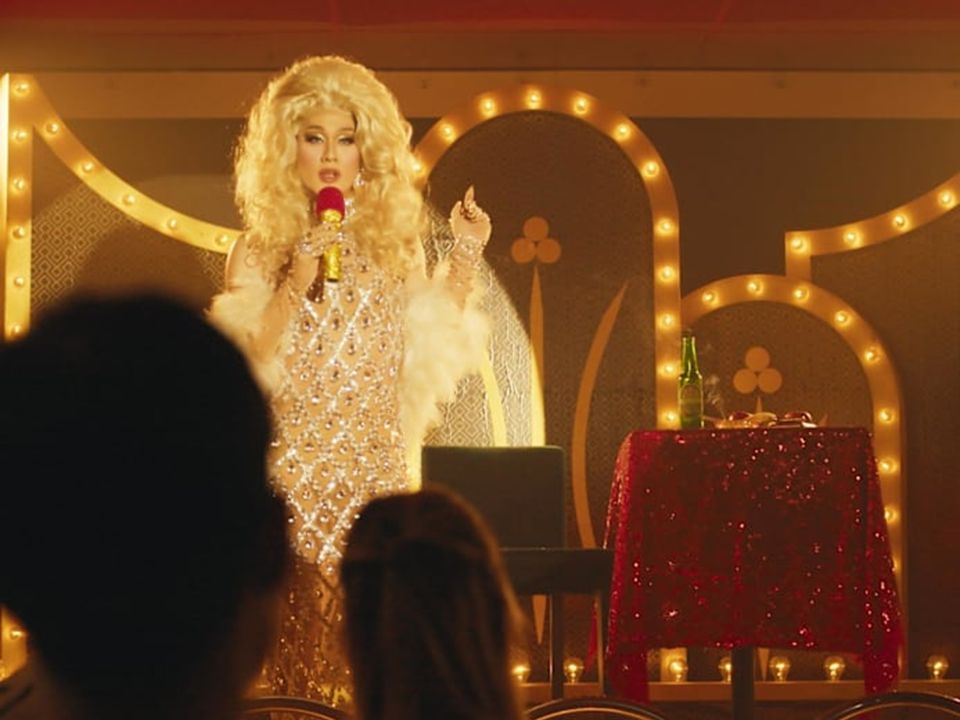
Ritchie Koh in his first drag role
The market for films about Singaporean drag queens must be sufficiently large to encourage director Ong Kuo Sin (王国燊, Wang Guoshen) to make his third about our island’s fabulous side. After Number 1 (男儿王, nanerwang), which earned lead Mark Lee (李国煌, Li Guohuang) a nomination for Best Leading Actor at the 2020 Golden Horse Awards, and the sequel Number 2, he has now delivered A Good Child (好孩子, haohaizi). As with its predecessor, his latest has secured a Best Leading Actor nomination for Richie Koh (许瑞奇, Xu Ruiqi) at this year’s Golden Horse Awards. The film, based on a true story, opens in cinemas—what’s left of them—nationwide today. At an early screening, we heard two lasses of no more than 25 state: “Only drag then can be nominated, meh?” Their skeptical question cuts straight to the heart of the matter: It is not just drag performances, but acts that are perform in cabarets, with lives circumscribed by the revue, that seem to be our industry’s primary path to international accolade.
There is no need to consult the oracles to comprehend the appeal of drag culture to filmmakers. More than half of their scripts can be handled by exaggerated makeup, lurid costume, and unsubtle acting. Interestingly, the costumes of A Good Child received a nomination for Best Make-up and Costume Design, just as Number 1 did (for which it won). There is a narrative shorthand at play when filmmakers lean heavily on costume and make-up to signal transformation, identity, and marginalization. A Good Child uses clothing cues to telegraph moral or familial tension (the mother receiving a purple blouse from her child is a clear symbol of acceptance), a technique that speaks to convenience and compression—evoking complex internal shifts in a single, emotional frame. That said, when the make-up and costumes do all the heavy lifting, they risk flattening the very character arc they are meant to support. We can’t help but wonder: does A Good Child truly earn its emotional beats beyond the surface?

When his character Jia Hao is off-stage
Both Number 1 and A Good Child are inherently advantaged by built-in flash from their subject matter. Drag costume is a layered art form that functions as a vehicle for celebration, resilience, and resistance, styled to wow and leave a lasting mark on fashion and performance. Costumer designer Shah’s biggest challenge in A Good Child was likely the costume for Mr Koh’s Jia Hao (家好), a drag stand-up who performs in a small unnamed bar, to the same limited audience each time he takes to the stage. It is not clear if they enjoy his jokes or his costumes, or both. As Jiao Hao’s drag persona is under-defined, his costume is part glamour drag, part camp drag, and mostly forgettable. It is hard to discern design breakthroughs in any of the costumes, but easy to think that all of them were sourced ready-made in Bangkok, where there is an industry that served the katoey (drag) market. If that’s the case, then Shah is more a costumer than a designer, putting together a lurid award-bait.
As the titular good son, the attention is squarely on Mr Koh’s conflicted Jia Hao, who goes home to take care of his mother, now suffering from dementia. As her memory declines, Jia Hao cleverly convinced her that he is the daughter she desired, and through this new-found relationship, they bonded, and through this maternal misrecognition, an otherwise impossible cohesion is catalysed. For a good part of the film, Jiao Hao is off stage, but perpetually in half-drag and with make-up. The narrative leads us to believe that Jia Hao is a gay man who performs as a drag queen, yet he’s never seen in recognisably male attire. That he must embody his mother’s daughter likely necessitates the protracted costuming, which comprises little pieces easily found on Shein. Director Ong Kuo Sin has emphasised the actor’s commitment to portraying a drag queen with authenticity by assuring the Chinese press that Mr Koh is “百分百直男” —100% straight.

Daughter and mother
When Stanley Kwan was doing the expected rounds of introduction to his 2001 film 藍宇 (Lan Yu), he did not have to affirm that lead actor 胡军 (Hu Jun) was “100% straight”. To be more current, Italian filmmaker Luca Guadagnino did not have to clarify the sexuality of Timothée Chalamet in the 2017’s Call Me by Your Name. It is not clear why Mr Ong needed to preemptively address assumptions about his protégé’s sexual orientation, other than his desiring to highlight the actor’s range and dedication—a heterosexual can play a drag queen, hence elevate Mr Koh’s acting chops. But when an actor has to sacrifice (Mr Koh reportedly lost “9–11kg” to fit into his costumes), and “stretch” his range, it becomes a performance of empathy rather than a lived expression of identity. The media has been so enamoured with his performance that they have raved about it. 8 Days, moonstruck, praised his portrayal as “better than both s Lee’s similarly costumed character in Number 1 and 2”. We have heard people describe his performance as “emotionally layered”, which seemed more about the idea of transformation than the actual emotional depth we felt on-screen. Sometimes, we feel, the industry rewards the effort of transformation more than the effect it has on the audience.
Richie Koh is not an actor blessed with subtlety. He lets the make-up do most of the work, the camp twitches and a bitch face do the rest. These are familiar tropes, exaggerated for effect, and when they’re not grounded in emotional truth, they risk becoming drag clichés rather than character choices. Mr Koh’s relies on surface-coded gestures that signal queerness without embodying it. His performance leans heavily on camp affect—arched brows, clipped sass, exaggerated femininity, chia char bo (吵查某 or fiesty woman in Hokkien) brassiness. These can be powerful tools in drag, but when overused or unmodulated, they flatten the character into a caricature. Mr Koh’s Jia Hao is more performed than lived, right to the end. Just before the credits roll, he is filmed, close-up, removing his make-up and wig. We felt nothing for him. That narrative device reminded us of 1994’s The Adventures of Priscilla, Queen of the Desert. While it’s not the absolute final scene of the movie, it is where the character Bernadette (played by Terence Stamp) removes her wig and makeup in a key moment of revealing a deeper, more private self to others that was memorable for its poignancy.
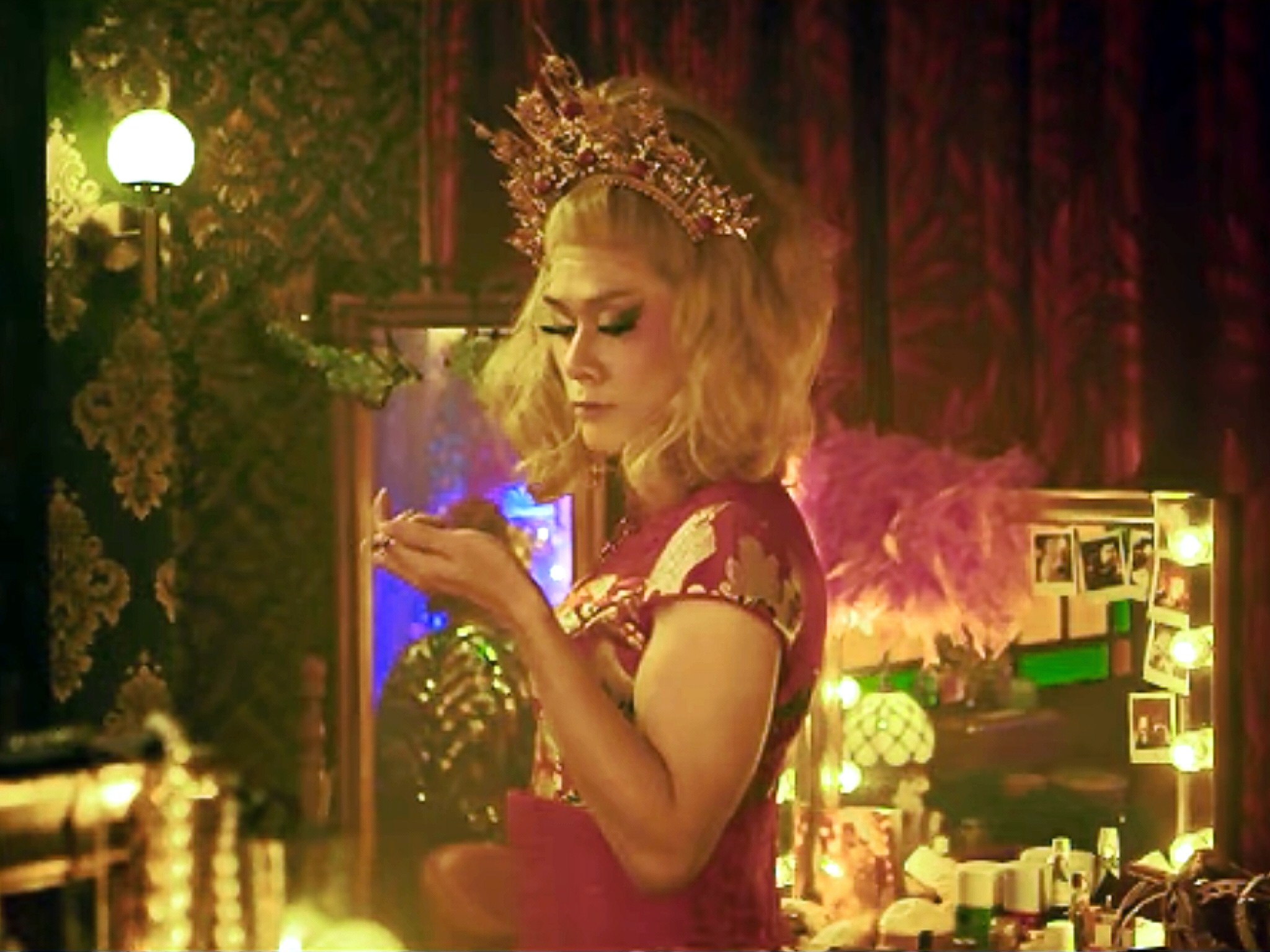
Jia Hao in his dressing room
A Good Child gestures toward emotional gravitas and social relevance, but it doesn’t carry the structural or thematic density of more gripping Taiwanese films it tries to emulate. It’s self-evident that they tried to make a movie that would sell in Taiwan (including the use of Hokkien or 台语 [taiyu]), but in a country that produces small gems such as 2020’s 亲爱的访客 (qin ai de fangke) or Dear Tenant, A Good Child feels like a warm-up band for a main event. Dear Tenant was one of our favourite Chinese-language films of that year. It won three awards at the Golden Horse Awards, one of which was the best actor for the lead Mo Tzu-yi (莫子仪), whose portrayal of the ‘tenant’ caught in an unusual domestic arrangement was both natural and nuanced. A far cry from one particularly good child.
Steeped in Taiwan New Cinema’s legacy of realism, restraint, and moral ambiguity, Dear Tenant was the directorial framing that A Good Child lacked. Ong Kuo Sin seems, to us, more interested in emotional shorthand than in building psychological depth. Richie Koh’s Jia Hao is telegraphed early and never truly evolves. The drag persona becomes a narrative device, not a lived tension. And the mother’s dementia, while poignant, is used more as a plot enabler than a space for familial and ethical complexities. In Dear Tenant, the protagonist’s queerness is never reduced to performance—it’s embedded in his grief, his caregiving, his legal vulnerability. That’s structural weight. The Good Child dramatically postures toward that, but, regrettably, doesn’t carry it, even in full make-up.
A Good Child is in cinemas near you now. Film stills: A Good Son/Clover Film
 Style on the Dot