When influencer Bryanboy recreated a legendary fashion photograph, he thought he was making a clever reference. It was a tribute that forgot to pay its dues
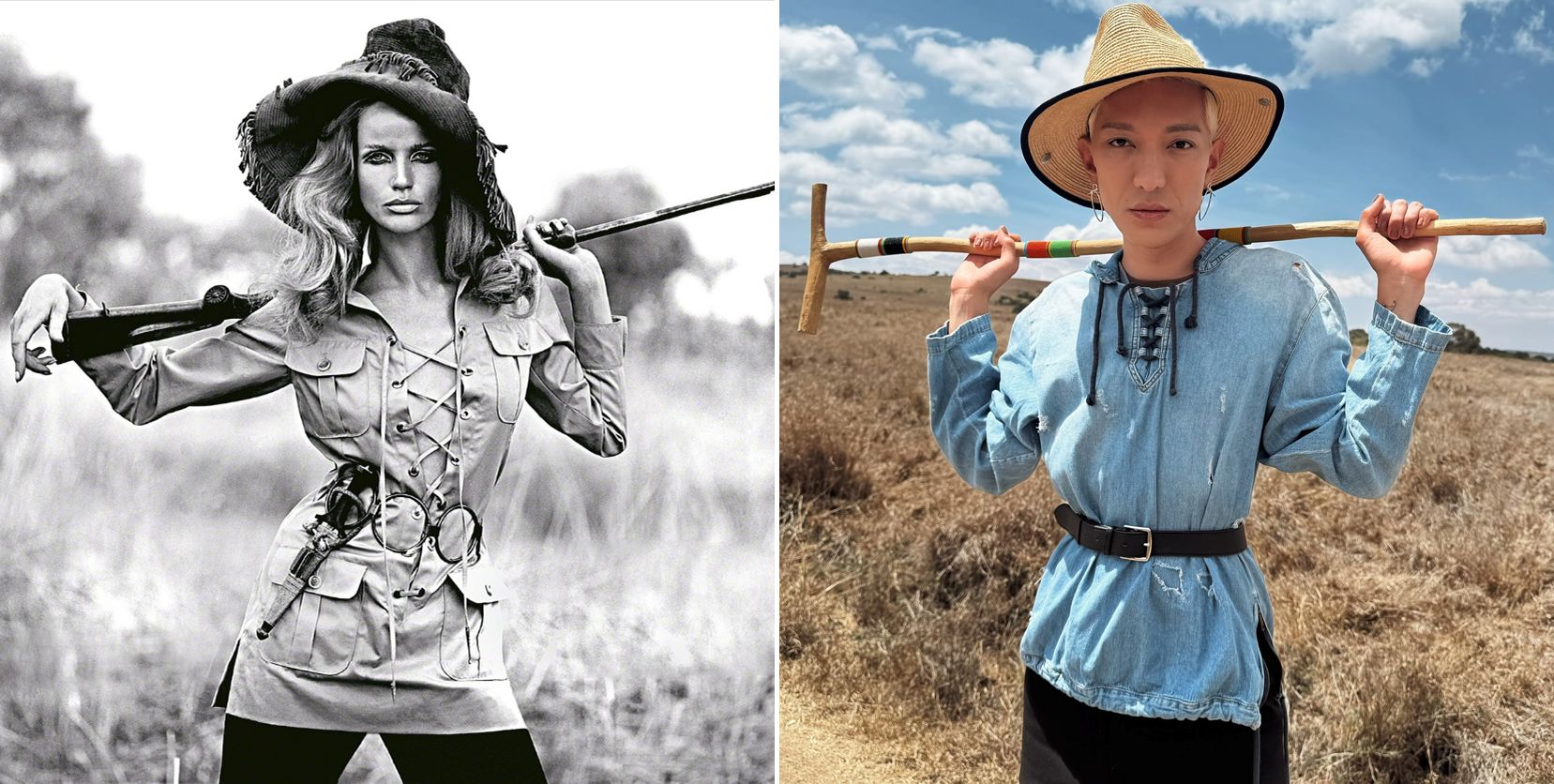
Safari chic versus nayon glamour. Left, Veruschka in Yves Saint Laurent and, right, Bryanboy in Saint Laurent, Photos: Franco Rubartelli/French Vogue and Bryanboy/Facebook respectively
One one side, you have what is considered a significant piece of fashion photography history. On the other, a scrappy, low-budget tribute. Twelve hours ago, on both Facebook and Instagram, Bryan Grey Yambao—famously known as Bryanboy—shared photos of himself in Kenya, starring in his own (reverse) colonial reenactment. One of them was him striking a pose in what appeared to be an homage to Veruschka (aka Vera von Lehndorff), as seen in the July/August 1968 of French Vogue, then under the editorship of Francine Crescent, whose tenure was known for being “prescient, daring, and courageous”. She helped establish French Vogue as a global leader in fashion photography. Fifty seven years ago, the German model worked the camera in a manner thought to be sexy, a hunter-performer sizzle that was not difficult as she was standing in front of her lensman-boyfriend, Franco Rubartelli. By contrast, the pinoy blogger/influencer appeared to have emerged from a long day of field work. A present-day tribute that forgot to pay its dues.
Veruschka wore an Yves Saint Laurent outfit, with a top that was described as a “safari dress”, for the Vogue editorial. While a “safari jacket” was first seen at the spring/summer show of 1967, it would be the one-off design that the model wore, created specially for the magazine, that the safari look became famous and a classic. Mr Yambao, now an expert in ethology, wore Saint Laurent too, from an era minus the Yves: denim hoodie that appeared in Anthony Vaccarello’s spring/summer 2019 men’s runway show. In that presentation, the model wore the hoodie tucked into slim black jeans. To imitate Veruschka, he wore the shirt over his bottom (a pair of shorts) and belted. The effect was a study in restraint, as the shirt’s laced-up opening, in a shocking display of modesty, didn’t splay to the navel. The original shoot captured the late ’60s spirit of travel, adventure, and a more natural, yet still glamorous, aesthetic. Mr Yambao, conversely, chose something far less adventurous: pastoral.
The effect was a study in restraint, as the shirt’s laced-up opening, in a shocking display of modesty, didn’t splay to the navel
The Vogue image, styled to evoke a safari, was shot in the landlocked Central African Republic. Veruschka appeared to be carrying a rifle and it was later reported that she did, in fact, pose with one. Whether it was loaded, it was not ascertained. Back then, the rifle, in the context of the fashion editorial, was a prop to reinforce the persona of an adventurous, self-reliant woman in the land of predators, drawing on a romanticized view of exploration and evoking a sense of rugged glamour. Today, however, toting a firearm paints a wildly different picture. What was once a symbol of “adventure” is now perceived as promoting violence, as well as championing trophy hunting, a controversial and harmful activity. This may explain why Mr Yambao chose what seemed like a fimbo or walking stick. Given the agrarian setting, it could have passed for a carrying pole, which is still widely used in his homeland. He did hold it up like one, a calculated reframing that sidestepped the original photo’s problematic symbol.
Curiously, Bryan Grey Yambo used a hand prop that was as authentic as a taxidermied smile. When realness is increasingly valued in a highly digital world, his entire persona is performative vapidity—a crafted veneer designed to be all sizzle and no steak. The tribute to an iconic fashion photograph ostensibly dodged its historical baggage, only to replace it with a new hollow symbol, borrowed from another culture. It was a testament to the disconcerting truth of the social media era: that authenticity is not an inherent quality, but a brand to be built, a character to be played, a look to be affected. It is likely his audience would not know who he was referencing (as he did not credit his source of inspiration), but they did get a spectacle of a tribute, a scowl of a selfie, and an influencer who is a method actor of his own life. Putting himself against a seeming nayon (rural village) is not dialing back the manufactured image; it is simply a fresh stage for the performance. And that, perhaps, is the most authentic thing about Bryanboy.
 Style on the Dot