The retired designer Andrew Gn appeared in the first episode of Mediacorp’s newest season of the Mandarin docu-series about Singaporeans who have made it—and living it up—abroad
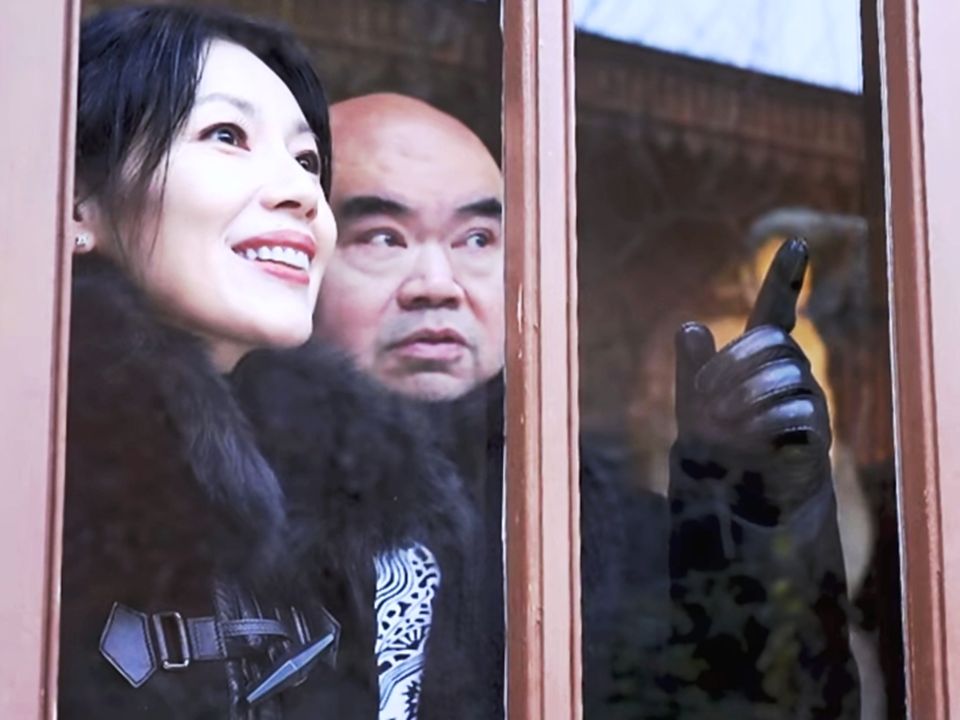
Sharon Au and Andrew Gn in Find Me A Singaporean
Despite his fame and the oft-used “highly-celebrated” description and despite different versions of himself (including the abbreviation AGN), Andrew Gn Chiang Tiew (鄞昌涛, Yin Changtao) has been largely a rather private fashion designer. This is so, even after his headlining retrospective at the Asian Civilisation Museum in 2023. But now retired, he is opening up… a little, if not his soul, then definitely his Paris apartment and his stew pot. In the first episode of the latest season of 稀游记 (xiyouji), or Find Me A Singaporean in English, host Sharon Au (欧菁仙, Ou JingXian) interviews the ebullient designer whom she considers a “好朋友 (haopengyou), good friend”. The artiste, still tenaciously linked to Mediacorp although she has left the broadcaster in 2018 and has been residing in Paris for the past seven years, introduces Mr Gn as a vague “时装界的灵魂人物” or key figure of the fashion world. Friends, presumably, put in the least amount of effort.
Although the episode of the season—subtitled ‘世界我的舞台 (shijie wode wutai)’ or The World’s My Stage—is about 45 minutes long, it does not satisfactorily explain why Mr Gn is lauded by Ms Au the way she does, other than that his clothes were worn by royals, socialite, and celebrities. She does not get to the heart of what defines a “key figure”, opting to say that Mr Gn “made a name for himself with his distinctive style not just in Paris, but worldwide”. She describes that style as a “blend of European regal opulence with the intricate craftsmanship of Asia”, using buzzwords without unpacking them. When she finally arrives at the Andrew Gn atelier/showroom in the historic Marais district of the French capital, she gleefully yelped to the owner: “这是我快乐的泉源 or this is the springhead of my happiness.” It shows that she is usable to distance herself from her 成人杂志 (chengren zazhi) or City Beat days. Ms Au does not hide how enamoured she is with the designer, his designs, his taste, his home, his chums, everything he impresses her with. She is constantly charmed, amused, bewitched, delighted, enthralled, impressed.
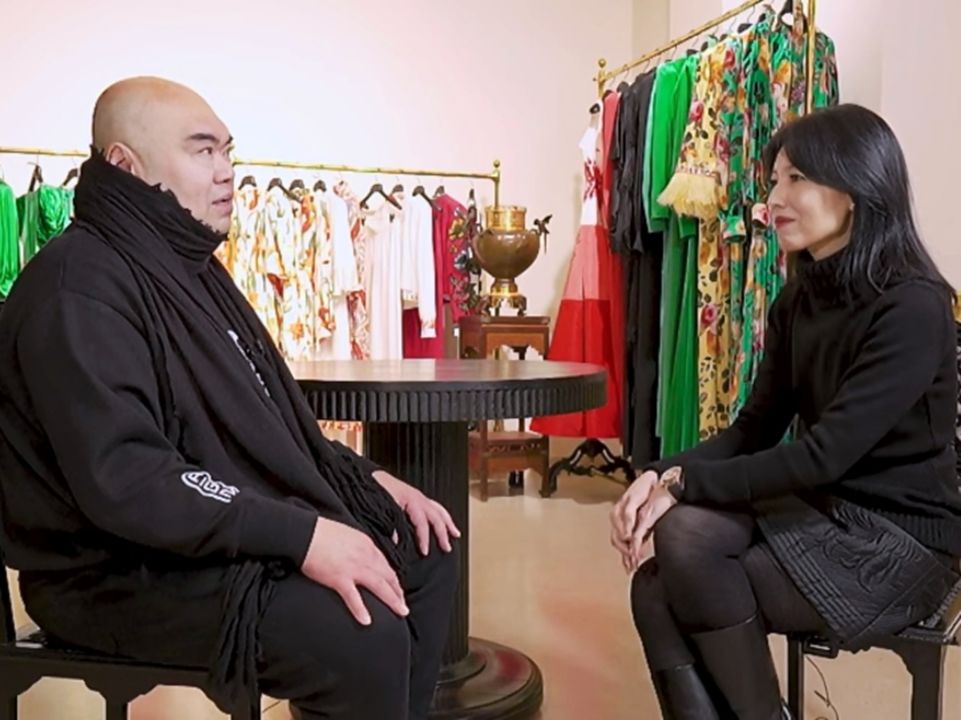
Andrew Gn and Sharon Au chatting in the former’s showroom
稀游记 (xiyouji), a clever pun on 西游记, the Chinese literary classic, Journey to the West; only now, it means ‘unique travel tales’, debuted in 2006. It is, at its core, a celebratory, human-interest docu-series that serves to connect Singaporeans with compatriots around the world. The show provides a platform for showcasing national talent and global success, but without typically delving into the complex or critical aspects of an individual’s life or work, artistic or not. Clearly aiming for a broader audience, it prefers a lightweight spin that tends to focus more on the narrative of success and national pride, rather than a deep analysis of the subjects’ profession or what truly led them to remain in their adopted city. The participants often state their pride in staying close to their roots, as if saying it for the folks back home. This feeling of performative declaration is evident in Mr Gn’s almost-too-neatly-packaged summary: “Being Singaporean is just a state of mind. It’s my roots.”
In a mix of Mandarin and curious English (“this dress never run out style”), Ms Au tries to establish how close she is to Mr Gn. She regales with the frequently repeated story of how she came to know the Singaporean designer. It was at a National Day celebration in her first year in Paris. As she recounts, she had eyed the last bowl of laksa of the evening, so did Mr Gn, and both 争着 (zhengzhe), fought over that spicy noodle dish. In the end, “I gave him the laksa,” she said, to “敬老尊贤 (jinglao zunxian)” or respect the elderly and honour the virtuous. In the show, she gets to meet the designer’s inner circle. “You have to introduce me to your fabulous friends”, she demands. They include two media folks and a head hunter, Singapore’s ambassador to France, and a trio of Singaporeans working in the city. Curiously, there are no fellow fashion designers or loyal staffers in the picture. Or, French customers, a fact that may be explained by one commentator familiar with his work who notes that his clients are “mostly Americans, Middle Easterners, and the mainland Chinese.” Absent too is Mr Gn’s long-time partner Erick Hörlin du Houx, seen as crucial to his success: Perhaps to better fuel the narrative of Mr Gn as a singular, self-made name.
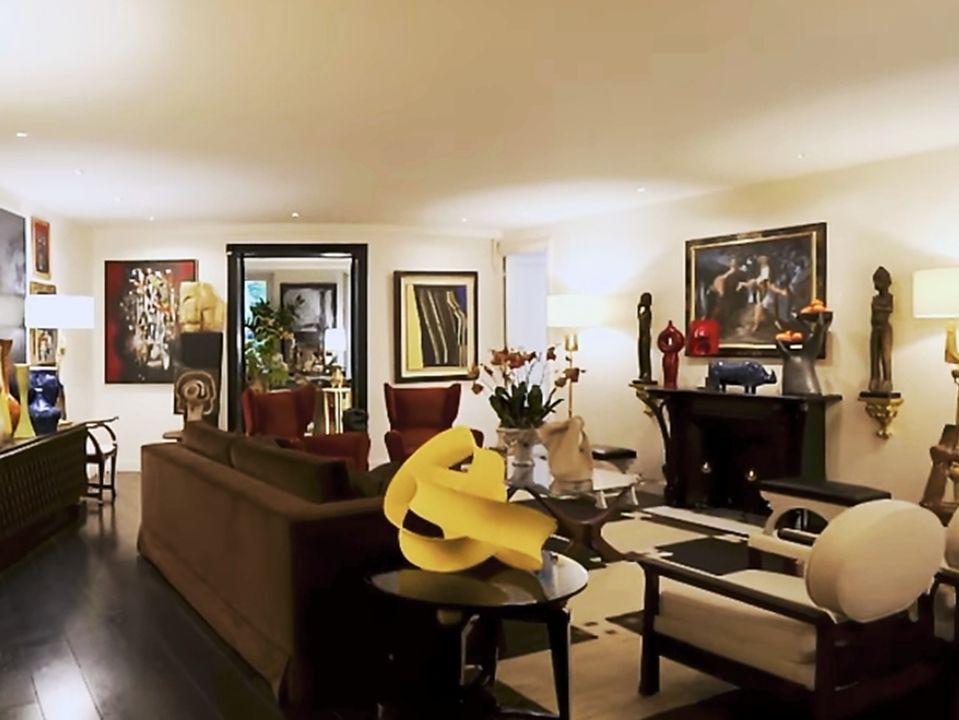
A peek into Mr Gn’s APris apartment
For the first half of the show, Ms Au speaks of her interviewee as a practicing designer although he “bid au revoir” since the end of 2023. It is not until past the half-way mark that she informs that he has retired, but she does not ask him how he occupies his time today. She reveals that he cooks, but without establishing how often, suggesting a detail presented for charm rather than information. When she visits his apartment, she does not say where in Paris Mr Gn lives, or in which neighbourhood. Inside, a strong European influence is discernible, which seems to stand in contrast to the show’s goal of celebrating his Singaporean roots. The camera uncovers a considerable collection of art and objet d’art that prompt the visitor to remark: “Your home is like a mini-museum.” Just as his atelier is her “springhead” of happiness, his abode is where she “feels so at peace” and “forgets all the mundane stresses of my life”. The show should have been titled, Find Me A Salubrious Friend.
It is easy to come away gaining almost nothing new about Mr Gn. One viewer said to us, “I didn’t learn anything. It was just her gushing and his bragging.” Perhaps that is unsurprising for a show that prioritises aspirational storytelling over a deep dive into creative processes or intense back stories. There are snippets of the unknown. Mr Gn reveals, for example, that as a child, his mother called him 和和 (hehe), as in 和和气气 (polite and amiable), which is an enlightening contrast to some calling him “boisterous”. Yet, for those interested in the nuances of the fashion business and how one Singaporean, who declares that “it’s easy to be king in a little village. I want to go to the big city”, makes it, this episode of 稀游记 is heavy as lint. Rather than build a “throne” that is “fit for a queen”, it would be simpler for the show to just say that Andrew Gn’s significance lies not in being a trendsetter, but in his input to luxury fashion as a cultural storyteller, and a pioneering international presence for his home country.
Screen shots: mediacorpentertainment/YouTube
 Style on the Dot