The five-decade old Female magazine is no more. In its place is a F ZINE

The first issue of the new F Zine
Fifty years is a ripe old age for a magazine—and perhaps too ripe. That must be why one of Singapore’s oldest publications had to be put out to pasture, only to be reincarnated as something younger, cooler, and profoundly eager to please. Female magazine, debuted in 1974, is no more. In the place of the veritable auntie comes a completely new, gender-neutral title, with a provocative name: F ZINE. Once, Female may have been the girlfriend to have, but she’s been summarily taken care of. The new publication, in its frantic quest for relevance, wants to be the next-gen BFF—an acronym that has twice the number of Fs of its title to double the fun. But, according to publisher Singapore Press Holdings (SPH) in a media statement, the evocative ‘F’ is really about “what matters to the Future”.
But ‘future’ is a rather anemic word. It speaks of the unpredictable, the unexpected, the unknown—hardly assuring stuff. It is uncertain, too, that when the new magazine’s target audience sees ‘F’, they would think of the sequel to today, tomorrow, or the week after, let alone a distant horizon. We ran a random (and admittedly unscientific) poll among ten Gen-Zers and asked what first came to mind when they saw the letter ‘F’. One said “nothing”, another said “don’t know”, three simply giggled, and five burst out with a gleeful “fuck” (one even asked what kind of perverted question that was). The reality is, ‘F’ is a strongly suggestive letter. SPH was, in all likelihood, fully aware of this. They didn’t choose or agree to it by accident, or because it’s a discreet letter preferred by library gnomes.
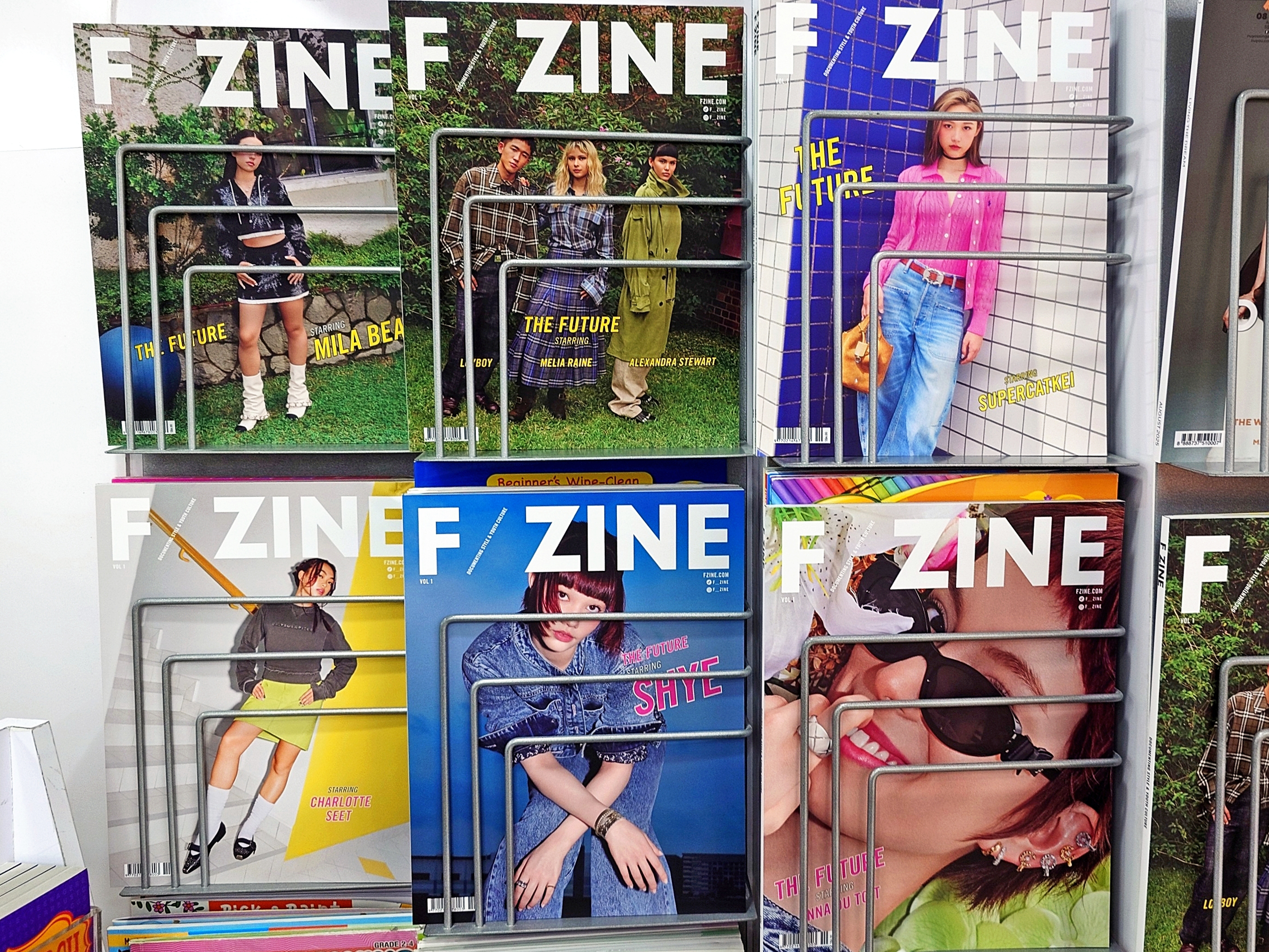
Six of the nine covers of the launch issue
We could sense the satisfaction those five had when they uttered “fuck”. It wasn’t just about the word’s singular meaning, which its ubiquitous use has long since negated. Rather, it was the raw, physiological sensation of pushing that fantastic ‘F’ sound out—a feeling that resonated in the chest, gladdened the heart, and brightened the eyes. But beyond the physiological, there was an emotional and cognitive release at play, even the interactional. F ZINE clearly knows that the eff sound can be uttered with no restraint and, possibly, with pure joy. (On the last page of the print magazine, staffers chose their fave F-words and none of them angers or thrills.) The title allows its fans (too early to tell if they have any, but we’re optimistic) to feel a sense of ownership, unbounded by propriety. In a word, ‘F’ is freeing.
The history of the letter ‘F’—Gen-Zers will appreciate—is a masterclass in finding one’s true calling. It began its fab life in Phoenician as a simple hook called waw, making a ‘w’ sound. The Greeks got a hold of it and, in a rebrand SPH would understand, called it digamma and kept the ‘w’ sound, but uttered with a certain flair, not unlike how Gen-Zers might now. Then the Etruscans, in a classic use-what-you-have moment, realized they didn’t need a ‘w’ sound and, with a TikTok-worthy shrug, declared it the letter ‘f’. The Romans, ever the pragmatists, saw the new sound and ran with it, giving us the steadfast F we know today—a letter that finally found its purpose after a very long and confusing identity crisis. Gen-Zers would appreciate that, too.
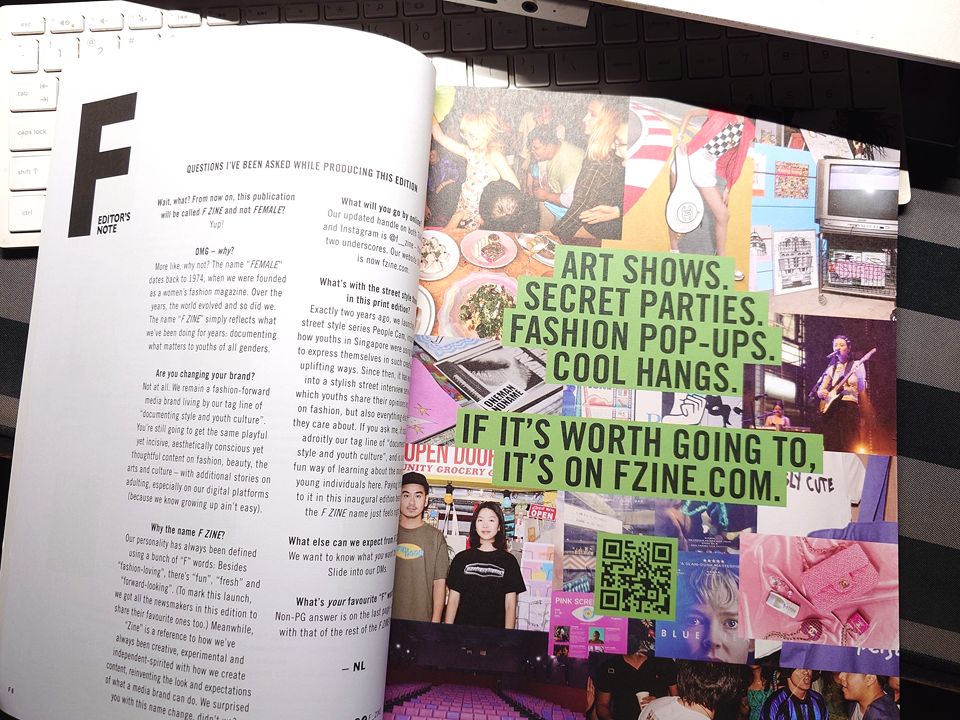
The editor’s page, now known as “F Editor’s Note”, is written and laid out to appeal to a very young reader
The magazine’s masthead is, however, less of a dramatic departure. Working with one letter less than the old Female, they have kept the bold sans-serif font, allowing the initial F and last E to remain in their former spots to serve as reminder of the past, like exposed bricks of an original wall. Rather than a backward slash between F and ZINE in the masthead, they have employed a diagonal bottom-to-top text that reads “DOCUMENTING STYLE & YOUTH CULTURE” (in Donald Trump-approved full caps). The zine spirit remains unchanged: vaguely DIY, created by true passion than big budgets. As in the remade Female of its last years, F Zine continues to sport a raw and deliberately imperfect aesthetic. Even the use of an ampersand in its masthead goes against the grain. All in, clearly to suggest the much-valued authenticity so craved today.
The use of “documenting” in the title is telling. Traditional magazines ‘report’ on trends—they tell you what to wear, what to buy, and how to be. The word ‘documenting’, however, changes that relationship. It positions F ZINE not as a fashion authority, but as an observer. Whether an accurate one is irrelevant. Its editor-in-chief Noelle Loh wrote in the “F Editor’s Note” (now designed to look like a random memo, with text that neither aligns with the left margin, nor is flushed right): they would go on “documenting what matters to youths of all gender.” This shifts the focus from telling readers what to do to showing them what’s happening. One of its own ads facing the “F Editor‘s Note” announced: “If it’s worth going to, it’s on fzine.com.” Truly gone is the commercial women’s magazine. F ZINE is now a cultural platform for all genders: It tries to sound more credible and look more relevant to a youth audience that no doubt values social commentary above all else.
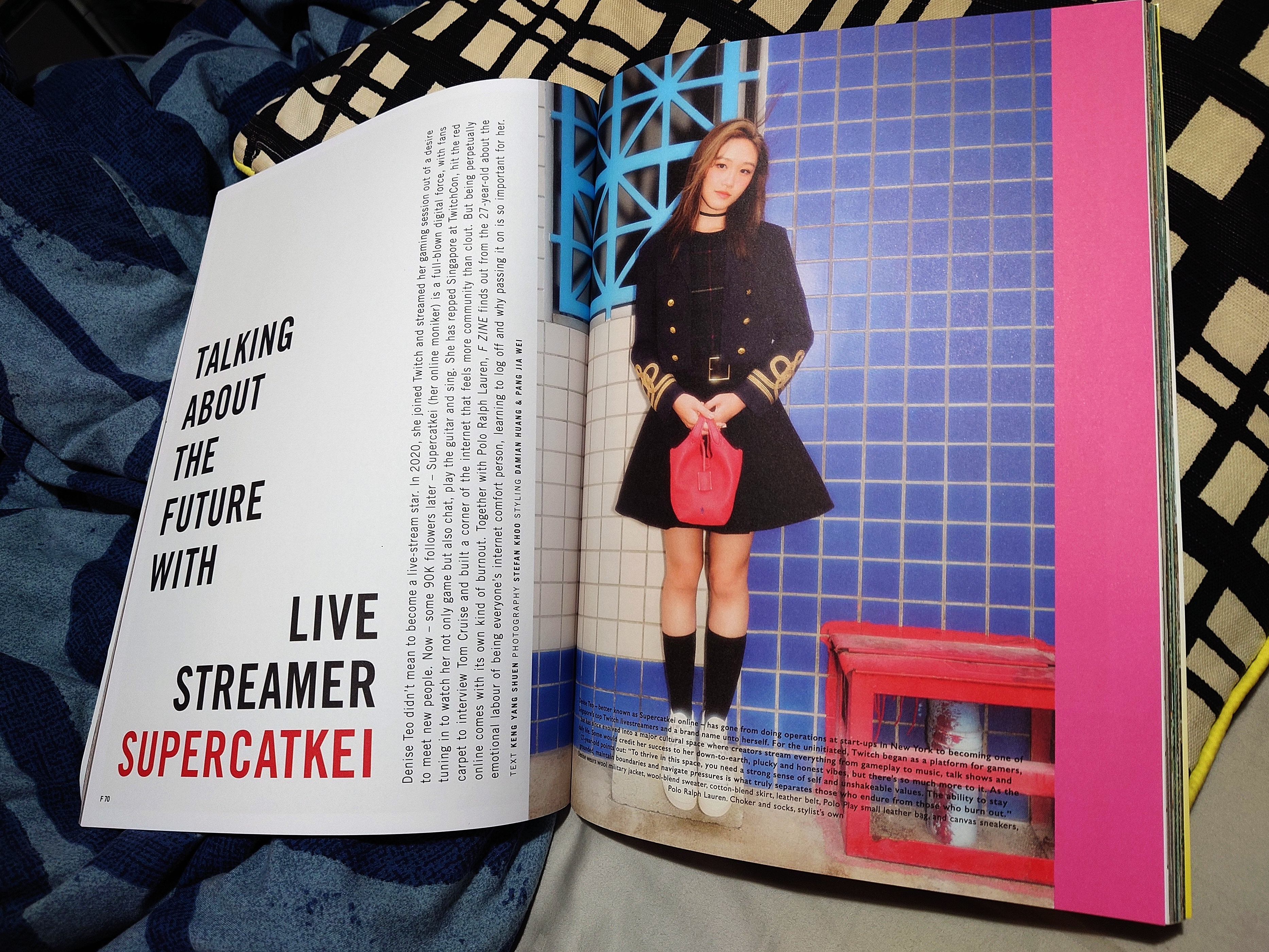
The fashion pages are mostly people/talent pages
Female magazine was launched in the same year as Temasek Holdings, in 1974, by the now-closed MPH Publications, part of the Jack Chia-MPH group at the time. While SPH’s Her World, founded in 1960, was the reigning women’s magazine at the time, Female would ascend to a very respectable No. 2, and largely remained there. In 2004, it was acquired by SPH—a significant event in the magazine’s then 30-year history, as it was now part of the stable that included its once fierce competitor. After the acquisition, Female underwent an extensive makeover (it became edgier and younger) to align with SPH’s portfolio of magazines for women. Now rebranded as F ZINE, it remains an SPH title, a loyal soldier in a corporate war for eyeballs it once fought from the outside, sometimes amid discouraging market conditions.
This reinvention of a 50-year-old brand wasn’t born from a sudden creative whim. As Noelle Loh, the editor-in-chief who continues to helm the new publication, wrote: the name “simply reflects what we have been doing for years”, which essentially was repositioning themselves to not compete for the Her World reader. In fact, Female’s last years were a foretaste of the current form of the title: targeted at the young. It has been and still is an act of self-preservation in a media business that has become a desolate graveyard for traditional publications. In an era where attention spans are measured in seconds and cultural currency is dictated by social-media algorithm, it is inevitable that F ZINE is a textual/visual form of TikTok, where Female had formerly gained considerable notice or, according to SPH, “11.2million likes to prove it”. In this feral media jungle, the very name Female simply had no place to shine. The determination to survive became F ZINE—a defiant F(U) to oblivion.
Photos: Chin Boh Kay

