Luxury brands are increasingly opening cafés, restaurants, and other food and beverage venues as a strategic move to enhance their brand image and connect with consumers on a “deeper level”. Really

The highly-Instagrammable façade of the Louis Vuitton cafe in Bangkok. Photo: Jakrit Suwanmethanon
If you are going to Bangkok this weekend, and hope to visit the wildly popular Louis Vuitton Le Café at the Gaysorn Amarin Building, you may wish to reconsider. Reservation is required even if you plan to have only coffee. And if you try to book a spot any time during your sojourn, you can’t. On the reservation page, managed by the New York-based reservation service Seven Rooms, you’d be told that “bookings for dine-in are to be made two months in advance”. We kid you not. Surely tourists could get a table without reservations? The staffers at the door will take your name and contact number, and add them to a long waiting list. They will tell you that when there is a cancellation, the table will go to those in this line. How long would the wait be? “Don’t know. Depend on how many cancel (sic).” Will we be notified if we do not stand a chance? “If don’t call you, you no chance (sic).” May we take a photo of the cafe? “No, you must buy at least one drink.” We won’t go in. “No.”
Diagonally across the street, a kilometre or so away on Phloen Chit Road, is the Dior “Gold House”. It is a beautifully manicured space that sits on what was the Morakot parking lot that normally served the customers of Central Chidlom department store, who prefer not to use the multi-storey carpark in the building. Although it appeared to be part of Bangkok’t oldest department store still standing, it belonged to the Sukusol family who had, for many years, refused to sell the property to the Chirathivat family who owns Central and the adjacent land on which the store occupies. The Chirathivats finally aquired the land last year for what the Thai media described as a “record-breaking” deal of 16 million baht (or about S$629,215) per square metre. Before they expand their flagship Central store, the space was leased to Dior, which built on it a pop-up, stage set-looking Gold House, with a Café Dior inside. And, similar to the LV’s rahn kah-fair, you cannot just walk in and hope to have your caffeine fix.

The entrance to the Dior café at the Dior Gold House, Bangkok. Photo: Jakrit Suwanmethanon
Luxury fashion brands are opening cafés and restaurants, not only in Bangkok, but elsewhere in Southeast Asia as part of a strategic shift towards “experiential retail and lifestyle integration”, those in the know have told us. It is not clear what “experiential retail” now really means, but if coffee is key, many brands already offer beverages (hot and cold) to customers at their stores (or, in the case of LV, able to turn one of their retail spaces into a kafe kucing or cat café in Kuala Lumpur). Payment for those beverages is not required if purchases are made. By “lifestyle integration”, we assume it to be brands taking into consideration the love and compulsion of customers (as well as those who are not) for sharing their luxurious lives on social media. All the brand-name cafés are meticulously conceived and lit to be amenable to the smartphone camera and to leverage social media, so as to extend the brand’s reach.
To access Café Dior inside the Dior Gold House in Bangkok, you would need to got through the door guards, who will determine that you have a reservation. Without one, they would turn you away. If you ask to see the store (which is essentially what the Gold House houses), you will be told to wait. An English-speaking sales-staff would then be assigned to you, if one is available. The person will guide you through the smallish retail space, devided into the women’s and men’s zones. With the brand now in transition (creative director Maria Grazia Chiuri has stepped down), there is a good chance you would not buy anything until the collections by Jonathan Anderson emerge. Surprisingly, the staffer-guide understands. You say you are there to have coffee and immediately a tablet is whipped out. And you are told that there is a slot at 2pm (two hours away) and a reservation could be made right away. If you wish to take a selfie, only the entrace is an allowable backdrop.

Prada Caffe at ION Orchard in Singapore. Photo: Chin Boh Kay
Brand emersion aside, there is something else at play here. When we spoke to a café operator to ask if the business of selling coffee and cake is so profitable that high-end brands like Louis Vuitton want in on it, he told us with a perplexed face: “without scale, it’s a tough business. The operating expense of a café is very high. These cafés are probably not making money—or little—out of the excerise.” Essentially, these luxury brand cafes, not a primary business, are deliberately-designed selfie stages, on which consumers create content, effectively turning every gleeful visit into a mini-marketing campaign for the labels. (We learned that there is a dining limit at Le Cafe—90 minutes, which seemed to say, take your photos and leave.) This strategy capitalises on the pervasive nature of smartphone photography and social media sharing, allowing luxury brands to “connect” with a broader, digitally-native audience in a “highly aspirational”—as it is often described— and accessible way.
We can’t help but sense that there is something exploitative about about the strategy, and inevitably ponder on the ethical dimensions of modern marketing and consumer behavior in the context of the F&B extensions of these luxury brands. Unlike paid influencers, café-goers can be seen as being used when they create free visual content for the likes of LV. These images and reels are directly linked by way of hashtags to the brand, increasing its visibility and searchability. Just search Louis Vuiton Le Café on both TikTok and Instagram and you will clearly see what we mean. This is a deliberate strategy by luxury brands. They invest in creating visually appealing spaces because they know consumers will photograph the “attraction” and share them. In this sense, consumers are part of the brand’s marketing machine, whether they know it or not.
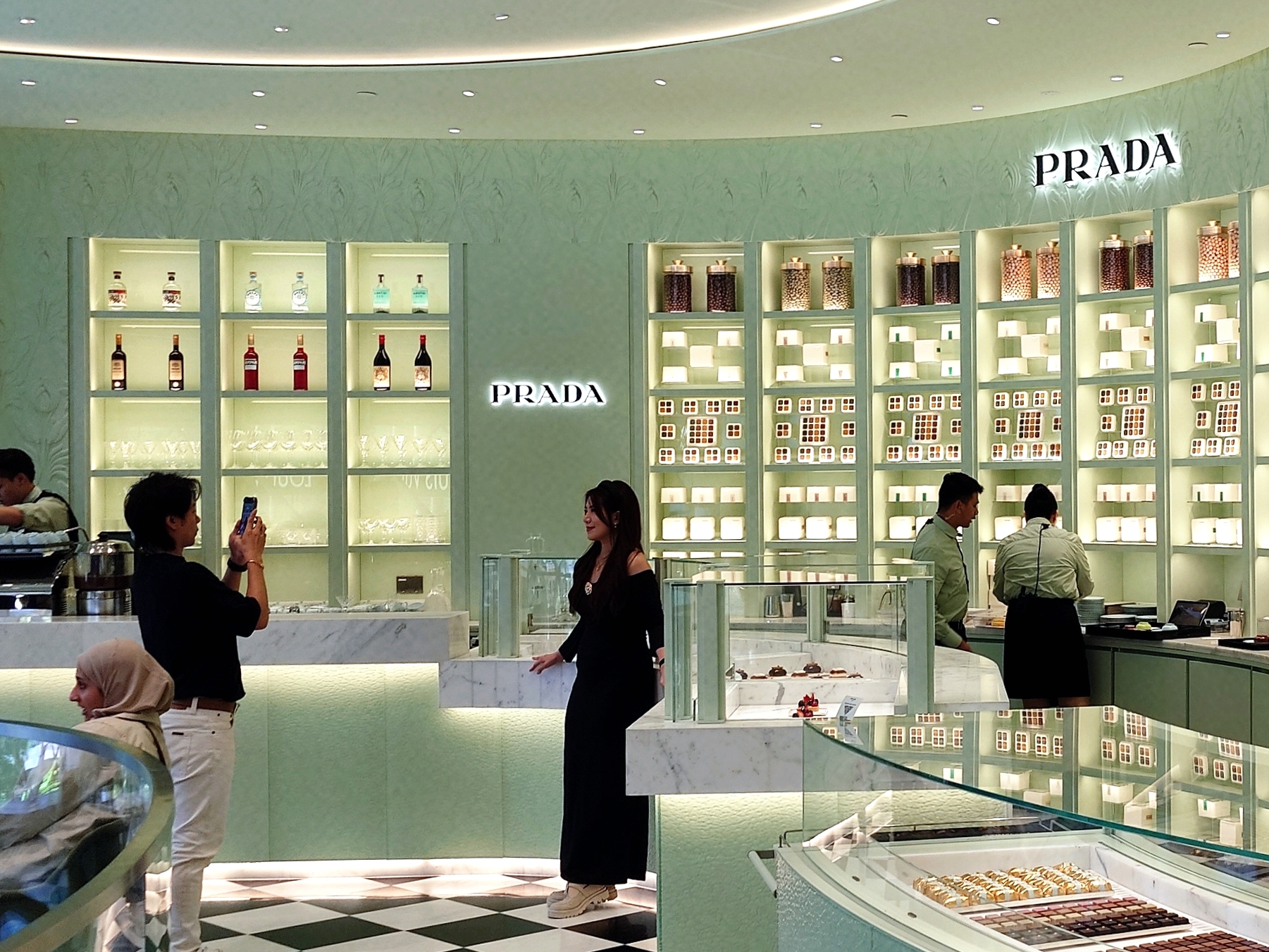
The inevitable selfie-session, as seen here at Prada Caffè. Photo: Chin Boh Kay
Singapore opened its first Prada Caffè in January this year at its ION Orchard store, refurbished to accommodate the coffee house. It is a swanky space and very much in keeping with the Prada aesthetics, as well as their unmistakable brand colour. In fact, among the many fully-functioning luxury brand cafés, the Prada Caffè is very much akin to their brand positioning and look. And they are not a pop-up business, unlike LV’s Le Café and Café Dior in Bangkok, both, their respective staffers say, are expected to stay open for “two years”. When we visited Prada Caffè one weekday afternoon (without reservation), we were told they were full. But the counter staff offered to check when a table would be next available. He came back and said that one could be had at 5pm. We did not take up his offer. When we asked if we could take photos of the space, he gave us a hearty “sure”.
The Prada Caffè is probably one of the most photographed on our Island by now, probably due to their far less fastidious approach to none-customers photographing their premises. Café-goers pay to be in these enhanced environments and to enjoy the experience, other than the food . Yet, they are used as user-generated marketing materials without compensation, while the products are paid for. The brands benefit significantly from this free labor and exposure. Sure, consumers choose to visit these cafes and to share content. No one is forcing them to. And they get to benefit from the social currency of sharing. The design intent of these cafés is often quite transparent, too: Consumers understand that these places are built to be photographed. Yet, it can be said that there is subtle exploitation. While it is not coercive and can be seen as a symbiotic relationship, it involves an unequal exchange of value, where the brand gains significantly more than the consumer.

Maison Margiela House of Memories cafe on Beach Road, Singapore. Photo: Zhao Xiangji
Joining the cafe rush recently was Maison Margiela’s House of Memories. Opened last month for two weeks on Beach Road, not far from Haji Lane, it was set up primarily to tout its Replica fragrance line. The café essentially catered to the “take-away customer”, a staffer told us, which meant that no reservation was required to enjoy a cup of coffee, ably provided by Equate Coffee, whose two co-founders were on hand daily to make the brews. One of them, Ryan Pang, said that the business was “unexpectedly good”. The company had presented a pitch to Maison Margiela, “like everyone else”, and “they felt that what we proposed was in line with their brand image.” That is essentially an all-white space with only two tables (with two chairs) and an against-wall bar seating with three chairs.
We asked if we could sit and was told to go ahead. On the table were a tester-bottle of the fragrance ‘Afternoon Delight’. There was also an amoeba-shaped, Maison-Margiela-branded plate, on which were three madeleines (one customer was heard describing it as “French kueh bahulu”). Earlier, we had ordered the madeleines, but was told food was not available. Seated with our coffee, we asked a staffer what the fake pastry was for. And she said, pointing to everything around us: “All these are for taking photos.” During the 20 minutes or so we were there, no one took out their smartphones to snap anything although there was a steady stream of customers. Perhaps, the all-white space, which could pass of as a repurposed laundry room, was not photogenic enough when compared to the more captivating, even glamorous, Le Café.

The fake food on the table at the House of Memories café. Photo: Zhao Xiangji
That these cafés had to be propped is indicative of the photo-backdrop nature of their coffee business. The selfie-ops allow a broader audience to buy into the brand’s hyped prestige and status without the high price tag of a fashion item (or, in the case of Maison Margiela, a bottle of perfume). They are not merely coffee shops in the traditional sense, where the quality of the coffee or the cake (even fake) is the main focus. Instead, their existence is driven primarily by their function as a platform of the visually engaging, which may account for how often diners are so engrossed in the photo-taking that they barely touch their food or are willing to let hot coffee go cold. The true product being consumed in these luxury brand cafes, as we have seen, is not the culinary offering itself, but the social capital derived from the experience
Ultimately, what something looks like often overrides what it tastes like. The aesthetic appeal becomes the primary driver for engagement and sharing. Crucial it is to capture the moment—the aspirational lifestyle and the connection to the luxury brand—rather than to savor the actual meal. Once the perfect shot is secured, sometimes requiring more than the time it takes to down a cup of coffee, the desire to engage with the food diminishes. Inevitably, the analog, real-world experience takes a back seat to the digital. Personal consumption is intertwined with public performance. While voluntariness is key to the consumer experience in these cafés, it doesn’t automatically negate the possibility of exploitation when there’s a power imbalance, information asymmetry, and an unfair advantage being taken. But this is, unfortunately, the somewhat unsettling aspect of the experience economy and the pervasive influence of social media. For luxury brands, it is a remarkably effective way to generate buzz and reach a vast audience. For consumers, it offers an accessible way to participate in and display an aspirational lifestyle. Never mind if they have to sacrifice the pleasure of a cup of hot coffee.
 Style on the Dot