Out they came, the peacocks with pride and panache
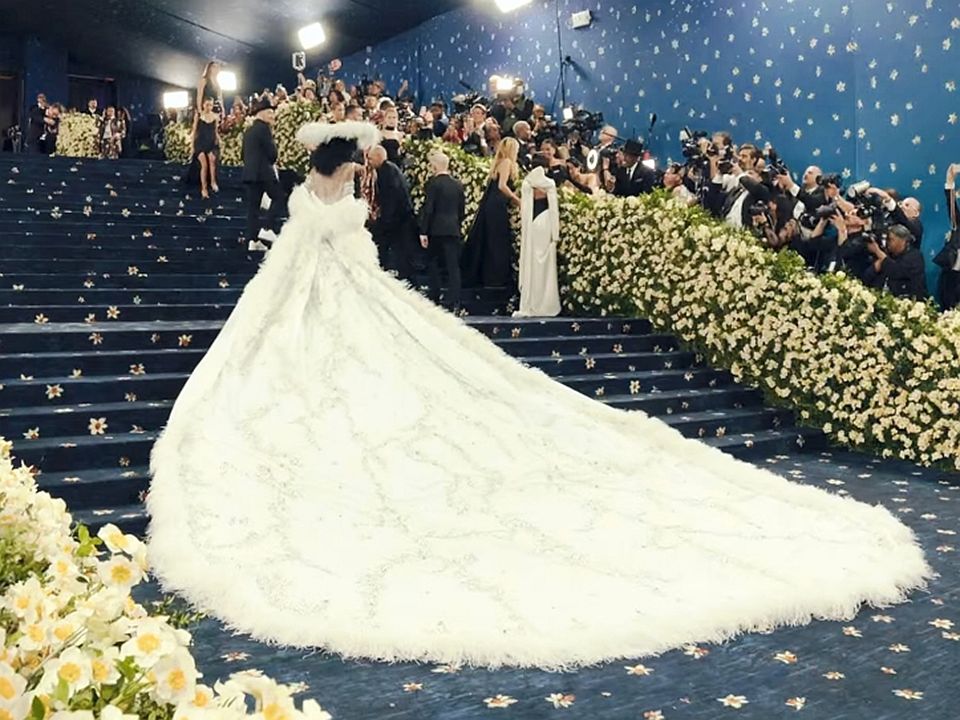
Diana Ross wearing a stole with a train wide and long enough to rival Rihanna’s in 2015. Screen shot: vogue/YouTube
This year’s Met Gala dress code ‘Tailored for You’ is phrased to provide flexibility in interpreting the title of the exhibition the event opened—Superfine: Tailoring Black Style. From the moment that theme was announced in October last year, we knew it was going to be hard to speak about the latest red carpet parade. When race is central to the exhibition and the display’s aesthetic exploration, critical evaluation can feel fraught. This is compounded by the current political landscape in America, marked by heightened awareness of social justice issues and ongoing debates about representation. They add another layer of sensitivity—this is not sheer as tulle, but laden as damask. Any critique could be easily interpreted through a political lens, potentially overshadowing the nuances of the fashion itself.
When chair Anna Wintour, dressed by Louis Vuitton in Pharrell Williams’s “tribute to Virgil (Abloh)”, spoke to the host of the red carpet livestream, Lala Anthony, she said, “At this moment of our political history, I think it’s incredibly important to stand next to the Black community.” By explicitly linking the exhibition to a very precise juncture of America’s political history and emphasizing the importance of standing with Black people, Anna Wintour is undeniably injecting a political dimension into the interpretation of Black style. “I’ve been very, very inspired by seeing how much it means to the Black community,” she said. “And I think it’s full of creativity and it’s putting a spotlight on amazing Black talent. I think it’s about self-respect and joy and confidence and liberation.”

Anna Wintour, Coleman Domingo, and Lewis Hamilton. Photo: Getty Images
Superfine: Tailoring Black Style, therefore, acknowledges current social and political dynamics on which the exhibition is set against. Moreover, by connecting the exhibition to the political moment, Ms Wintour elevated its significance beyond aesthetics. It is hard not to read that she wanted to amplify Black voices and celebrate Black culture, especially when she was called out in 2020 for being slow to hire people of colour in her organisation, to which she sent out an email of apology. While fashion can have political underpinnings, Ms Wintour’s framing clearly brought a political lens to it, even to the red carpet. In a polarized and sensitive environment that is America now, there’s a real risk that explicitly injecting a political message into a fashion exhibition and its attendant opening night might stir up partisan views than invite the exploration of Black style, particularly those of Black dandies.
Watching the livestream very early this morning, it was hard to concentrate on the fashion when the potentially political bears down heavily. It struck us that while the Black male attendees were all in self-acknowledgement mode, they were not necessarily speaking of remarkable Black style other than the peacocks that many came as, further pointing to the belief that Black men tend to prefer a more aggressive form of dress. It is, of course, possible that the pressure of the red carpet environment, with its emphasis on immediate visual impact, might have encouraged a more overtly expressive form of style. Co-chair Coleman Domingo set the mood with his Valentino inverness cape (well, actually cloak since it was floor-length) that had a gospel choir vibe to it, and would not be out of place in the next chapter of Sister Act, if a flamboyant monsignor is needed.

Two other co-chairs, Pharrell Williams and A$AP Rocky. Honorary co-chair Lebron James did not attend. Photos: Getty Images
The other three co-chairs, Pharrell Williams (in Louis Vuitton) and A$AP Rocky (in his own design from his own label AWGE), played down the elaborately styled for looks that reminded the world that they are fathers who just happened to dress better than other dads. Subverting some of the expected extravagance of the Met Gala—that includes and Lewis Hamilton (in Grace Wales Bonner)—and, in doing so, stood out? Among those at the apex of this fashion pecking order that the Met Gala often reveals was Anna Wintour in Louis Vuitton, dreamed up by Mr Williams as homage to the late Virgil Abloh (the other ghost that kept appearing was Andre Leon Talley, ironically once believed to be shunned by his former boss, Ms Wintour). The ice blue coat and the silver dress underneath—a standard silhouette for the editor—paired to project the frosty powerhouse that she is widely reported to be.
Superfine: Tailoring Black Style is a thesis on Black dandyism and the first Met exhibition dedicated to menswear since 2003’s Men in Skirts. While some adopted dandyism to the extreme, there are those who prefer to keep it startlingly safe, in particularly among non-black attendees, who could possibly tried to escape the easy charge of cultural appropriation. The extreme embrace and the startlingly safe approach underscores the complex dynamics of confident engagement and cautious avoidance, all within the same space. Through the attendees, there is the suggestion that Black style today is itself a plethora of anything-goes as long as it eye-catching or performative. Damon Idris, for example, came in an F1 racing one-piece; he ripped it apart only to reveal a surprisingly bland, maroon Tommy Hilfiger suit.

Cynthia Erivo, like so many attendees, could not resist a dramatic long train. Photo: Getty Images

The women who tried to standout: (from left) Halle Berry, Doechii, and Rihanna. Photos: Getty Images
Conversely, the women did not approach dandyism as an opportunity to indulge in some role-playing. As in the past, there was a near-obsession with the train: the wider and the longer, the better. First to set the scene was Diana Ross. She came in with a sweeping stole that was five-and-a-half metres long, and embroidered with the names of her children and grandchildren. Conceived by the Nigerian designer Ugo Mozie, it took up so much real estate, it needed its own postcode. Others married to their trains included Shakira in a pink Prabal Gurung wreck and Cynthia Erivo in Givenchy froth, designed to show her rock-chick inclination. Sure, the trains—usually requiring up to six assistants to lift so that the wearer could walk—were bold statements that ensured the stars were noticed and photographed from multiple angles, but they also meant that other attendees were waiting, somewhat pathetically, in line for their turn to step out onto the red carpet.
While those trains deliver the wow factor and generate headlines, they also subtly underscored the inherent hierarchy and the orchestrated flow of the Met Gala red carpet. This year, late dramatic entrances of stars were noticeably absent. But still the spotlight found them. Rihanna, with visible baby bump (the other was Indian actress Kiara Advani), actually covered her tummy, but the Marc Jacobs outfit still drew attention to her pregnancy with the coat worn as a skirt and the lapel underscoring her stomach, with a bulk at the back that made her look expectant in front and the back. But Halle Berry was not opposed to showing some stomach and more southwards in her ‘slashed’ LaQuan Smith gown that was clearly not meant to be as modest as the mitter curtain at the car wash. And then there was the rapper Doechii, dressed as if a primary school truant, covered in Louis Vuitton’s Damier Azur canvas, making Megan Thee Stallion in Michael Kors the prom queen she usually is not. If Madonna somehow missed the mark. In Tom Ford, she looked like she auditioned for Godfather and didn’t get the part!

K-pop royalty in predominatly Black: (from left) Lisa, Jennie, and Rose
More Asian stars were invited this year, but most chose to avoid direct engagement with the dress code, possibly out of a fear of misinterpretation or causing offense. Liza, who would have been on theme if she wore the Markgong tuxedo-coat she picked for the Oscars in March, chose a black lace Louis Vuitton jacket and bodysuit (designed by Pharrell Williams) that was more for stage than the red carpet. But we thought she was quite clever to go without pants or a skirt (she did not have to deal with a cumbersome train, for example and she could skip up the stairs quickly) until we spotted Sabrina Carpenter (also in LV) and Doja Cat (in Marc Jacobs) similarly happy to go with just panty and leggings from the waist down. Talking about leggings, Lisa and Pharrell Williams’s wife Helen Lasichanh (who was without pants or a skirt too), wore identical hosiery, with the LV logo scattered all over. Sure, LV is the main sponsor of this year’s event, but must it be logo galore and Pharrell Williams the main man, especially when he does not do womenswear?
It does raise questions about the balance between celebrating the exhibition’s theme and the promotional interests of the event’s major sponsor. Last year, Loewe sponsored the event, but the red carpet wasn’t replete with brand identifiers. Lisa was not the only Blackpink member on the red carpet or the only one among them boasting brand affiliation. Jennie was her usual doll self in Chanel, a blank-canvas mannequin in the black-and-white skirt-over-jumpsuit that had the requisite tailoring, but was short on interpretive twist that could bring Chanel closer to Black culture. Brand identity, on her, easily obscured personal style. Among the three, trying the least to stand out was Rosé, but therein lies her allure. If Black style is about authenticity, Rosé was beaming with APT verve in a somewhat non-descript Saint Laurent suit over which she threw on a billowy gown (reminiscent of YSL in the ’80s). Hers, too, was a casual relationship with thematic resonance, but she did not let the brand swallow her whole.

The Asian men doing away with Black dandyism: (from left) Henry Golding, Diljith Dosanjh, and Shah Rukh Khan. Photos: Getty Images
The guys from Asia, too, preferred adopting a broader theme, even the tailored through their own cultural lens. They showed that self-expression can be compelling than vain attempt at thematic relevance. Punjabi pop star and actor Diljit Dosanjh chose Prabal Gurung to look like a maharajah, complete with a cape featuring motifs that pointed to his sometimes troubled homeland. Bollywood biggie Shah Rukh Khan was outfitted by Indian designer Sabyasachi Mukherjee to allow him to be the Baadshah (great king) of Bollywood. Mr Khan need not be a dandy when he is already pop royalty. Malaysian actor Henry Golding was far less exceptional, wearing a grid-patterned, gold suit by Ozwald Boateng, but the unnecessarily skinny lapel made us aware of how thick set he has become.
Although Asian men did not directly reference the Black dandy, they created a powerful counterpoint to a potentially narrow Western interpretation of the dress code. Their presence, together with the women’s, reflects the growing cultural and economic influence of Asian nations, which could contradict outdated and prejudiced notions that exist amid certain sectors of the American right—the belief that Asian nations are impoverished or populated by a rural underclass, even if cultural diplomacy may not change the isolationist tendency of the U.S. today. Simultaneously, their style broadened the conversation around what “tailored” and “stylish” can look like on a global stage, one that the current American administration is clearly and aggressively distancing itself from.
Erratum: earlier we incorrectly identified the outfit Rihanna wore to be by Thom Browne. It is, in fact, by Marc Jacobs
 Style on the Dot