The Swoosh, already facing a decline in sales of their kicks, is probably not enjoying Donald Trump’s self-declared “Liberation Day” when he announced a raft of tariffs on practically everything imported into the good ’ol US of A

On the red box of one of our still-favourite Nike sneakers, the V2K Run, it is stated very clearly on the label indicating the model and the size that the shoes inside are “Made in Vietnam”. On the left-hand corner of the underside of the cardboard box is information it, too, is “Made in Vietnam”. And that probably includes the tissues that wrap the shoes to keep them pristine. We suspect that the Swoosh would be one of the hardest-hit clothing/footwear brands in the U.S., following the newly announced import tax by the tariff-mad Donald Trump on every one of the country’s trading partner. Vietnam is wacked with a whopping 46% tax (neighbouring Cambodia, another key footwear sourcing market, higher still at 49%). If the tax won’t be rescinded, the V2K Run, which on average retails for US$120 (or about $161) in America could, very soon, be priced at US$175.50 (or about S$236), assuming Nike will not absorb the tariff charges. What has Mr Trump liberated Nike or US consumers from?
Nike is, of course, not the only sneaker brand that produces their kicks in Vietnam. All our recent purchases (admittedly our last from Nike was the V2K Run from a year ago)—Asics, Cloud On, Mizuno, and Saucony—also indicate on their respective boxes that the products are made in Vietnam. Their products will, therefore, be similarly taxed when exported to very soon tariff-saturated U.S., but Nike, being America’s best-selling sneaker brand—according to Statista data from last year—that chalked up about $33 billion from footwear sales, which accounts for 68% of its total revenue, could be severely affected by what Mr Trump called rather gleefully “reciprocal tariffs (basically, tit-for-tat)” at the White House’s Rose Garden this morning (our time). And their overall business could take a terrible hit, considering that Nike is dependant on Vietnam for much of its production since the Swoosh—and compatriot brands—tried not to be caught in America’s escalating trade tensions with China by sourcing and producing in the southern neighbour of zhongguo.
Nike, being America’s best-selling sneaker brand, could be severely affected by what Mr Trump called gleefully “reciprocal tariffs”
Vietnam, according to Reuters, runs a $123.5 billion trade surplus with the U.S.. Nike’s and other American sports and apparel brands’ reliance on Vietnam’s manufacturing capabilities significantly add to the ASEAN member’s billion-dollar surplus figure. According to Nike’s own annual report, the brand produced 50 percent of its footwear and 28 percent of its apparel in Vietnam in its 2024 financial year. On the Nike Investor Relations website, it is stated that the Swoosh started making their shoes in Vietnam in 1995, with contracts for just five footwear factories. Although figures vary and supply chains change and evolve, Nike (including sibling brand Converse) today works with 155 manufacturers—primarily in and around Ho Chi Minh City—for their footwear, apparel, and sporting equipment, according to the business news site Vietnam Briefing.
One of the reasons why Mr Trump is adamant about tariffs is his desire for American companies to bring manufacturing back Stateside. But many businesses leaders speaking to the American media have been clear: it is not going to happen overnight, and it could take many years, involving, without doubt, massive investment. In the case of Nike, it is unlikely that they will start building production facilities on home turf right away. To be sure Nike produces some footwear parts in the US, mostly their signature Air Soles in Arizona, Missouri, and Oregon. If all Nike shoes and apparel are to be wholly made in the U.S., they will definitely cost more, even when they are presently already slapping a premium price on their goods not produced there. As we have seen with “made-in-USA (and proudly labelled)” New Balance kicks, they typically costs 25% to 35% more than those produced in Vietnam. One reason often cited is the higher U.S. labour cost.
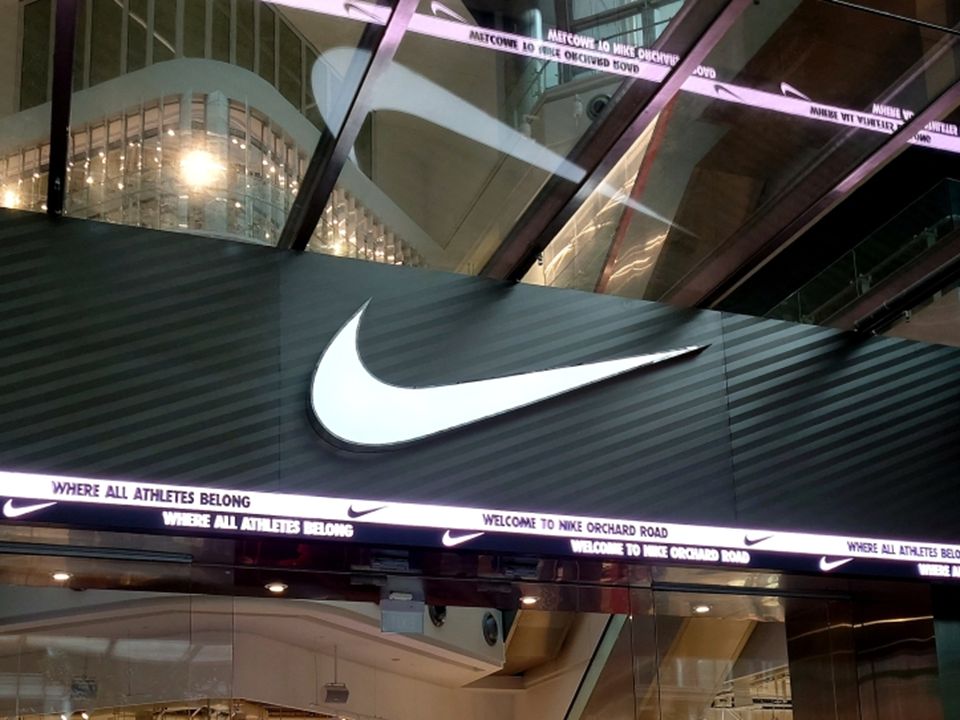
We are no economists as Mr Trump arguably is, but we could see that prices will go up, and, no doubt, Nike’s too, even of those products sold here. (Trump has slapped a “baseline” 10 percent on imports from Singapore, never mind that we run a trade deficit with the U.S. or that we have a free trade agreement with them.) The impact of both the baseline and reciprocal tariffs will no doubt impact what is already a complex global trade system. When we were in the Nike flagship earlier today, we spoke to some shoppers who were unaware of the new tariffs or the potential world-wide trade war, or the possible price hike of Nike shoes. One woman told us, “Aiya, Nike all made in Vietnam, won’t affect us, lah.” While it is true that Nike products intended for sale on our shores are shipped directly here or through one of the several distribution centres in Southeast Asia, it does not mean that they are shielded from tariffs applied in the U.S..
The reality is, there will be, as with international trade, the ripple effect on pricing everywhere. If tariffs increase the cost of Nike products shipped into America, it could increase Nike’s overall production cost, including those anywhere along the supply chain. And the brand may attempt to distribute the increased cost across their global operations to maintain profit margins. If Nike adjusts prices upwards in their home market to offset the levies, there is the possibility that they would push prices up elsewhere, including Singapore. The potential of indirect effects are too numerous to mention here, but we cannot ignore the interconnectedness of global trade, in particular supply chains and the pricing strategies corporations such as Nike adopt to stay competitive and profitable. Whatever happens in America—liberating or not—does not stay in America.
Update (3 April 2025, 21:30): Nike shares saw sharp drops after markets open on Thursday morning. According to Reuters, “Frankfurt-listed Nike were down 6.5 percent on the day”. It is not yet clear how much worse its shares will perform. Nike is not the only sportswear brand to experience the dip. The share prices of Adidas and Puma slid, too, hitting their lowest since November 2016.
Photos: Jim Sim
 Style on the Dot