The brand’s “Made in Singapore” claim has been questioned by the online leather bag investigator Tanner Leatherstein
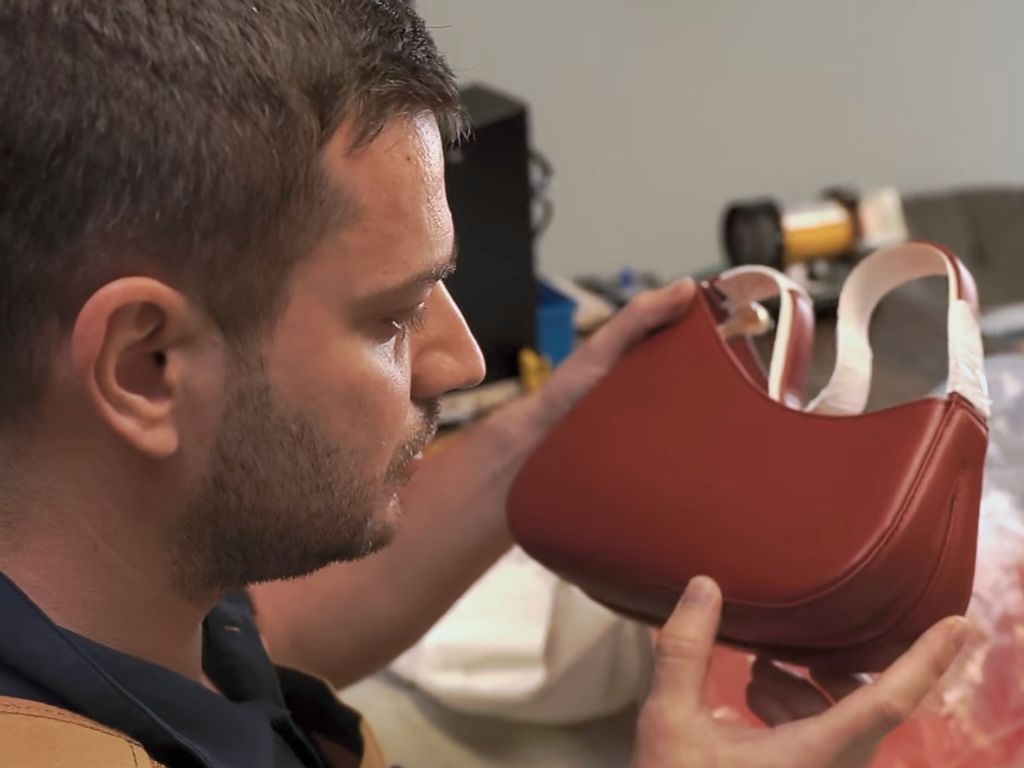
Volkan Yilmaz examining a Aupen bag in his workshop. Screen shot: tannerleatherstein/YouTube
The popular social media page Tanner Leatherstein yesterday shared a post on YouTube the findings of their investigation into the “viral” bag brand Aupen, believed to be “founded” here in Singapore. Tanner Leatherstein, helmed by Turkish leather specialist who is based in Dallas, Volkan Yilmaz, looked into the likelihood that the much-publicised Aupen bags are made on our shores, as claimed by the brand on their website, but not stated on the products, as uncovered by Mr Yilmaz. On the description of the YouTube reel, he wrote, “In this video, I break down the hype behind this ‘Made in Singapore’ label, explore the PR machine behind it, and reveal my own investigation findings. How far does the truth stretch?” This was posted just two days after Aupen shared on their socials images of Lady Gaga carrying the brand’s Nirvana bag. Indeed, was anything about Aupen’s production origin prevaricated?
In the course of his research, Mr Yilmaz did speak to a PR representative from Aupen, but the staffer was not identified. Mysterious operations apparently heightened the brand’s appeal. According to a report by The Straits Times (ST) in May this year, Aupen’s creator/owner “has chosen to remain anonymous”. CNA, too, was unable to uncover the people behind the brand. ACRA records show that Aupen is “wholly owned by Grand Ocean Products Pte Ltd”. And “Aupen has studios in both Brooklyn and Singapore,” noted CNA. “However, not much is known about Aupen’s team, which comprises anonymous designers.” How many designers there were or where they were from has not been revealed by the brand, but shortly before the publication of both news articles, Aupen wiped clean their Instagram page (and reposted four days before national Day), except for three posts. It also shared that “after 18 months, Aupen Design Collective bids goodbye”.
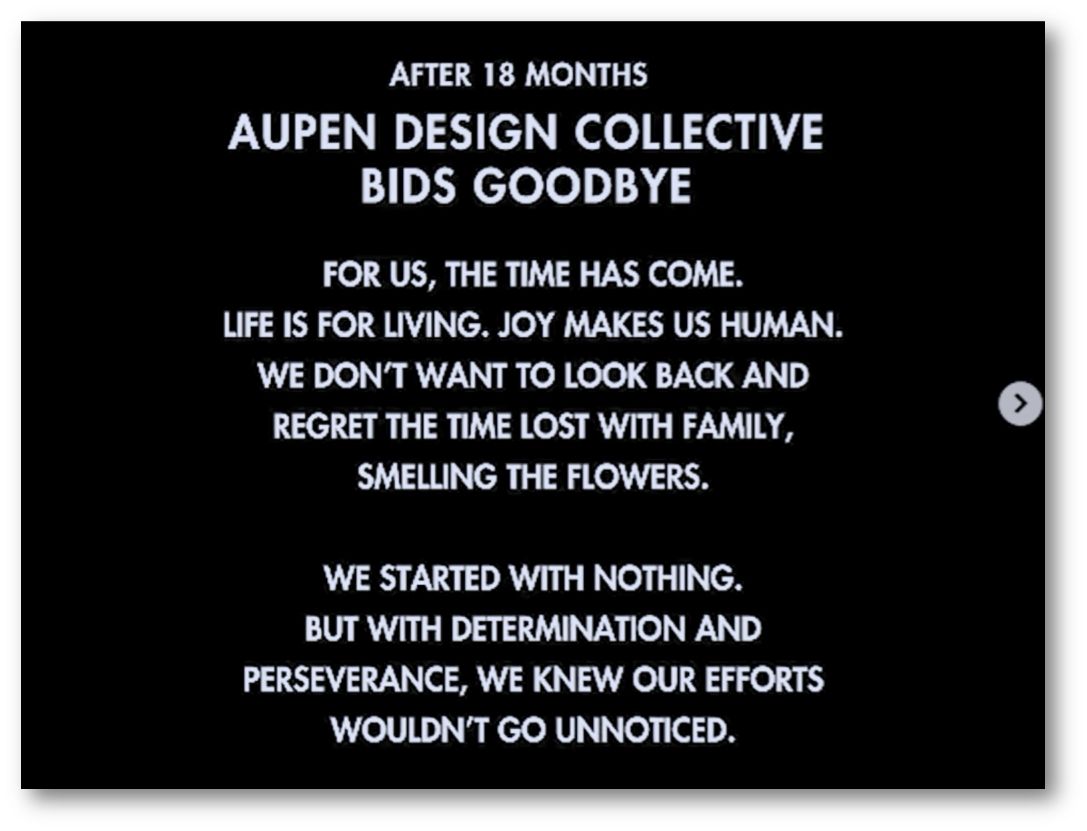
Aupen’s Instagram announcement on 10 May 2024. Screen shot: aupenofficial/Instagram
That disclosure shocked fans, mostly, as it appeared, to be from the US. Aupen—its name a portmanteau of ‘authentic’ and ‘open’—announced that the decision came on the heels of the “departure of their design team (presently, on their ‘About Us’ page of their website, a photo of four individuals—two Caucasians and two Asians—were shown above the ‘Who We Are’ header), but they later stated that it was taking a break, quickly debunking the suspicion that the celebrity-favoured brand was shutting down. During the time, there was also chatter that the brand was receiving investment overtures from several businesses, including “the H&M group and several private equity firms”, as Aupen revealed to CNA. About two weeks later, ST reported that Aupen announced a far more dazzling pair-up: “partnership with LVMH Metiers d’Art”, an initiative that was put forth in 2015 to, as per LVMH, “build bridges… between tradition and evolution, between craftsmanship and creativity, between the best manufacturers and the most celebrated maisons.”
What aroused Mr Yilmaz’s curiosity about Aupen was the brand’s claim—on their website—that their bags are Made in Singapore, a state that the YouTuber rightly noted, “is known for its high cost of living, but not for leather crafting”. Although we do have leather bag manufacturers here, such as Chan Yew Leather Artisans, founded in 1941, they are not associated with the categories of leather bags that Mr Yilmaz dissect-reviews. He also stated that he has “never seen a bag made in Singapore before”. Nor many of us here. Mr Yilmaz, who is familiar with some of the best leather bag manufacturing towns/cities in the world, from “secret” Ubrique in Spain to popular Guangzhou in China, was also intrigued by Aupen’s rapid rise in popularity (just within two years), especially among what our local media enthusiastically and repeatedly identified as “A-list celebrities”. The brand has no physical store, yet is “beloved” by those who also carry the likes of the Birkin, and, as Mr Yilmaz observed, who “aren’t the types to dig deep online to find bags to flaunt”.
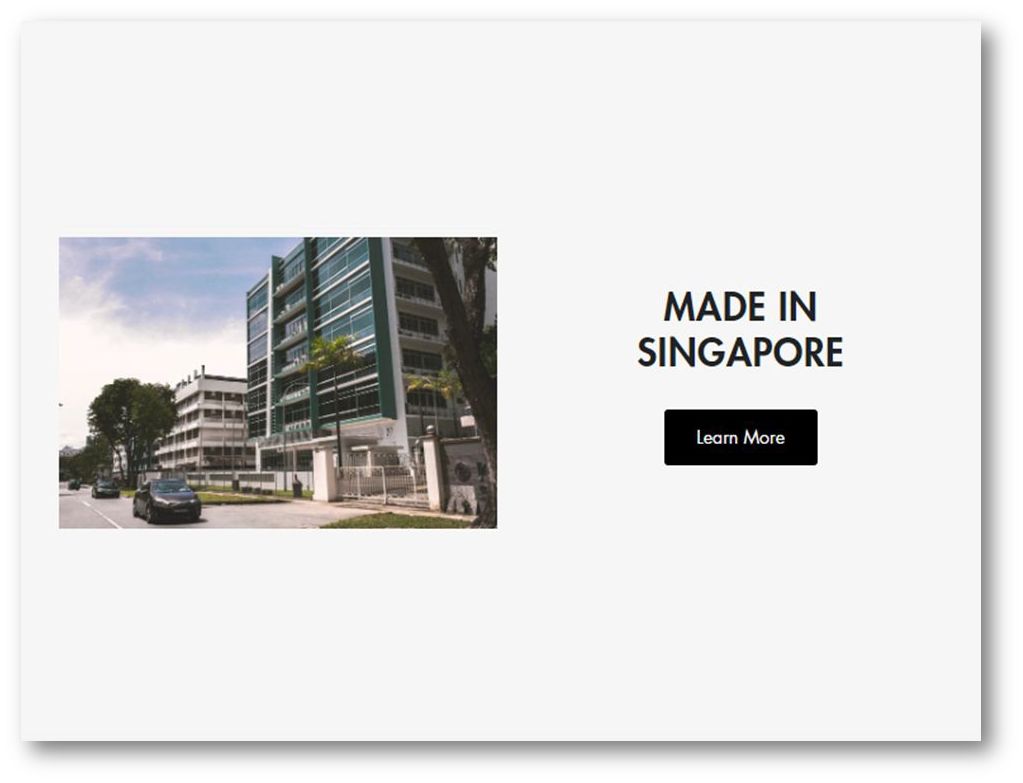
On the Aupen product page, a link to information about their bags’ manufacture in Singapore. Screen shot: aupen.com
He said that he “did two months of research” on the brand, even hiring a “private investigator” to assist in his digging, rather than flying here to see the manufacturing for himself, as the former was “a more sensible option”. He did not say when he started the probe. The first thing he did was to order a bag—the model Fearless for US$340 (about S$443)—online. When he unboxed it, he “loved it at first glance”, noting that “the leather felt really good and the design and craftsmanship were impressive”. And when he cut up the bag, as he normally would in his reviews, he saw “very thoughtful engineering”, noting that “the inside materials [were] chosen wisely and designed wisely.” He concluded that the bag was “definitely the work of professional and master craftsmen”. When he performed his signature “acetone test”, the leather was revealed to be “super minimal” in finish. He described the calfskin to be “beautiful leather—I love it”.
While he appreciated the construction of the bag and the quality of the leather, he did note that, although Aupen had claimed that their bags were made in Singapore, it was not indicated on the bag at all, or shown on the label or tag where it was produced. Mr Yilmaz thought this missing information “odd”. When he had the chance to speak to Aupen, he asked them about the bags’ production provenance, remarking that, “given Singapore’s high-cost economy, how was it possible to sell these bags at these price points?” Apparently, the Aupen representative he spoke to “confirmed three times that they had a single manufacturing partner, with ten artisans working for them, creating their designs in small batches.”
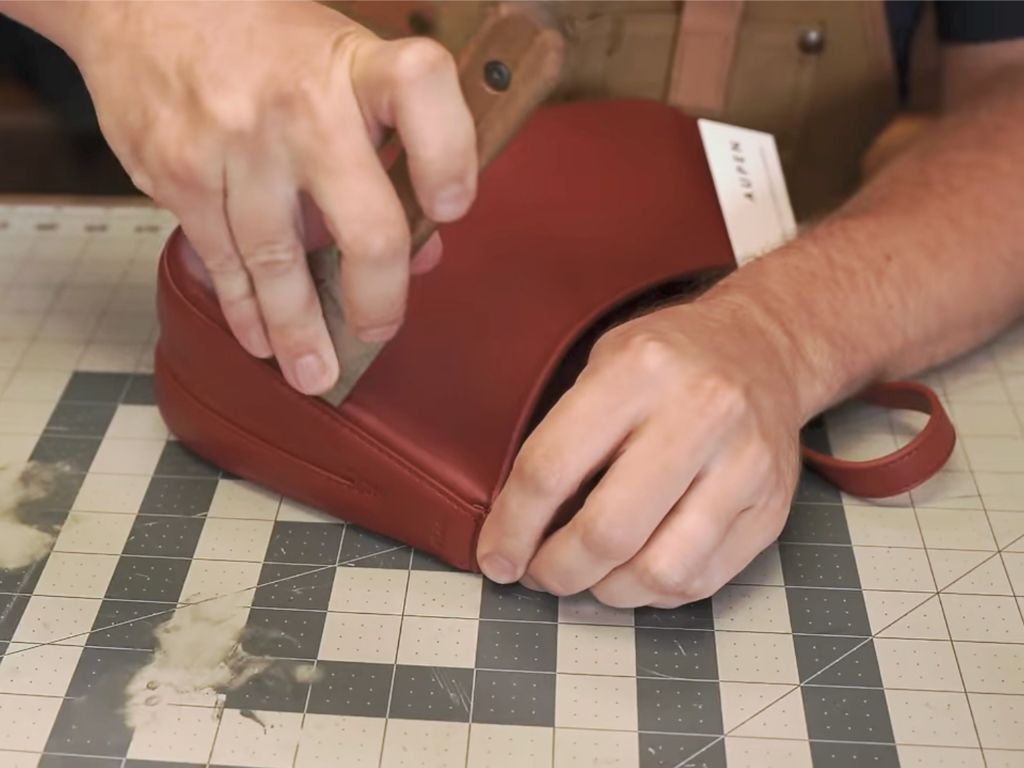
Mr Yilmaz “dissecting” the Aupen bag he bought. Screen shot: tannerleatherstein/YouTube
The people at Aupen were “very professional and kind” to him, he said, but Mr Yilmaz was still saddled with doubt. And as some of his “best friends from school were from Singapore” and he “admire their work ethics”, he did not wish to consider that Aupen had lied to him. “But,” as he continued, “the professional in me noticed so many discrepancies.” He turned to his private investigator, but unfortunately the report they filed was “disappointingly shallow”. Mr Yilmaz decided to do the sleuthing on his own, online. He went back to the Aupen website too look for clues. On it, a photo of a building was suggested in the accompanying text to house the brand’s production facility. Reverse-image searches coughed up an edifice identified as Solstice Business Centre. When he looked up ‘leather goods’ at the address, he found one Crockohdial Pte Ltd, a 40-year-old producer of “luxury leather goods of the finest bespoke quality”, according to the company website. Mr Yilmaz compared a photograph on the Aupen page that showed a man working on a belt with another somewhat similar image on Crockohdial’s ‘About Us’ page. It was easy for him to conclude that the two photographs “came from the same workshop.”
He then called Crockohdial under the pretext of wanting some prototypes made and exploring the possibility of production. When he mentioned Aupen—the Singaporean brand he knew of—to the person he spoke to (unidentified), he was apparently told, “yes, they used to come here to work with us,” but, as Mr Yilmaz informed somewhat disappointedly, “the conversation ended there.” He then derived that “this may be the place Aupen got help to develop these bags, but clearly they were not making the bags at this point, at least not in that building shown as Aupen factory on their website.” But his search could not just end there. He looked at the shipping label on the box in which the bag came in. There was apparently “no ‘From’ address”. He then when to the tracking page of the UPS website and learned that the parcel was picked up from the city of Dongguan (东莞) in Guangzhou (广州), China.

Fan Bingbing with the Aupen Fearless Re-Edition Noir. It is not known if she was paid or gifted, or if she bought it. Photo: Harper’s Bazaar
Familiar with the production and logistics of the leather bag trade, Mr Yilmaz had already guessed that it would be somewhere in Guangzhou that a brand such as Aupen could get bags “of this calibre” produced. To him, “the whole thing doesn’t add up from a cost standpoint.” Based on the Aupen pricing, he was certain that the bags could not be manufactured in Singapore, where “it would cost at least as much as it would if you make it in France or Italy”. He even conducted a comparative study of how much a leather craftsman would be paid among the leather goods-producing nations of the world. His findings showed that Singapore ranks the second highest after the US in average annual (leather) craftsmen salaries. He went on to say that, given Auspen’s target is the American market, “it makes no sense to ship this bag to mainland China for storage and distribution,” adding that “even brands based in Hong Kong and making their goods in China—they are housed and shipped out of Hong Kong mostly.” Otherwise, he explained, “it just imposes too many unnecessary complications and costs, and logistics.”
He then suggested that that could be why the bag he bought to dissect and review did not indicate on itself where it was made. He went as far as to say that “there is a very smoky operation going on here”. And that he “was not going to regard all the answers (he) got from Aupen’s PR team as true statements.” He then proposed a theory: that “a deep-pocketed secret financier behind this operation, masterminding all these PR gimmicks”. His belief is that there might be a plan “to create a social media hype brand and, perhaps, exit with a handsome payout through an acquisition by a large group.” Rather heavy charges there, even if one thinks that LVMH Metiers d’Art would be extremely careful with the brands they associate with. Volkan Yilmaz admitted that he liked the Aupen bag that he bought, but “absolutely hated the gimmicky PR strategies coming from a brand claiming authenticity in its name,” adding with a tad of frustration, “everything I encountered during this investigation was far from authentic.”
Update (9 October 2024, 15:15): Is Aupen experiencing a sense of guilt? On 4 October, Tanner Leatherstein published a shorter version of the original video shared a month ago on YouTube about the authenticity of Aupen’s origin of manufacture. Not long after, the Singaporean bag brand’s website was changed to a password-protected page. And then it’s back up. This time, as we checked, there is no more mention of the bag being made in Singapore. The place of manufacture is now an even bigger enigma. It is not known why Aupen refuse to reveal where their bags are made. There is presently only one style of bag available: Nirvana, two in leather and one in raffia. Their ‘About Page’ is now a simple black page (the photograph of four unidentified individuals has been removed) with white text that reads: “Founded by Nicholas Tan and based in Singapore, AUPEN is renowned for its asymmetrical designs that celebrate the beauty of life’s imperfections. The brand focuses on minimalist, authentic designs, showcasing exceptional craftsmanship without compromise.” The credentials of this Nicholas Tan are not stated. He remains an international man of mystery.

