American travel influencer Devin Halbal is very popular in Asia, as it were. And now, she is on our island, doing what she does best: Gather her followers to scream under her smartphone mounted on a selfie stick. What the excitement is about, however, isn’t exactly clear
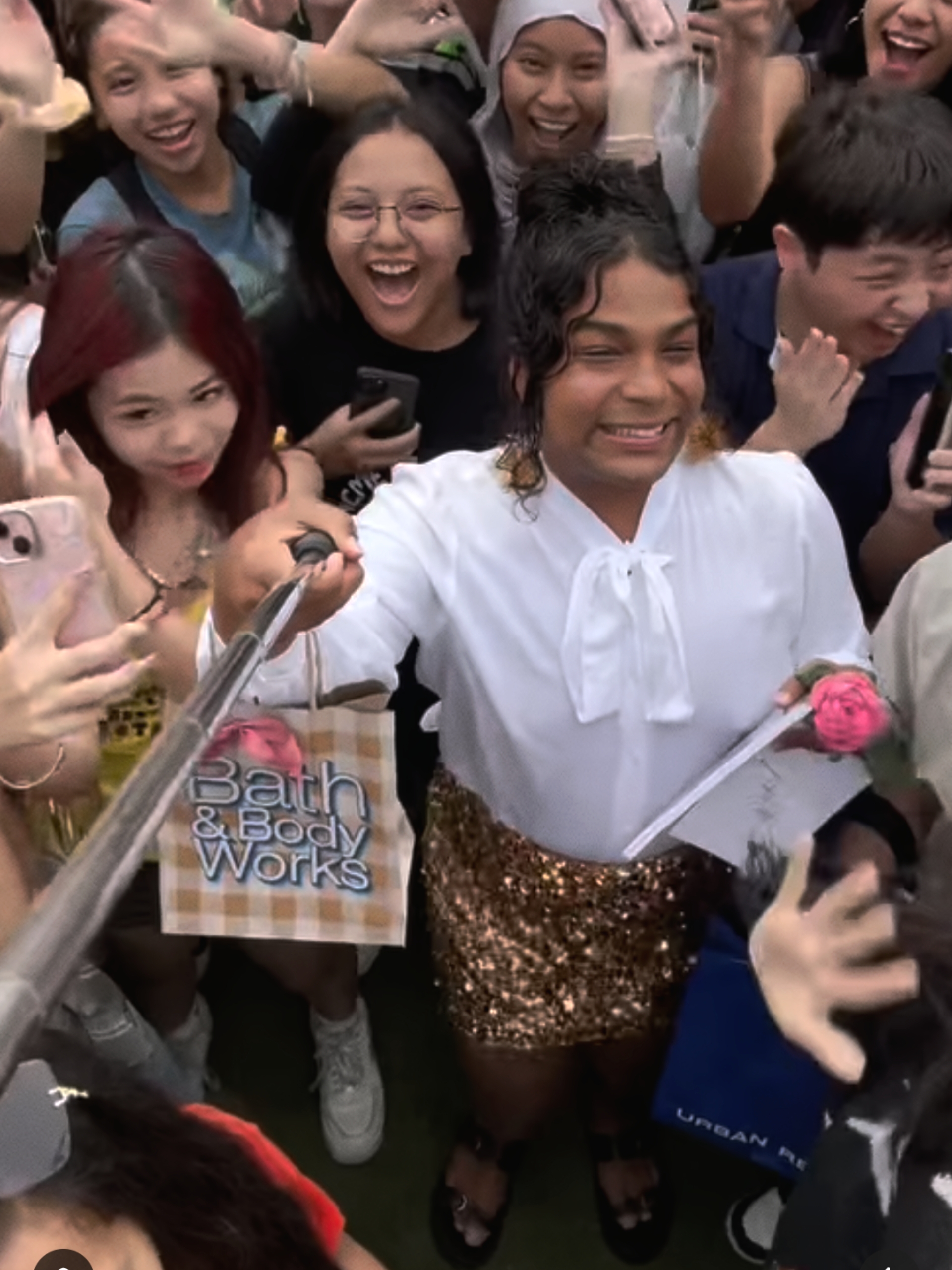
Devin Halbal (centre) and her delirious fans in Sentosa
This weekend, while the spotlight is trained on Fan Bingbing taking Malacca by storm, on our island, someone else is also drawing attention, as well as hordes of screaming Insta-fans (literally) to herself. American travel vlogger/TikToker Devin Halbal is on a tour of Asia, and has landed on our shores to the delight of her screaming followers (literally). The 26-year-old New Yorker had shared videos of her relatively quiet arrival at Changi Airport, which belied the reception she was to receive during the first meet-and-greet in Sentosa. The throng—of mostly the young—is amazingly diverse, and effectively showcases our city as multiracial and, perhaps, more importantly, inclusive. As if mimicking the greetings she received in not-so-plural Japan and South Korea, her Singaporean fans—some bearing gifts, some trying to out-camp her—came very close to their “queen”, jostling to be within view of the lens of her phone camera mounted on a selfie stick that extended one and half times longer than her arms, and to hear her say, as well as shout out with her, the pet word that got her famous: kudasai.
It is not clear why an American saying—or squealing—a word that generally means “please” or “please give” (depending on usage) in Japanese is so fascinating or amusing that she could attract multitudes to follow her like she was the Pied Piper of Hamelin, and allow themselves to be filmed looking totally in the throes of some inexplicable rush, sometimes bordering on delirium. Known as Hal Baddie on TikTok, she shares mostly the same reactions to her presence, whether in Tsim Sha Tsui, or Sentosa, and amazingly she is able to maintain the same expression of being overwhelmed as her followers appear to be. And when she raises her selfie stick higher to capture a bigger view of the crowd and then encourages that adverbial response by uttering a single noun, everyone delightfully obliges. This must have been an immersive experience for the fans. On Sentosa, she shouted out food names: “chicken rice”, “chili crab”, “laksa”, and after each, her obedient followers screamed in unison, “kudasai”.
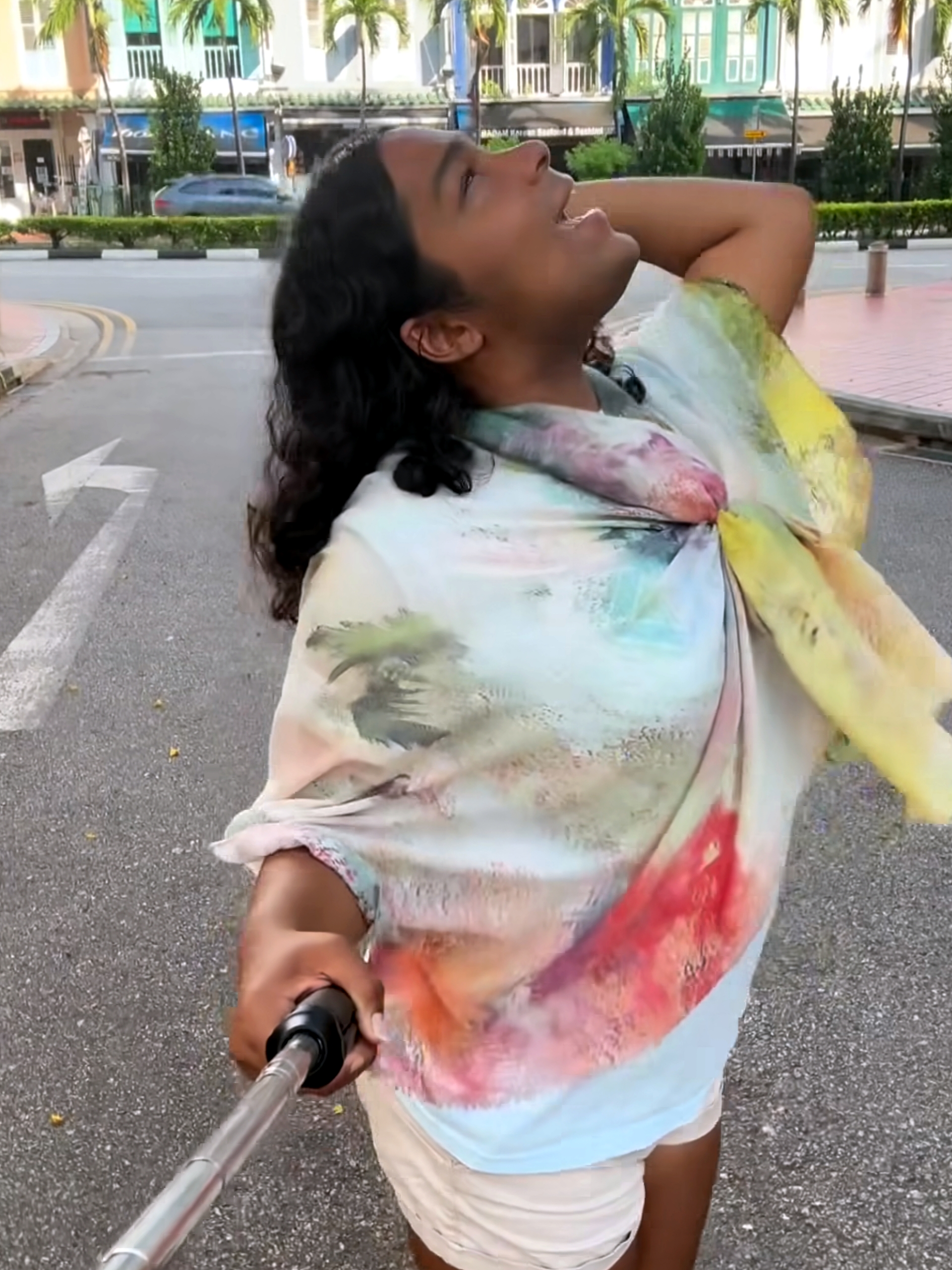
The Kudasai Girl posing and singing with Tanjong Pagar Road as backdrop
If kudasai is not Singlish enough for you, Ms Halbal has something else for Singaporeans. On TikTok, she shared a reel of her singing exaggeratedly and monotonically, “Please lah sialll. Please lah sialll. Majuuuuulah”, and commenting that it was “one of [her] favourite Singaporean chants”. Might it catch on? Or would it occasion some fuss? Some members of the Malay community, for whom sial is possibly no longer considered rude or crude as it was before (making the purportedly more polite sia redundant), or has its sting removed to be even as friendly as fellow particle lah, sing it too. A Singaporean TikToker even suggested that it should be “our anthem”. Another, just as approving, suggested that “they should teach this in schools.” Encouraged by possibly her seeming nescience, her followers offered other phrases she could use, including one apparent subject, who wrote with glee, “Pls say CB lah my queen”. It is quickly understandable that Ms Halbal’s appeal is her common touch. She does not care to sound pompous; she prefers expressions that locals of the cities she visits can immediately understand and quickly and happily vocalise.
As her story goes, it all happened in now-frightfully popular Japan. Ms Halbal has been a travel influencer with considerable following for a while prior. As her early vlogs centred on her adventures in Europe, she was largely unknown in Asia. In January this year, she decided to visit Japan—like so many people—for the value the low yen temptingly offered. According to a profile in The New York Times, Ms Halbal took a trip to the old merchant city of Kurashiki in Okayama Prefecture, a choice that is unusual (but then again, maybe not) for a travel blogger. Among nihonjins, she tried to learn Japanese and one phrase that she said she kept hearing was kudasai. To her, it was something catchy and cute. And she adopted it. The clever thing about co-opting an expression not your own for your personal brand is that you can sell anything thereafter by simply applying, in her case, the spoken sound as a suffix to anything deserving mention or an audience, affirmatively. Sushi, kudasai. Bubble tea, kudasai. Durian, kudasai. Stop, kudasai?

Changi Airport made sure Devin Halbal was warmly welcomed and generously gifted
Apart from her catchy and cross-border use of kudasai, Halbal’s online popularity could be that she is a confident and comfortable, “medically transitioned,” transgender woman, as she told W in 2022. She revealed on Tik Tok last year: “I am a boy and a girl, and neither at the same time.” Nothing more, nothing less. Her presence was—interestingly—appreciated by tourism-related entities here. Upon her arrival, Changi Airport welcomed her with a trolley of gifts and a sign similar to those of receiving arrivers at the exit of the baggage claim carousels with signs holding up the names of the guests. Below her now-recognisable moniker, three phrases (probably to suggest to her what local words she could use with her pet word): “Changi Airport, kudasai”, “kopi peng, kudasai”, and “lobang, kudasai (which, if taken out of context or, worse, used literally, could be frightfully rude and disastrous)”. The open arms were extended to her by Jewel, and then Sentosa, and the Ice Cream Museum, the latter two where she thrilled her fans. “Meet-and-greet” sessions—as she calls them—are usually organised for pop or film stars, but Ms Halbal was neither. Therein, perhaps, lies her appeal.
In a recent interview with Hong Kong’s South China Morning Post, she said, “I just identify with beauty and all things pretty and fashionable.” This is prettiness that is related to the TikTok world. This is not necessarily fashion as Vogue knows or identifies it. This could, in fact, be both anti-pretty or anti-fashionable. Although she has been linked to some brands—a trip to Ibiza for Loewe and an interview with W, she is, image-wise, more down-to-earth, with a wardrobe she used in her Asian tour so far not quite memorable or groundbreaking . Ms Halbal’s content and the positivity are novel, but her clothes are relatable. She is dressed not unlike the average fashionable TikToker who is deeply enamoured with Shein. For her first meeting with fans here, she wore a white pussy-bow blouse (braless) and gold sequinned mini-skirt, which recalled the many seen at the Taylor Swift concert in March. The genius in Ms Halbal’s approach is not her standout clothing, but her willingness to be counted among the masses.
There is no fashion excess, no compositional cleverness in her photos or reels. She does not pose against impossibly beautiful backdrops or place herself in striking scenes. Her strategy debunks the belief that followable Internet stars need poise, showiness, and filters to win. Her realness means she is comfortable with and without makeup, being pretty as well as teary. Like many who consider their physical self central to their content, she is prone to pose in a lot less clothes than she should, to the extent that she could not resist the draw of nudity. In a piece she wrote for Refinery 29 in 2018, Delvin Halbal stressed: “clothing means more to me because it has to”. Yet, she is willing to let the lack of clothing mean something to her too. In the complex world and politics of gender identity, fashion could represent something or nothing at all. But for Kudasai Girl’s excitable fans, it is likely only one word that matters, kudasai.
Screen shots: devinhalbal/Instagram and halbaddie/TikTok
 Style on the Dot