Vogue World in London shows she is able to save more than just fashion

Kate Moss, seemingly entrapped, opening the show
Fashion has always wanted to be festooned with the superfluous. Or, more than what it can stitch. Similarly, Vogue is not fulfilled with being a magazine or a medium that delivers fashion content to a fashion-content-consuming audience. So they came up with Vogue World, just in case you thought that their brand influence is not global enough, even when there are now 28 international editions of Vogue. After last year’s anything-goes street affair in New York, the event is back, this time in London, on a stage in the West End. Unlike its debut, the one-night-only English affair involved more than 2022’s “Vogue army”. Now, the performing arts community of the capital was engaged, so too the director Stephen Daldry of The Crown, offering not quite a circlet of distinction, weather for the head or stage.
Vogue World was touted as “London’s Met Gala”. The city has never had a red carpet posh enough. So American-style festal excess and ostentation had to be imported to not just support the performing arts of the city, but also to kick start London Fashion Week, all made possible, as we already know, by the ambitious-till-now Anna Wintour, who reportedly left for London before New York Fashion Week came to a close, much to the chagrin of the Big Apple’s industry stalwarts. If she could save fashion retail with Vogue Fashion Night Out, she would be able to do the same for the performing arts through Vogue World. Days before the curtains of Vogue World were raised, rumours with the juiciness not less substantive than the latest royal gossip emerged about the back of house ”power struggle”. According to a report by The Guardian, published three days ago, the rivalry is between outgoing editor-in-chief Edward Enninful and the woman persistent hearsay indicated will be replaced by her fellow Brit. In June, Mr Enninful announced that he would be stepping down (no successor has been announced) so that he would have the “freedom to take on broader creative projects”.
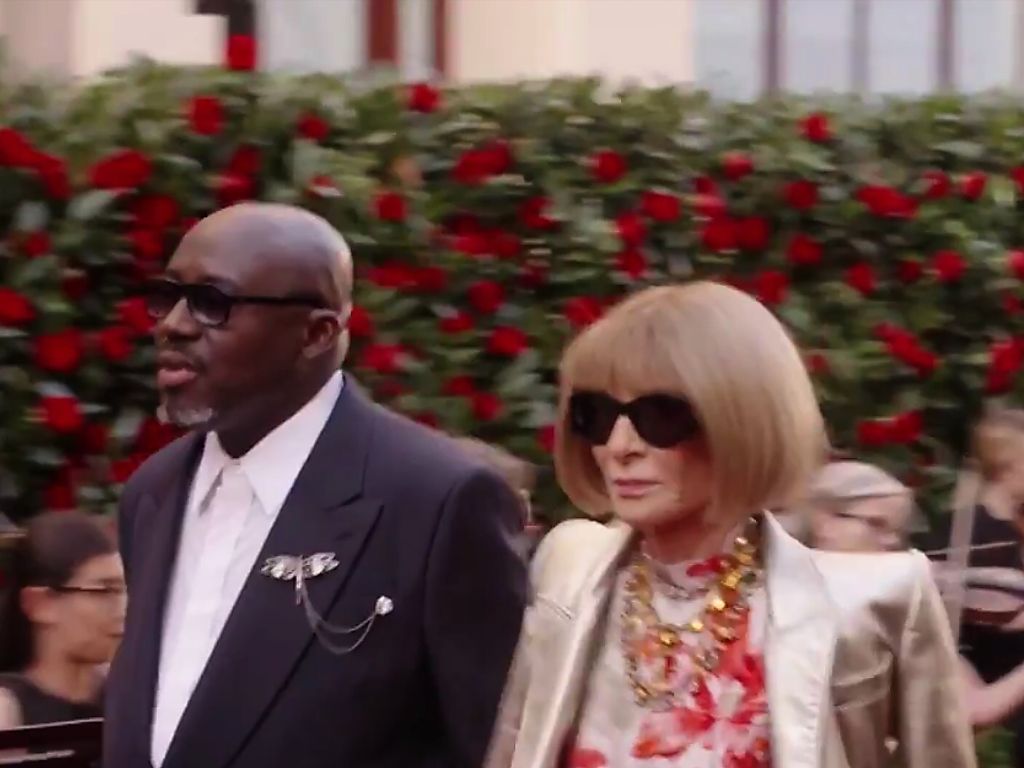
Rivals arriving. Edward Enninful and Anna Wintour
As The Guardian noted, “initially, it was regarded as a pivot to further posit himself as Wintour’s successor.” But, somehow, that would not be happening, yet. The chatter in London of the discord suggested that “the event has become a prime opportunity for Wintour to reaffirm herself as the most puissant person in fashion.” But, Ms Wintour, has through the years, spread her wings beyond the no-longer-challenging-for-her garment industry. Designers who get their kicks no more from putting out collections after collections, go on to create products for homes. When that is not enough, create aircraft interiors, and if that is really inadequate, build hotels. These days, brands such as Louis Vuitton want to be relevant not just with what they make and sell, but also with culture. Anna Wintour is somewhat similar. It isn’t enough that she has established considerable power in fashion, she needed to go further. She has dipped her toes in the (American) political pond, had a costume centre named after her, aligned herself with sports personalities, and more, all the while surviving the difficile organisation that is Condé Nast.
On the red carpet, both Ms Wintour and Mr Enninful put up a happy and harmonious front. But they did not appear without company—Ms Wintour’s pal, the Australian film director Baz Luhrmann (Moulin Rouge). All three, dressed as if going to a dinner at a country club, rather than to the equivalent of the Met Gala, were camera-ready; the hard-nosed Ms Wintour seemingly more delighted with the Prada-clad Aussie’s presence. As in New York, guests had to climb a staircase to be received by Ms Wintour from her queenly perch. But the attendees took the dress requirement (there was no apparent dress code) less seriously than those who attended the grander Met Gala. Sure, Sienna Miller arrived as puffed-up as she was pregnant and Jodie Turner Smith came as a gift wrap, minus the gift… and the wrap, but what fantastic fashion was there for the annals of British red carpets?

Annie Lennox, the best performer of the evening
The London edition of Vogue World was, as the magazine described it, “a theatrical West End production encompassing the best of British culture and fashion”. But the 37-minute extravaganza felt more like a short Britain’s Got Talent finals, minus the interruptions or repeated close-ups of judges. It didn’t help that it was a rojak of performances. It opened with a video of Kate Moss getting her face fixed before going onto the stage to show off an abstract, upper-body performance that could be bad taichi (frankly, she appeared unmotivated) under what looked like a kelambu (mosquito net)—her fans probably thought it was a massive bridal veil. And then came the serious stuff—opera, dance, and play, with Shakespeare thrown in for theatrical cred and high-culture branding. Imperatively modern interpretation (and the abandoning of rigid adherence of period styles) meant that Juliet and her beloved Romeo had to go clubbing(!) when their famous balcony exchange came to an end. And in the distance, you could hear Basement Jaxx.
A Vogue event is not quite fittingly branded without fashion, specifically the clothes. So between performances, whether they were germane to the acts or not, models in garments of widely unrelated styles walked across the stage, among dancers, or below, among guests. At one point, while FKA Twigs, in a bandage of an outfit, was performing (accompanied by the Rambert ballet company) A Fine Night, Cara Delevingne appeared in some punky outfit (hilariously compared to Dennis the Menace), went on stage and kissed the singer—lip to lip. No points for the right answer to who they were emulating. Ms Twigs’s boyfriend Jordan Hemingway was reportedly in the audience, and watching. Aside from the missing and for the most part, the clothes were forgettable. They were there to remind the spectators that this was an Anna Wintour-engineered spectacle given the sheen-free veneer of the “performing arts”.
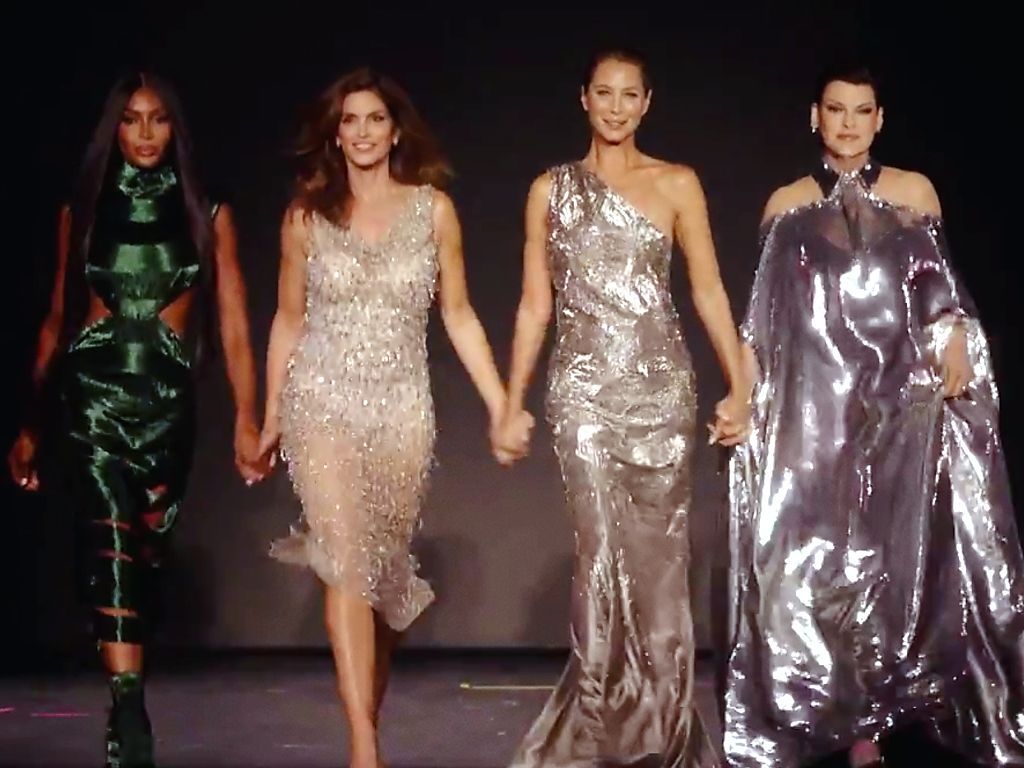
The ‘Supers’ for the finale of the jumble of a celebration, Vogue World
If there was an award for the best performance of the evening, it would have, without doubt, gone to Annie Lennox, who sang Sweet Dreams (Are Made of This) and There Must Be An Angel (Playing With My Heart) from her Eurythmics days. On stage her formidable presence was unmistakable. Vogue rightly described her vocal act as “spine-tingling”. And she took what Vogue World implied seriously—dressed in a dazzling coat with gold embroidery by Richard Quinn. The show started with a supermodel. It had to close with supermodels. Given their double covers for this month’s British and American issues of Vogue, the appearance of Naomi Campbell, Cindy Crawford, Christie Turlington, and Linda Evangelista was hardly surprising, but unanticipated was how unhappy (or unwilling?) Ms Campbell looked. In fact, the four women could hardly be considered the highlight of the evening when they were barely working it. It was Vogue that made them and it would be Vogue that keeps them… visible.
Anna Wintour makes stars of whoever she deems worthy; and unmakes them just as rapidly—Edward Enninful the recent vivid case (and, of course, the late Andre Leon Talley from the not-so-distant past). The making she does is now connived under the umbrella entity of Vogue World. Magazines are nothing these days—no longer the platform that could do more for Ms Wintour. In the past, she mostly desired to consolidate her media power (through her journey from British to American Vogue, by way of House and Garden), but now she is aiming for international power through the multimedia and cross-disciplinary vehicle cleverly packaged as Vogue World. As Condé Nast’s “chief content officer”, she has ingeniously taken herself out of the humdrum position of editor-in-chief for something that could afford her, creatively, larger scope, defined only by what could be contained in that World she made, which could be anything. Don’t be surprised if what she thinks of next is Vogue World: Wimbledon.
Screen shots. Vogue World/YouTube
 Style on the Dot