…and, may be, tech kid. The spring/summer 2024 at Fendi is a mixed bag. Oh, for tools
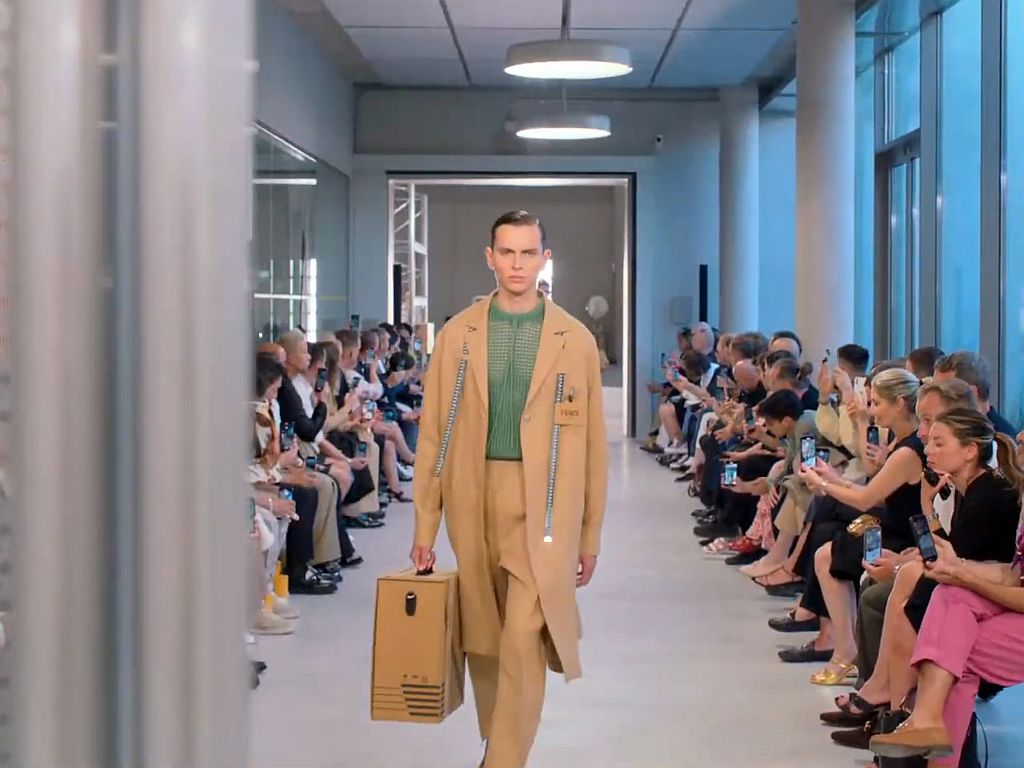
It takes a village, they say. But with Fendi, it took a factory. The brand’s latest show was staged on their factory floor of their newly built facility in Capannuccia, a 30-minute drive from the heart of Florence. As the models walk down what could be the central aisle of the well-appointed space, workers reminded show attendees that there are those who still needed to keep to the factory’s operating hours while others who probably never held a cutting tool in their lives sat very closely to the work stations to watch a fashion show. The staff went about their work—some cutting materials for bags—seemingly unfazed by the presence of the guests even when the lights above their work stations flickered, now and then, in tandem with the beat of the music blaring.
How do you make men’s fashion manly? That seems to be the question Silvia Venturini Fendi asked this season. Menswear requires fashion, but it also needs to be masculine, to have purpose. Whatever all that means today, Ms Fendi brought the aesthetics in line with the jobs traditionally associated with men. And the garb, as well as tools(?) required to get the work done. And it was the obvious those ruled. Aprons were key, whether full or the truncated used to wrap around the waist. And whatever strap-on required to hold tools. So you had a bit of factory hand here (did she use any of the staff to model? 🤔), a bit of farm help there, massive amounts of fan boy, and, for sure, the tech kid who still demands working from home. To be sure, also the Grab Food delivery guy (we don’t know which company dominates in Italy)—there was even a bag (leather, of course) that could house four cups of hot lattes, just in case any ’ol bag provided by Grab isn’t stylish enough!


Ms Fendi, of course, romantised work wear. She tweaked it for young urban males who might wish to dress as if they were actually skilled at doing something that required years of training and precision, but not thinking that robots have been taking over most of these jobs. Even measuring tapes had a part in the hints of proletarian chic, with shirts (and outerwear) that had specific tabs on each side of the chest to prevent the tapes from swinging too wildly, and, in due course, slip off, undetected. One shirt-as-car-coat had markings usually seen on paper patterns, an idea already explored by the Japanese a long while ago. If a relaxed suit gave inadequate hints of a workshop or, as it were, a factory, a belted tool bag, strapped insouciantly to the waist, may argument the intended toughness. In case that an apron is too long or too literal a reference, they could do be shortened to the length of a blouse. It had to be subtle.
But there was nothing indirect among the unexpected profusion of the halter-neck tops. It is understandable that they took the silhouette of the apron, but these were designed to add an unmistakably feminine touch to the work-wear equation. Other than those that were shirts (and knitted polos) tucked into pants, they were those that were tunics that and others that can be fastened with a bow in the rear, exposing, in some cases, a bare back. Following Jaden Smith’s ads for Louis Vuitton, it is possible that Fendi thought that the tops that left arms and shoulders bare would be the next big thing. If, however, the halter’s too advanced for you, consider the singlets and dungarees that similarly expose well-developed deltoids and biceps. But what was more eye-brow-raising were the body suits (at least they appeared to be), cut high on the sides and worn with trousers that were not especially low, but exposed the waist, on both sides. Was Fendi bringing some kind of sexy back?
Screen shot (top): Fendi/YouTube. Photos: Fendi
 Style on the Dot