Two women, both with a modelling career, both ended being first ladies, and more pertinently, both are linked to Donald Trump: one with her identity borrowed, the other with hers tethered to his. Models just lead better lives
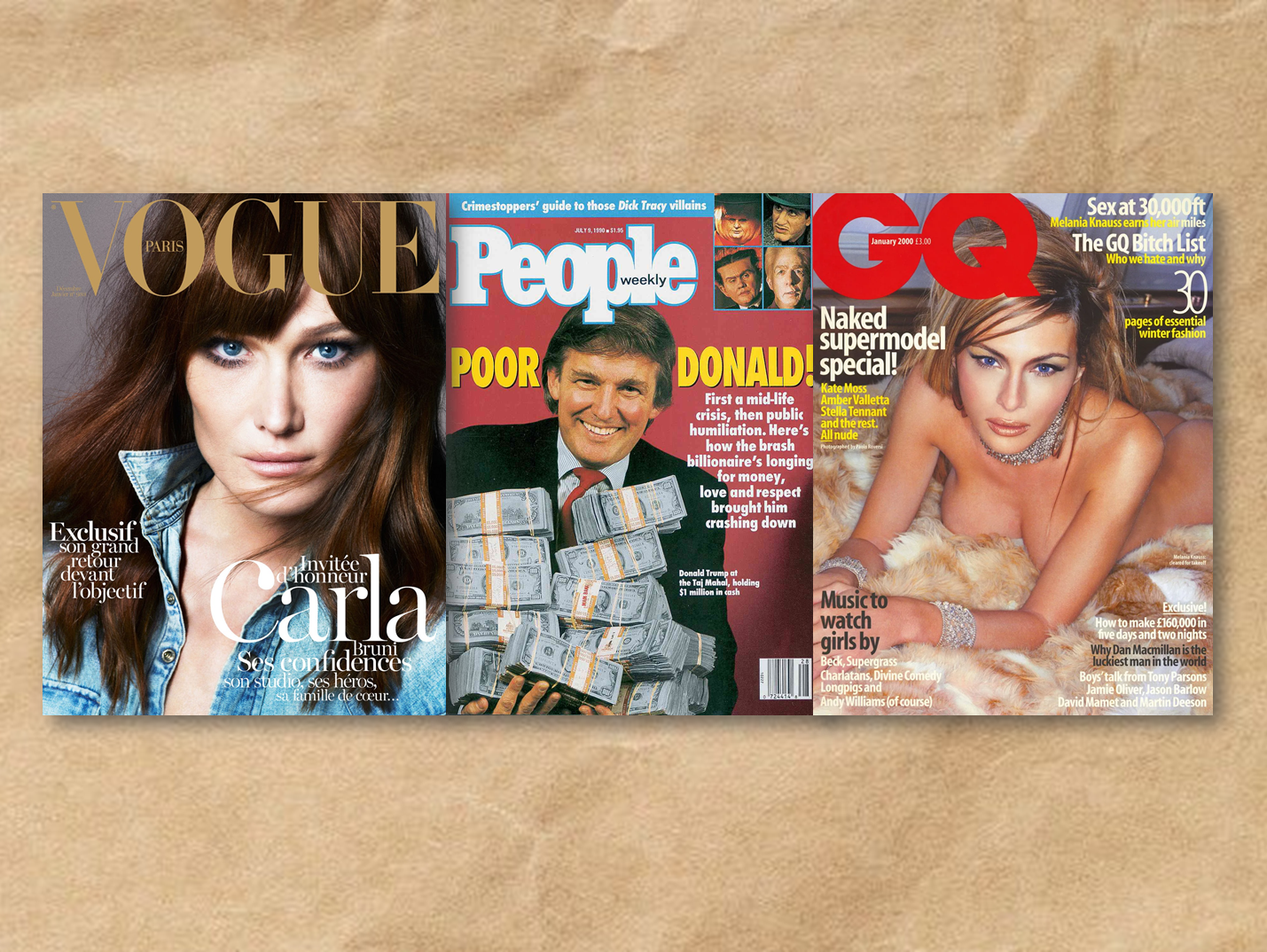
From left: Carla Bruni, Donald Trump, and Melania Knauss. Photos of the covers: respective magazines
In the summer of 1991, a month after the Philippines experienced the second-largest volcanic eruption of the 20th century when Mount Pinatubo blew its top off, an unusual, but scintillating telephone conversation took place in New York City, 13,700–13,800 kilometres away. A reporter from People magazine, Sue Carswell, had sought an interview with Donald Trump. Instead, she received a call from a man who identified himself as “John Miller”. He said he was Mr Trump’s “new” publicist, asserting that he was “sort of new here… sort of handling PR because he (Mr Trump) gets so much of it.” Following the developers-tycoon’s divorce from his first wife Ivana Trump, the media was fixated on his relationship with Marla Maples and rumours of other high-profile romances. That Mr Trump would come up with an alter ego named John Miller and had him speaking to the press was perhaps unsurprising. In a 1990 court deposition that was part of a lawsuit involving the construction of Trump Tower and the employment of undocumented Polish workers, Donald Trump testified under oath that he had “on occasion”, when speaking to the press, used the alias “John Barron”. Sounds familiar?
In the conversation with People, this John Miller, who was beginning to sound like a village gossip than a PR pro, elaborated to Ms Carswell about Mr Trump’s social life: “He gets called by everybody. He gets called by everybody in the book, in terms of women.” Ms Carswell asked him, “like who?” He replied: “Well, he gets called by a lot of people.” She was persistent: “What about—I mean, this Carla Bruni? How important is she right now?” He continued to persist that Trump received calls from many people, but he came back to the model in question, saying, “So now he has somebody else named Carla who is beautiful and I guess you have something on her.” He later added, “Carla is a very beautiful girl from Italy, whose father is one of the wealthiest men in Europe.” Whatever Trump-as-Miller implied, Ms Bruni flatly denied anything happened between them and added that she met him only once at a charity event (and not at the Plaza Hotel during a Carolina Herrera fashion show, as Mr Miller asserted). While that was a fantasy, the meeting between Mr Trump and another model Melania Knauss (as she was then known), seven year later, was not. Ms Bruni was once described by Karl Lagerfeld as a “beautiful creature who can wear anything”. Mr Lagerfeld probably had never heard of Melania Knauss.
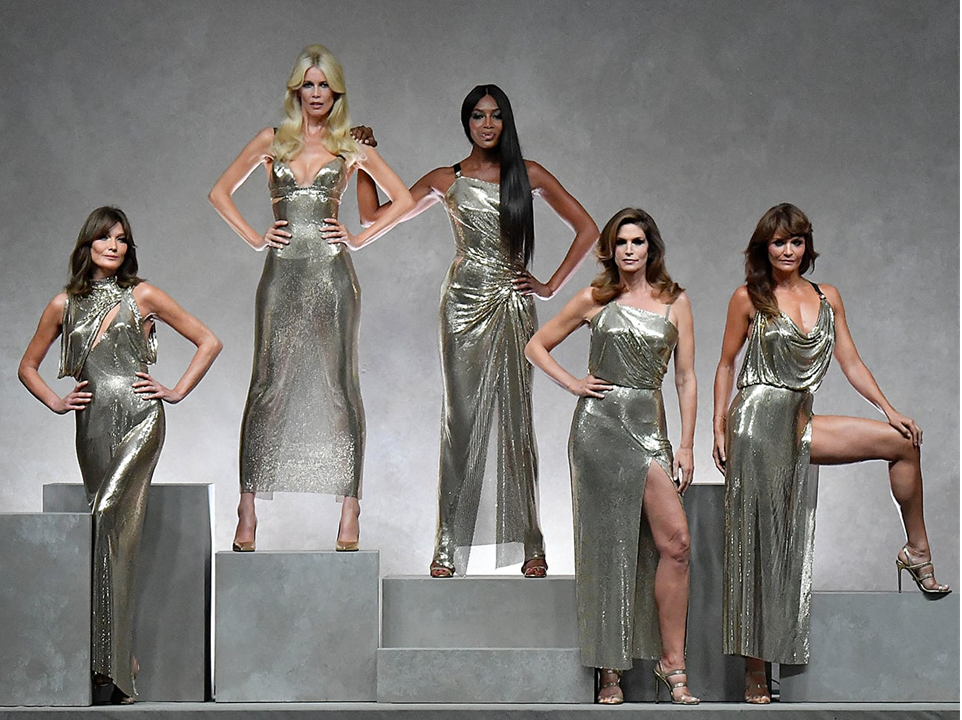
Carla Bruni (first, left) with Claudia Schiffer, Naomi Campbell, Cindy Crawford, and Helena Christensen for the Versace runway show in 2017. Photo: Getty Images
Much later, Mr Lagerfeld famously found the Trumps “fascinating” as a social phenomenon, but in the ’90s, the professional distance between the ‘Super’ and the ‘commercial model’ (her non-fans, hitherto, call her a “catalogue model”) was the Pacific Ocean. The rumours of her involvement with Mr Trump would continue to dog Ms Bruni, so much so that even after she married Nicolas Sarkozy in 2008—three years after Ms Knauss to Mr Trump—she still refuted the persistent chatter that she knew Mr Trump intimately. “Actually, the whole situation was very vague and just did not exist,” the recording artiste told the Daily Beast. “So I was very surprised when he went to the press.” Melania Trump now did not have to distance herself from the man that the supermodel described as “obviously a lunatic”. The one person Mrs Trump has to keep an arm’s length away—and a leg’s, plus the five-inch heels—is Jeffrey Epstein. Last Thursday, she was at the Grand Foyer of the White House, standing behind the presidential shield, angrily declaring: “I have never been friends with Epstein”. And if that was not convincing enough, she added: “To be clear, I never had a relationship with Epstein…” There were no known photos of Ms Bruni with Mr Trump. The archives are practically hemorrhaging photos of Ms Knauss cozying up to that dead predator.
Although both woman were models before they became first ladies, Ms Bruni and Ms Knauss existed in entirely different ecologies of fashion-industry power. Carla Bruni came of age in the late ’80s/early ’90s European high-fashion system, dominated by Paris and Milan. She was part of the supermodel craze of the period: walking for Versace, Dior, Givenchy, appearing on Vogue covers, and mingling with the “Big Six”—Naomi, Cindy, Linda, Christy, Claudia, Kate. At the peak of her career in the late 1990s, she was one of the highest-paid models in the world, reportedly earning approximately US$7.5 million in 1998 alone. Melania Knauss, by contrast, worked in the ’90s/early ’00s commercial modeling world that was more fragmented and less centralised. She did catalogue work, advertising campaigns, and occasional magazine covers, such as Sports Illustrated’s swimwear issue (so did Martha Stewart, who was also a former catalogue model, but did not depend on that career to be the media mogul she is today) and British GQ, which admitted in a later editorial that she did appear on their cover and within the pages when “it was the lads mag era after all”. Her eventual visibility came less from fashion and more from proximity to Trump’s celebrity-business empire. Whatever her aspiration as a mannequin was, Ms Knauss wasn’t part of the supermodel pantheon; she was looking up at it.
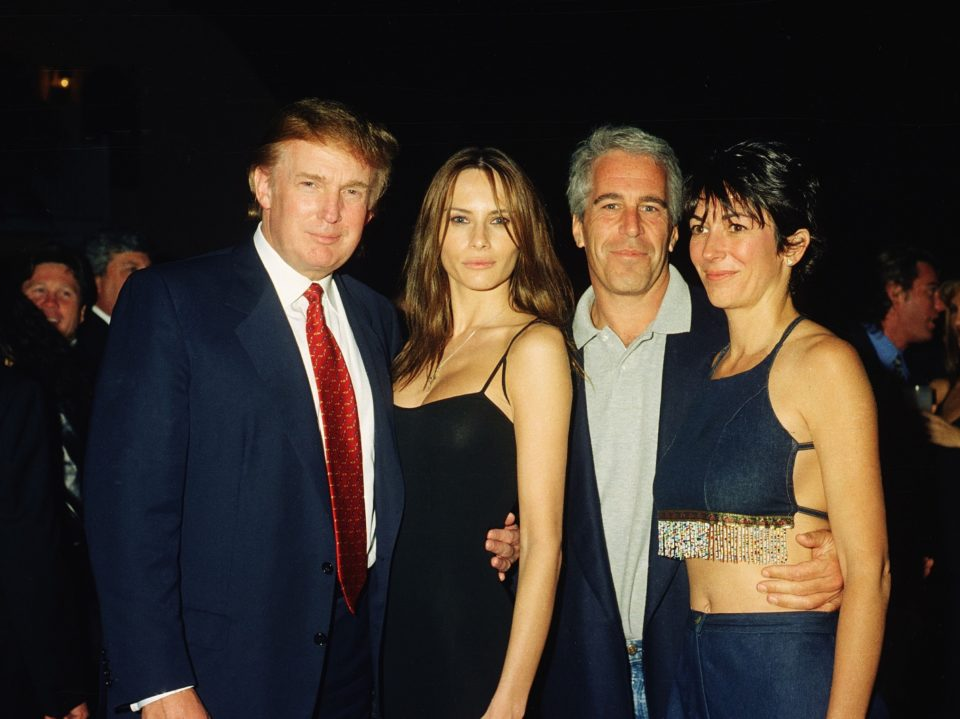
Probably the most circulated photo of Melania Trump’s modelling days. She wass flanked by Donald Trump, Jeffrey Epstein and Ghislaine Maxwell. Photo: Getty Images
In the many profiles of her that she received in the American media, Melania Knauss was a model who “met” Donald Trump in the Kit Kat Klub in 1998. That anecdote has been treated almost like a fairy tale—model meets tycoon, he pursues her, marriage follows. We hardly got to hear about the romance. The Kit Kat Klub in Manhattan occupied a unique and somewhat surreal intersection between the gritty nightclub scene of the ’90s and the high-society glamour of early 2000s New York. It was not a nightclub in the traditional sense, but a theatrical venue—specifically the Broadway home of Cabaret. After theatre hours, the space was leased for events, and one of those was ‘The Zampolli Parties’. If that name rings a bell, it’s because he, Paolo Zampolli, once presided over the very modeling agency that deemed Melania Knauss genetically viable for a paycheck. In a fit of industrial foresight, he was the one who officially weaponised her cheekbones for the open dating market (Mr Zampolli had claimed he was the one who introduced the model to the building magnate). Ms Knauss probably understood that her value was determined by the social existence she could cultivate in the clubs—making the Kit Kat Klub meeting not just a marriageable match, but a professional pivot. Back then, models have the enviable chance to enter dance clubs free as organisers of parties such as Mr Zampolli believed beautiful women attract the right, cash-flushed clientele. In 1998, while Ms Bruni was banking seven-and-a-half million dollars on the strength of her own aesthetic signature, Ms Knauss was entering the Kit Kat Klub as part of a free-entry model circuit, looking for the condensed signature that could finally pay the rent.
Donald Trump has taken to calling his wife a movie star. This happened in her self-vetted documentary Melania and even before it hit the big screens in January this year. Whether one documentary of a woman being herself and strutting across her own living room in high heels can accord her movie star status has aroused debates. Carla Bruni has, however, appeared in Woody Allen’s Midnight in Paris (2011) and five other films with cameos of her, as her. But Nicolas Sarkozy, as far as it is publicly known, has not called her a star de cinéma. If she ever hooked up with Donald Trump, would he show her off as one? Her fleeting association with him was more tabloid spectacle than substantive relationship, but it did place her name in Mr Trump’s flashy orbit for a time. Melania Trump is, however, central to that orbit. She is not only a political spouse, she is a fashion figure and a movie persona. And now, trying to convince the world that she had nothing to do with the one man who moved in her overlapping social circles. If a global supermodel found the association with her husband “vague and non-existent”, how does a catalogue model explain away the numerous documented photos? In 2017, the year Melania Trump became the first Eastern-European first Lady, Carla Bruni released a single that was a remake of the Depeche Mode hit, Enjoy the Silence. Pronouncing ‘trivial’ rightly, she sang with imperturbable ease: “words are trivial/Pleasures remain/So does the pain/Words are meaningless and forgettable…. Words are very unnecessary/They can only do harm.” Might that sentiment have served FLOTUS well that afternoon at the Grand Foyer? We could have enjoyed the silence.
 Style on the Dot