Melania Trump took to the Grand Foyer of the White House to challenge the hearsay about her links to Jeffrey Epstein. To be certain, she did call them “lies”. And she did it, armoured in total power dressing
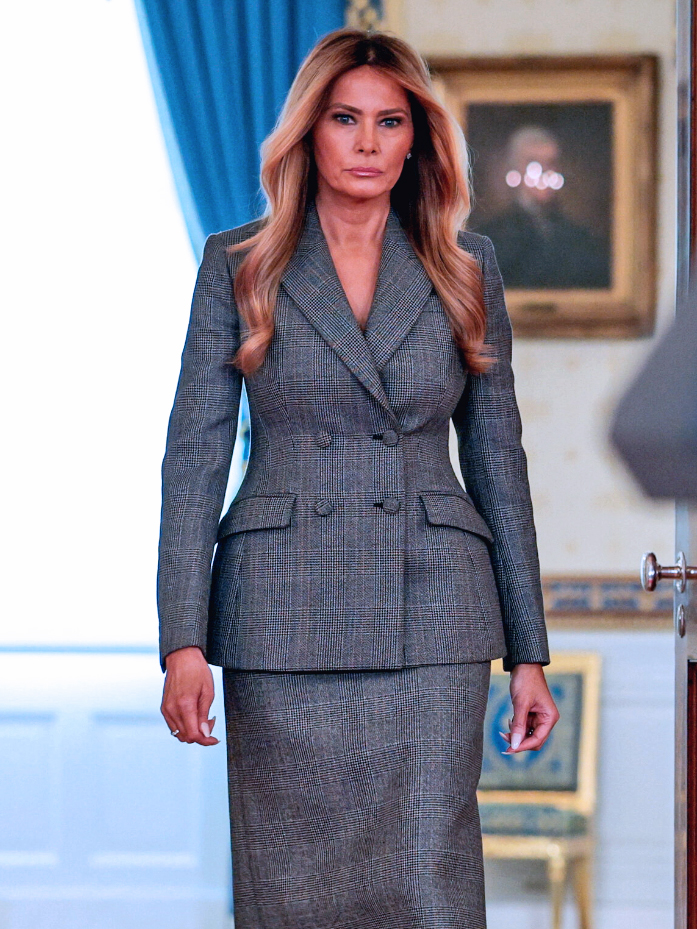
Melania Trump has, once again, brought power dressing back. Well, she never really put it aside. But this time, the projection of power is vital. She was not there, on the White House foyer, to dress for success. Admittedly, we are quoting the title of author John T. Molloy’s book of 1975, when Mrs Trump was five. Back then, Mr Molloy was basically saying that one should wear conservative, high-status clothing to manipulate how others perceive one’s authority and boost one’s career. But now, for Mrs Trump, her career is less a concern than her reputation. She appeared before the media—as her husband has been to defend a war he started—to focus on straightforward denial and reputational defense; she was seeking exoneration. And she had the ideal skirt-suit for it. In fact, it looked to be something she had worn before: at the signing of the Take It Down Act in May 2025. According to WWD, the suit she wore then was from Prada, a surprising choice for a woman glued to a more traditional vision of feminine dress. In fact, it was and still is a clinical pivot. Prada is the brand of the intellectual; by wearing it (or appearing to), she pulled a brave front against the rumours rather than just out-glam them.
Even that suit did not make a first-time appearance then. It was reportedly used for a shoot for a profile with the European media prior, and also worn to other close-door events. It is impressive enough that Mrs Trump recycles her sartorial choices. But media reports are emerging that she wore Dolce & Gabbana for that White House announcement. If that is correct, it would, no doubt, be on-brand for her. Her supporters (mainly her husband’s supporters) say she is “consistent”. So was Barbara Bush. To be sure, the tailoring was impeccable—much easier to keep the accent charming when your collar was reinforced by Italian wool. But, whether it was Prada’s clinical intellectualism or a Dolce & Gabbana cinched defence, the intent was the same: to project a silhouette of stability where the message was reactive. Both suits were double-breasted with pronounced lapels; both in the grey of battleships. She wears no shirt beneath, no jewellery. By stripping away the glitter of the traditional first lady—the pearls, the silk blouses—she creates a look that was entirely functional and severe. It was less an outfit than a uniform for a high-stakes deposition. Both looks comprised single outers that were sufficient shields against the scrutiny she had long dodged with admiral-like persistence. The formal outfit and the formal foyer with the nation’s flags signalled a state institution defending its borders, rather than a wife defending a marriage.
The tailoring was impeccable—much easier to keep the accent charming when your collar was reinforced by Italian wool
The term “power dressing” emerged as a distinct fashion philosophy in the late 1970s and peaked in the mid-1980s. It was designed to help women establish professional authority in corporate environments that were historically dominated by men. Names that come to mind are Anne Klein and, a little later, Calvin Klein. Initially it was about blending in. If you could not be one of the boys, you could look like one of them. Then it became about asserting dominance—the silhouette augmented authority, projecting confidence in the corporate boom era. Now, as Mrs Trump wore her reimagined suits of power, they no longer signaled entering or conquering largely male spaces. It was more about projecting legitimacy and composure in the face of scandal linked to a man, specifically Jeffrey Epstein. The continuity is the suit as a symbol of control, but the cultural function has dramatically shifted from gender to reputational politics. If Mr Molloy’s Dress for Success was about climbing the (corporate) ladder; Mrs Trump’s power suit was trying to keep the ladder from being kicked out from under her.
These days, a scandal is simply another piece of content to be “re-authored”, to use a trending phrase. You can deny the accusations, but you still need to assert that you won’t stand for them. What should have been flickering tabloid campfire. and stayed that way, was turned into a high-definition national broadcast. Mrs Trump opened her five-minute speech, after wishing those before her a good afternoon, with the negative, making the scandal the primary witness: “The lies linking me with the disgraceful Jeffrey Epstein need to end today.” No pleasantries. There was rhetorical fragility infused into that steeped opener. By establishing that the allegations levelled at her are “lies”, she immediately centres the rumours rather than her own authority. Compare that to Michelle Obama’s “when they go low, we go high,” which framed her speech around values rather than opponents. And by employing the adjective “disgraceful”, she didn’t just describe Mr Epstein, she disqualifies him. It makes him someone beyond the pale of acceptable company. Now, she wasn’t just denying rumours anymore; she was declaring a moral judgment. First, she cleared her name. Then, she took his.
What should have been flickering tabloid campfire was turned into a high-definition national broadcast
The Grand Foyer speech might have served her better if she had sent it out as a written statement. It is unclear why a public appearance was preferred when she won’t take questions. A communiqué from her office would have been logically superior for accuracy, but, presumably, it lacks the theatre of defiance that the administration requires. In the spectacle economy, a PDF sent to the media is easily dismissed as staff-written, lawyer-advised, or edited to hide the truth. It can’t be expensively togged. It has no heels to click on marble. Mrs Trump’s spruced, suited appearance projected a specific kind of pained authenticity, one that probably required many hours in front of a mirror to look like she has spent the past years resisting being swallowed by scandal. Making everyone sit (or stand) through her speech and then watch her trot her well practiced steps back into the White House (she was already seen catwalking out) had the making of Melania II. That walk back was a visual punctuation mark. It exclaimed: “I have said my piece, and I am above the fray.” A written statement would have no exit; it just lingers, like cheap perfume, waiting for the stink to bother.
But what truly distracted during her brief speech were the wonky syntax and pronunciations. Catergorise as “caterise”, encounter as “a counter”, convicted as “convinced”, and unfounded as “unfound”. She dropped not only syllables, but the apostrophe. She said with certainty, “Epstein abuse of his victims”. She was even inconsistent with her pronouns. She went from “Donald and I” to “Epstein and me”. “I” could suggest intimacy and “me”, not? Instead of cleanly severing the association, her phrasing left traces of ambiguity—exactly what she desperately wanted to avoid. In moments of moral declaration, such stumbles and mispronunciation undermined the authority of the message, making her denial sound less like a shield of truth and more like a paper-beaded curtain in high wind: decorative, but remarkably easy to see through. And all of these came from the advantage of reading from a script. As it turned out, Figure 03 is the true orator.
Photo: Reuters
 Style on the Dot