Lisa’s new single, in collaboration with Anyma, could have been written for the pop elite, but will mostly likely be blared on the bikes of food delivery riders

You have seen and experienced it before. You’re walking on a footpath, heading to the MRT station. The day is scorching, but you are in a terrific mood, looking forward to lunch with your besties. Then suddenly something behind creeps up. It isn’t tangible, but is still physical—an aural intrusion as polite as the slurp of sucking through a straw in a quiet cinema hall, but a hundred times amplified. It starts more like a soft hum that very rapidly turns into a strident blare. Before you realise it, the food delivery rider whizzes past you, a sore of sound. He stops at the traffic light ahead, the music relentless, its deep, pounding bass shatters the rib cage, the environment in total surrender, even if for 30 seconds. You have heard it before. And you will soon be hearing it again as Lisa’s latest song Bad Angel hits the airwaves. Bless you.
Lisa’s new single is an old irritation. A track made in collaboration with the Italian multi-disciplinary entity, Anyma, it’s a darkly cinematic mood piece with a throbbing, not pulsing, bass that is more a physical force than a melodic line. It’s a heavy, low-frequency rumble that the rib cage feels first. When heard through a pair of headphones, it is unapologetically industrial, with distortion and resonance that evoke angry machinery rather than traditional instruments. Above that, the repetitive melody leans on shimmering synths and processed arpeggios, often metallic or glass‑like, as if shatters that were promised a floor, but decided a strobe was much more their sense of urgency. This is food delivery rider music, through and through. You will very quickly hear it on the way to the MRT station.
the repetitive melody leans on shimmering synths and processed arpeggios, often metallic or glass‑like, as if shatters that were promised a floor, but decided a strobe was much more their sense of urgency
Despite the Italian multi-disciplinary branding, the song’s true functional habitat is the handlebar, so too the over-eagerly Autotuned vocals of Lisa. It is known that, among the members of Blackpink, Lisa has the weakest vocals, making the post-production tinkering drive home the point. Anyma is the solo project of Matteo Milleri, an Italian-American electronic music producer, DJ, and a digital-media artist whose entire oeuvre is really based on an alternative universe of the dark and the relentlessly colourless. It’s when the shade of low-battery notification meets glitch-gothic gloom. A world that will go up in pixelated slo-mo and then reassembles itself, but still in that grey of lint. We were told that it is this world that Lisa inhabits—she, an augmented human, an indeterminate in Anyma’s “transhumanism”. But here is the humourless irony: While the robots of the world are looking and operating increasingly like humans, we have here a living Lisa trying to be a droid.
The music makes little sense without the accompanying music video. You can’t have Anyma music without the Anyma vista. Just as Lisa’s voice is processed until metallic, her image in the video is staged in cybernetic ruins. The machine‑angel-hybrid-as-白发魔女 (baifa monu, white-haired demon) sleeps on a catafalque, or for Asians who enjoy anything by 金庸 (Jin Young), what could pass off as 小龙女 or Xiao Long Nu’s 寒玉床 (hanyuchuang) or cold jade bed that has the amazing effects in assisting in the cultivation of qi, calming the mind and spirit, beautifying the skin, and clearing heat. At the beginning of the video, the bad angel awakens. And then she is restored her full energy and consciousness, but not from the magical powers of a stone bed, but through tubes connected to her leotard, rather than her skin or any entry point of her body. The bad angel clearly doesn’t have a spirit to calm, but a battery to recharge. Lisa was probably too busy to sit through half a day of make-up; she is operating on a schedule where blending refers to strategic alliances, not making her skin a zone to plug in. She moves on that bed or slab, as if a visual-language-action model, exposing her bare rump like a knowing sex doll. Bad Angel, you bet.
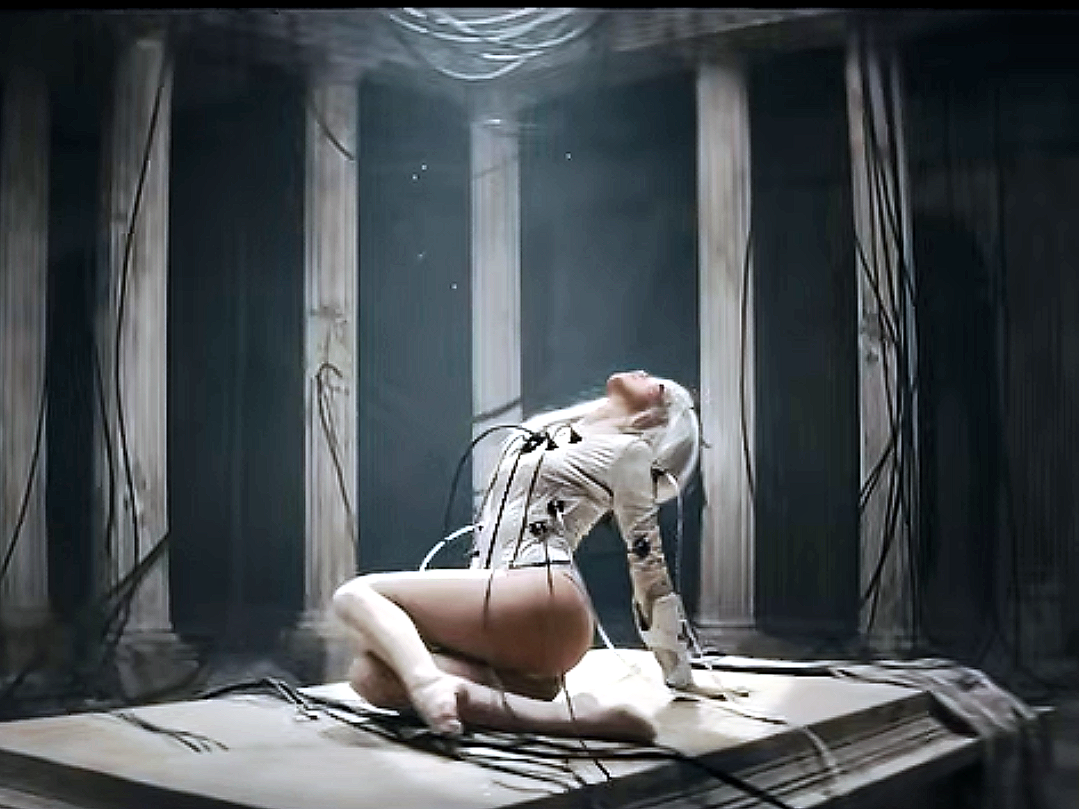
Lisa isn’t even a fully integrated cyborg; she’s just a model wearing a prop. When she leaves the bad Indiana Jones: Raiders of the Lost Ark set, she suddenly grows a pair of massive wings, but these are forelimbs of flight that need robotic arms to flap. Just a bad angel in droid finery. It is hard not to think of her Victoria’s Secret gig two years ago. As a performer on the VS show, her wings were meant to look light, ethereal, and magical—im sum, an unyielding riot of estrogen. Now, ensconced in Anyma’s parallel universe, the wings are heavy, mechanical, and literal. By showing the robotic arms holding them up, she exposes the ‘labor’ of the image. Clearly, she is no longer helping sell bras and panties. We remember when she walked for Celine, but she went from that to Victoria’s Secret, and then now a lost presence in a digital wasteland. Each stage seems to strip away more of the human. Increasingly, she is appealing less to the elite, and more to the street-level majority.
As soon as she took on solo projects, Lisa adopted a “bad” image, from being a Rockstar (who is major enough to occupy an entire Bangkok street in Yaowarat for her MV—not bad for bad) to ‘riding’ a bike at the VS show to being the fallen angel who admits, “I’m pretty, pretty bad for an angel” and delights in it. Lyrically, Bad Angel is bold, but shallow: it delivers catchy, rebellious, short-syllabic lines written for festival chants. What drew us was not her framing herself as a figure of stained purity, embracing independence and defiance, but the one line which she sings less as a command than a limp possibility: “I don’t wanna war when I say so.” In a track framed around angelic corruption and cybernetic shambles, the human plea inside a machine aesthetic is unexpected. With global conflicts and cultural fatigue around aggression, the line resonates, but only as convincingly as a woman playing a silicone mimic. In that sense, Lisa’s Bad Angel is emblematic: a processed voice is like process food, including those sent by delivery riders. You can’t believe it’s good for you, but you like it anyway. And that is bad.
Screen shots: wearelloud/YouTube
 Style on the Dot