A magazine, such as Vogue, is a window to the world. Putting the editor, even a former one, on the cover turns that window into a mirror
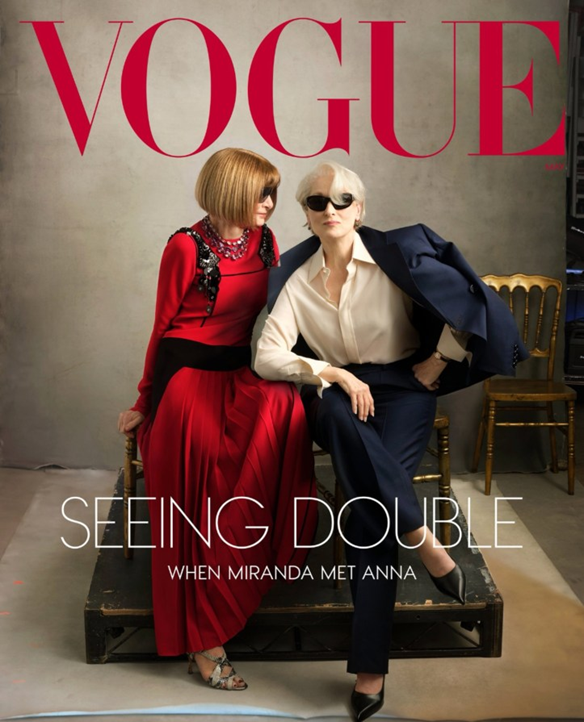
Devil times two. Photo: vogue/Instagram
The magazine business has changed, we kept being told. And nothing attests to that more vividly than Anna Wintour on the cover of her beloved Vogue. A title she has yoked to tenaciously for 37 years, Vogue has pulled itself away from ever featuring their editorial head—past or present—under their masthead. Likewise, we imagine Miranda Priestly would not put herself on the cover of the unimaginatively-named Runway. But there it is, the two Devils on guilt chairs as diabolical thrones. The cover photo was shot in a studio, with Ms Wintour appearing alongside Meryl Streep, aka Miranda Priestly, the fearsome celluloid editor herself. As Vogue avoids covers without the subject looking at the reader, at least one of them gazes at the camera: Ms Streep. Her companion. By contrast, did an ID-mag cover style, showing basically one eye, and behind shades (both wore sunglasses to play inscrutable). Ms Wintour looks somewhat yearningly, as if smitten, at the actress. A femme and an andro. This could have been the cover of Out. And nothing is quite compelling as a powerful 黄金年华 (huangjin nianhua, golden-year) industry titan falling in love with her own myth.
If Ms Streep’s gaze, even when obscured, is performing for the audience; Ms Wintour’s is posing for the mirror. But a mirror does not show you the future; it reflects the past, embodied by the present. And the past was definitely evoked. The stylist and photographer summoned are Grace Coddington and Annie Leibovitz. Ms Coddington is a former Vogue staffer who was the audience favourite in the 2016 documentary The First Monday in May. Her I-don’t-really-care-what-Anna-thinks attitude endured. She is probably the only stylist Ms Wintour trusts (not that anyone can tell her what to wear). Ms Leibovitz, a magazine photography veteran, is also a “court photographer” of the American establishment, having photographed presidents Barrack Obama and Joe Biden, and presidential hopeful Hillary Clinton. Ms Leibovitz doesn’t just take fashion photos; she takes official records. By commissioning her, Ms Wintour isn’t just partaking in a cover shoot; she is commissioning a state portrait. Does Ms Wintour view her tenure not merely a job, but one adjacent to presidency? While Vogue has made it position clear when it comes to the American election, it is not the White House webpage.
By commissioning Annie Leibovitz, Ms Wintour isn’t just partaking in a cover shoot; she is commissioning a state portrait
Vogue, as far as we’re aware—including access to a formidable private library of Vogues that go back to the ’70s—has historically never put its own editors-in-chiefs on the cover, not even Diana Vreeland, who was famously self-aware and theatrical, and entertaining. She never crossed that line. She cultivated myth through her columns, her persona, and later her museum work, but she never appeared as the face of Vogue, not even when she was credited with inventing the ‘blockbuster’ fashion exhibition, introducing theatrical displays and specific themes (such as The World of Balenciaga in 1973) that drew massive crowds. From the beginning, editors were meant to be invisible architects, not cover subjects, however influential they were. One former editor told us, “I don’t even us a photo byline.” Ms Vreeland understood that the cover belonged to the dream, not the dream-maker. But now it’s a different media environment (lest someone reminds us again), one where AI can presently take the place of a living interviewee after, for years, creating covers with imaginary beings or fashion spreads with the most ideal ratio of fashion models to lifestyle set. If Ms Vreeland cultivated myth through words and absence, Ms Wintour does the same through presence and cinematic alliances.
Many observers are saying that this is Ms Wintour’s way of cementing her legacy. We think it is more than that. No one has courted Hollywood as enthusiastically as Anna Wintour has, not even Graydon Carter! Most recently, she appeared on the Oscar stage—Hollywood’s own Hall of Mirrors—with Anne Hathaway to present the Best Costume award. She was performing a new role entirely—not the invisible architect of fashion media, but a visible participant in Hollywood’s own ritual of self-mythologising. But Hollywood has been on the horizon. A year before that, she orchestrated one of movie land’s most extravagant events, Vogue World Hollywood, staged in Los Angeles, blending runway, film references, and celebrity appearances. Unlike Vogue World: London or Paris, which leaned on fashion heritage, the Hollywood edition was pure cinema spectacle. Ms Wintour deliberately shifted the axis from couture to film, even if the show looked more a clumsy parody than filmic tribute. When we think about it, her affair with Hollywood went as far back as the first cover to feature a Hollywood star, the May 1989 issue featuring Madonna.
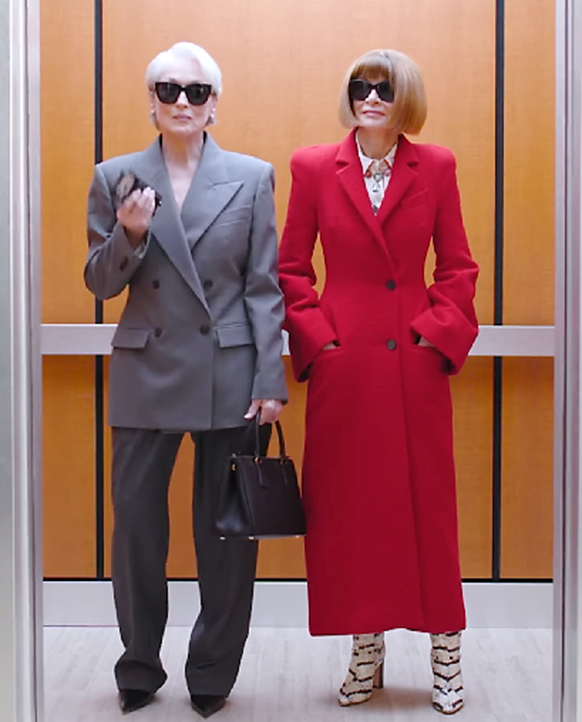
Miranda and Ann. Screen shot: vogue/YouTube
Even though Madonna was primarily a music star, she was already entangled with Hollywood, having by then acted in Desperately Seeking Susan (1985) and later Dick Tracy (1990). By choosing her, Ms Wintour was not just tapping into pop culture, but also courting Hollywood crossover appeal. A pivot to Hollywood now is really not far-fetched. There is an accompanying reel on Vogue’s YouTube channel that is a parody of the parody that is the Priestly and Sachs lift scene in the upcoming The Devil Wears Prada 2. This is the first time we see Ms Wintour “act”, if being yourself amounts to that. The dialogue between the two women is, at best, pithy. They are just trying to out-bitch each other, no doubt delighting the film’s fans. The reel comes with end credits that would not be less impressive than a Hollywood short, complete with gaffer and key grip. This was a production worthy of not just a global chief content officer, but a star of a very specific firmament. Ms Wintour would not let anyone point a iPhone at her. With the filmlet, she is no longer a journalist being interviewed; she is a subject being produced.
So what happened “when Miranda met Anna”, as the cover blurb seduced? Well, nothing much. The cover story was “moderated” by Greta Gerwig of Barbie fame, with Vogue’s editorial head, Chloe Malle serving as “court stenographer”, she wrote in the editor’s note. Just record, silently. This is a gaggle of grannies getting together to talk about life and how many grandkids between the two septuagenarian subjects and how much time they need to spend with the little ones. They are not talking to the reader, but to each other. Ms Streep has availed herself to the media since the start of her career and if she has nothing much to contribute to the conversation, it is understandable (but what she said about returning to DWP after 20 years is revealing. She clearly didn’t do it for another Oscar nod)). Ms Wintour, the impenetrable one, has all the conversational spark of a patient in mid-lumbar puncture. She offers only the most cautious, rehearsed lines—“It’s such an honor to be played by Meryl, however distant Miranda is from myself” when answering a question “about being 76”. That’s not lucent illumination; it’s perfunctory courtesy.
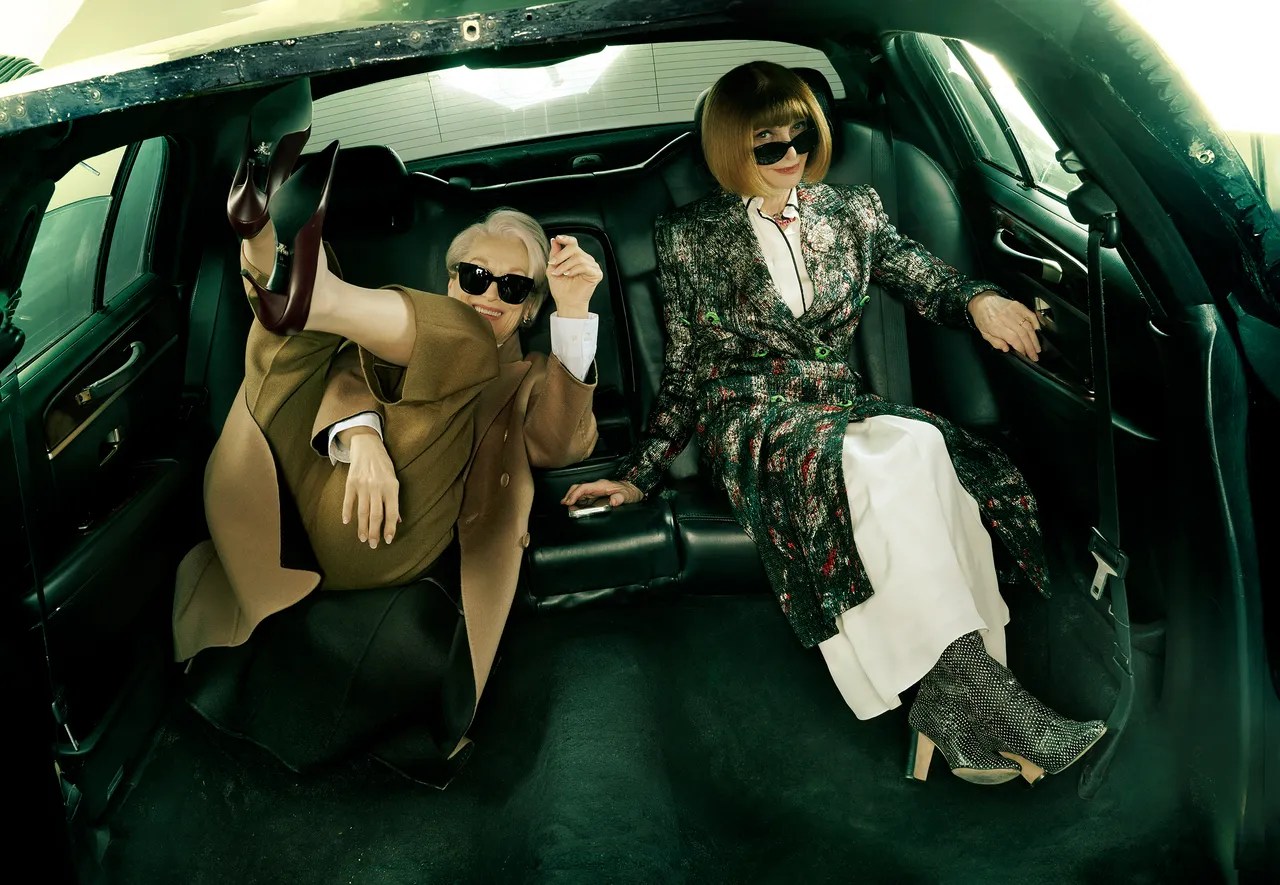
Who’s the woman? Who’s the man? Photo: vogue.com
When Ms Streep asks her, “Do you see that anyone will have a career like Karl Lagerfeld’s”, she replied, unaroused by the question: “I feel Matthieu has found the job of his dreams” and then went on about how the Wertheimer brothers are “patient”. If that response is meant to drain the room of energy, Ms Wintour succeeded marvelously. Of course this cover story is not designed to provide depth and detail. The questions are so general that you could fit her nice comments on a divinity stick and still have room for lucky 4-D numbers. The text is deliberately empty so that the Hollywood tableau can speak louder than words. She knows that any genuine revelation—like what her travel expense is during fashion week or who has replaced Andre Leon Talley as her gay best friend, as well as companion to her couture fittings—could destabilise her myth. The platitudes ensure that the cover story is about the idea of Anna Wintour, not her wisdom. Since editors were never supposed to be cover subjects, her very appearance breaks with tradition. But by speaking blandly, she avoids breaking character—a two-dimensional icon. Exactly as she is in that filmlet.
If Anna Wintour can’t even answer a question about the future of the industry without sounding like a corporate press release, the high altar is officially empty. She was once famously described as an “editrix”. The Vogue synonym is more than that. She is the consummate editricks. She knows all the hacks as early as MIT students using a ‘hack’ to describe a clever, unconventional technical solution. And now it matches perfectly with the era of the “life hack”, culminating in the best hack of them all—her own presence on the cover of Vogue. It’s the ultimate ‘editrick’: making the world believe that a 76-year-old global chief content officer promoting a movie sequel is the most fashionable thing that could possibly happen in May 2026. The irony is best expressed by Variety: “The person getting the most out of the long The Devil Wears Prada 2 press tour isn’t even in the movie.” Even the Hollywood trade press—the very firmament she is courting—sees the transparency of the hack. A fashion figure in her golden years, so infatuated by the caricature that she finally merged with it. It’s a hack unseen in the fashion world—disappearing into your own myth so completely that you don’t even realise the institution you lead has experienced a “disintegration”, as Meryl Streep so accurately described it, right behind you.
 Style on the Dot