The Nigo-led brand Human Made is expanding rather aggressively outside Japan with stores in Hong Kong, Seoul, and Bangkok in less than 19 months. Singapore can only watch, as a wholesale footnote
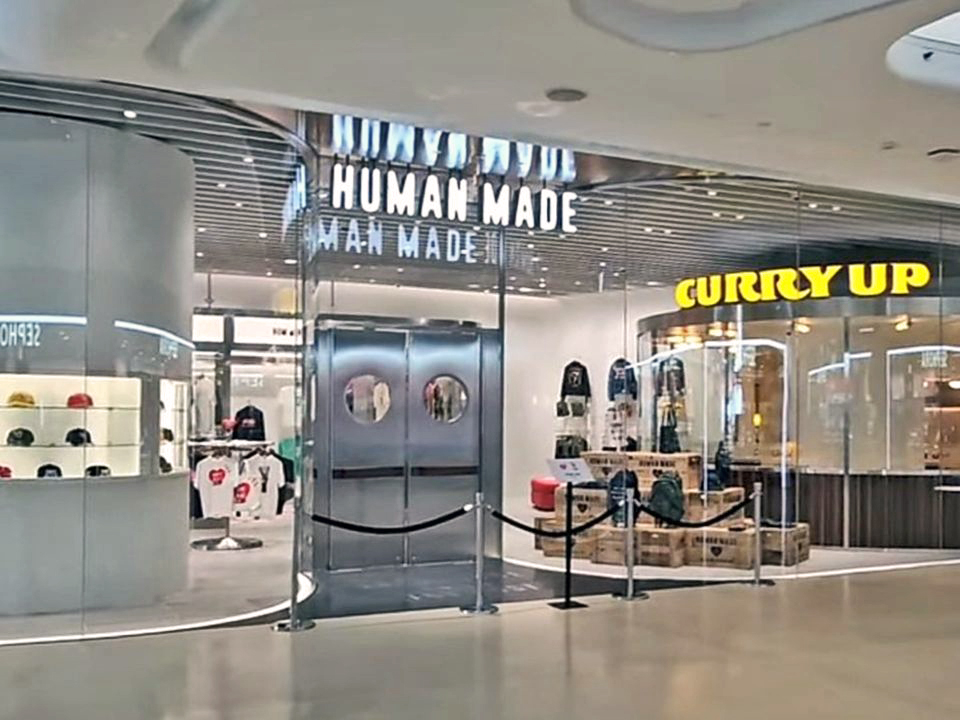
Human Made at Central Embassy, Bangkok. Photo: Jagkrit Suwanmethanon
Last Friday, still-in-a-brand-grab-frenzy Bangkok opened the city’s first Human Made store and its adjacent Curry Up restaurant at Central Embassy, the 12-year-old mall that is the luxury crown jewel of the Central Group. Still described as “the newest luxury mall” on their website, Central Embassy welcomed with fanfare the Japanese brand conceived by Nigo (born Tomoaki Nagao), in 2010 as a replacement for his doomed-for-him A Bathing Ape, eventually sold to Hong Kong’s I.T Group. The krungthep outpost is only the brand’s third city for Human Made in Asia after opening in Hong Kong and Seoul (excluding Japan). The company has been mum about plans for a Singapore store. At the opening, Nigo himself was in attendance, together with the usual bunch of media types and streetwear influencers, and stars, including Kunpimook ‘BamBam’ Bhuwakul (of Got7), who looked lost and was togged in a “Kaws Made” Tee-shirt that looked like a Uniqlo X Kaws, and so tight it would delight Gucci’s Demna Gvasalia.
The next day, outside the mall—designed by Future Systems alum, Amanda Levete—a very long queue was seen by motorists, pedestrian, and BTS commuters, stretching the entire length of the building’s façade on Ploen Chit Road and down the perpendicular Witthayu Road, and, according to news reports, all the way to Phetchburi Road, effectively forming a 1.1-kilometre of a human chain that could possibly be visible from space. This was remarkable considering that Central Embassy is widely known for its calm ambience that required serial ‘tuning’ of their retail spaces. Human Made is the result of what has been announced on the hoarding prior as a “new concept”—retail Siamese twins, a clothing store that comes with a restaurant in tow. The al fresco patience was reserved for what has been described as the brand’s “Bangkok exclusives”. Nothing says fashionably restrictive quite like standing in a three-hour humidity trap for the privilege of buying a THB3,590 (S$135) T-shirt with an elephant on it.

Second from left, BamBam, second from right, Barom Bhicharnchitr, and far right, Rei Matsunuma, CEO of Human Made. Photo: bambam_universe/Instagram
Or THB 10,650 (or S$400) Muay Thai shorts in a mall that sits on land that was formerly the British Embassy, for whom a line this long, even on visa application mornings, was probably rare. The opening frenzy was anticipated with a physical lottery held at Level LG of Central Embassy for entry to the store (participants were required to arrive between 7:00 AM and 7:30 am. Anyone arriving even a minute after 7:30 am was disqualified from the draw). Human Made’s dramatic entry into Thailand was made possible by what has been described as a “strategic retail partnership” between the Japanese brand and the Thai upstart Siwilai, a lifestyle and retail outfit that is the brainchild of Barom “Tay” Bhicharnchitr, the 4th-Gen scion of the powerful Thai retail family, the Chirathivats, ranked by Forbes in 2025 as Thailand’s 5th wealthiest, with a net worth of US$8.6 billion. Mr Bhicharnchitr is the younger of the two sons of Central Group’s vice-chairman, the highly-regarded Yuwadee Chirathivat, whose grandfather, opened the first Central Department Store, upon which the family’s riches were built. It is unsurprising that most Bangkokians consider the high-profiled “hi-so” Mr Bhicharnchitr, a “classic nepo baby”, as a local retail observer told us, which earned the maternal relative the reputation as an ostensible “rebel scion-prince”.
Nigo’s retail tenancy in Central Embassy is grandly designed as Human Made Land, according to media reports. It is no doubt a handsome piece of shop space—where the Dean and Deluca shop and cafe once sat—that conveniently faces the entrance of the link bridge to Central Chidlom, the grand dame of Bangkok department stores. But to describe it as land is rather staging a one-man opera in a photo booth. It looks less about the rai and more about a psychological enclosure, even if glassed. Human Made is advantaged by Nigo’s friendship with the Chirathivats—if not, at least one Bhicharnchitr, the scion-prince. Unlike his cousin, Natira Boonsri, who is seen as a “business prodigy” and is entrenched as the pacemaker of the heart of their family business, Central Department Store, Mr Bhicharnchitr augments the Group’s vibes. He was first made marketing director of Central Embassy before becoming the MD. Siwilai was launched in 2014, amid one of the ‘remake’ exercises of the mall. It is deemed a successful multi-label clothier and “cultural curator” that also spawned food and entertainment businesses, including the resuscitation of the first Central Department Store, named Central: The Original Store, in the Charoen Krung neighbourhood of Bangkok. That, however, did not joyously share the success of Siwilai in Central Embassy.
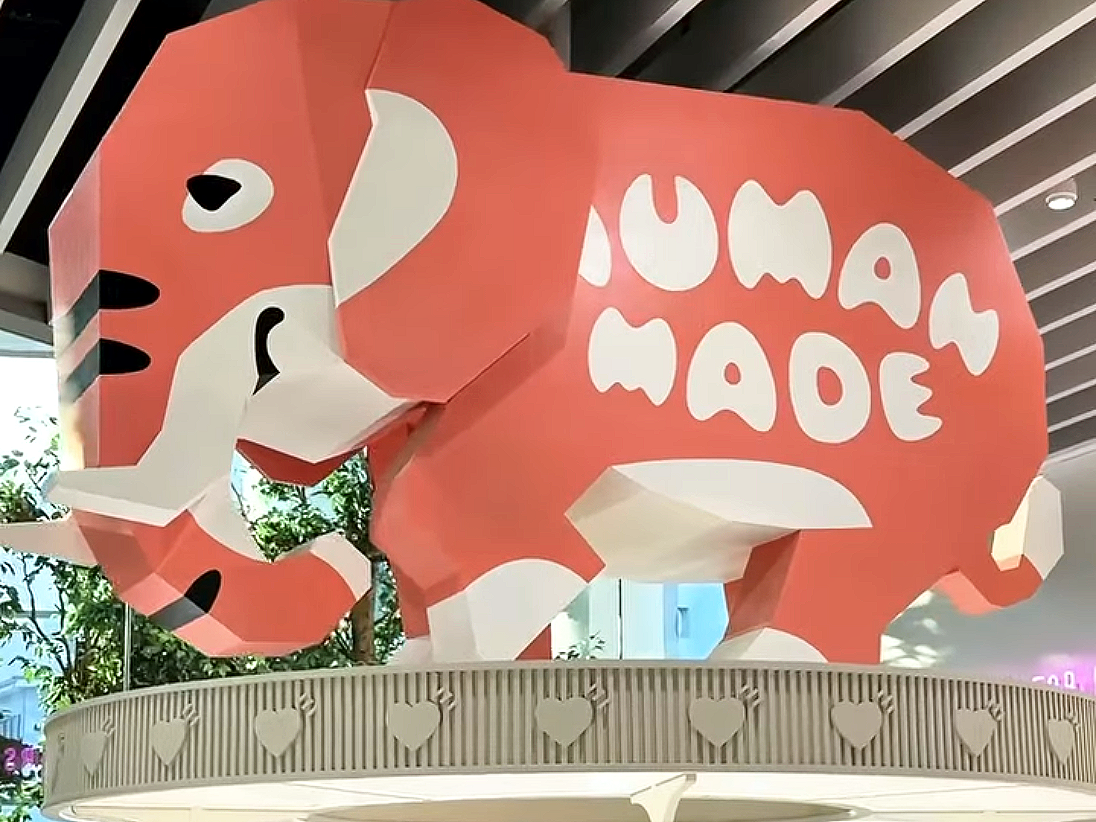
The Human Made Thai Elephant that sent Bangkok into a state of bear delirium. Photo: jagkrit Suwanmethanoj
Siwilai is arguably a triumphant curation of what Bangkokians, especially guys, want to buy in the capital city. Central Retail Corporation, especially through its distribution arm Central Marketing Group (CMG), had always played it safe when it came to a lively brand mix. To be certain, CMG did try. In 2013, there was a retail experiment in the form of Next to Normal, sited at CentralWorld. This uncharacteristically Central product attempted to push a more “forward” and youthful merchandising approach, which on the selling floor, did not look like a bunch of oldies trying to sell young. They stocked American names like Thom Browne and the now-defunct Hood by Air and Opening Ceremony; France’s Damir Doma, Maison Margiela, and Kitsuné; and Japanese streetwear stalwart Undercover and denim iconoclast Vanquish & Fragment. But in the end, the bold new frontier became a cautionary tale. CMG could not shed their commercial bent; they could not resist the urge to de-risk: they stocked Ralph Lauren to boost sales, but that was really a preface to their closure in 2019. That it could last six years wasn’t a total failure of taste, but a failure of stamina.
Mr Bhicharnchitr’s Siwilai, however, doesn’t need stamina in the traditional sense. It has a life support system powered by his mother and Central Embassy’s marketing budget. So it breached that conventional safeness that CMG tended to returned to. He took the cool of the tenacity of street style seriously. He stocked his store with a mix of Japanese streetwear staples, others from the U.S., as well as their eponymous house brand. Still, Siwilai is not Tokyo’s Nubian. Or Freak Store. What it does have to its advantage was Human Made. According to Bangkok streetwear lore, Mr Bhicharnchitr became chummy with the main man Nigo, just like a younger version of our Earn Chen (who was, notably, at the opening too). And the rest is a trajectory that led to the 1.1 kilometre Ploen Chit khiw on Saturday morning. This also made Human Made look good after the company’sTokyo IPO last year. A visual intervention that’s much needed after the financial mishap that Nigo found himself in while managing A Bathing Ape. Around 2010, the chatter was that the guy was straddled with ¥2.5 billion (about S$20.2 million) in debt. A year later, he sold his brand to Hong Kong’s I.T. Group for a song: US$2.8–3 million. In 2013, he stepped down as the label’s creative head.

BamBam with Nigo. Photo: Jagkrit Suwanmethanon
In some ways, it isn’t hard to see that Human Made is not wildly different from A Bathing Ape (Bape), at least aesthetically. There is always the cute animal graphics (an elephant for Bangkok—no explanation required), but how far forward the chang could amble is not immediately apparent. Bape’s eventual fall from grace was not hard to discern: Once the Shark Hoodie was in every mid-tier mall, the Ura-Harajuku magic died. The one thing in Nigo’s favour now is that, while at Bape he was largely a one man operation, he presently has a business partner for Human Made: Pharrell Williams. And in Bangkok, he has the retail support from Mr Bhicharnchitr’s Siwilai. Human Made has the balance sheet to survive, but the Bangkok flagship is a high-stakes gamble on the ability of the Central heir with a colourful social reputation to be an operator rather than just a curator. Inside the glass-walled Human Made Land, both should not be as interchangeable as a tuxedo and a tracksuit. If his new charge is given the Central: The Original Store treatment, it will be a very expensive museum for clothes nobody buys.
On Saturday morning, some Singaporeans were seen (more like heard) in that rather linear queue. They had flown two hours the day before to get in line as dawn breaks to buy pieces from a brand that is already available in our city-state through Club 21 at Como Orchard (except the Bangkok-only pieces). It is telling that some Japanese brands are bypassing Singapore, the supposed gateway to Southeast Asia, for bigger retail hotspots in Hong Kong and Thailand. There is a beautiful duplex Club 21 store nearby (designed by the irrepressible Studio Krubka, one of Bangkok’s go-to architectural firms) at the new One Bangkok mall, and Human Made would feel right at home there. But that would not be their Land. They would be just another brand on a hanger, as they were in Siwilai. While Club 21 is a powerful tenant at One Bangkok and soon, at Icon Siam (also designed by Studio Krubka), Barom Bhicharnchitr owns the vision of Central Embassy. He can give Nigo terms that even a retail powerhouse like Club 21 might struggle with: the ability to run a boutique with specialised exhaust system for a curry kitchen next door, in a luxury mall, and the freedom to hold lottery-style entry events that disrupt normal mall flow. In fact, Club 21 can do the same for them. Nigo just needs to be chummy with someone there.
 Style on the Dot