BTS is just a pop act, and yet their comeback was treated like a matter of state
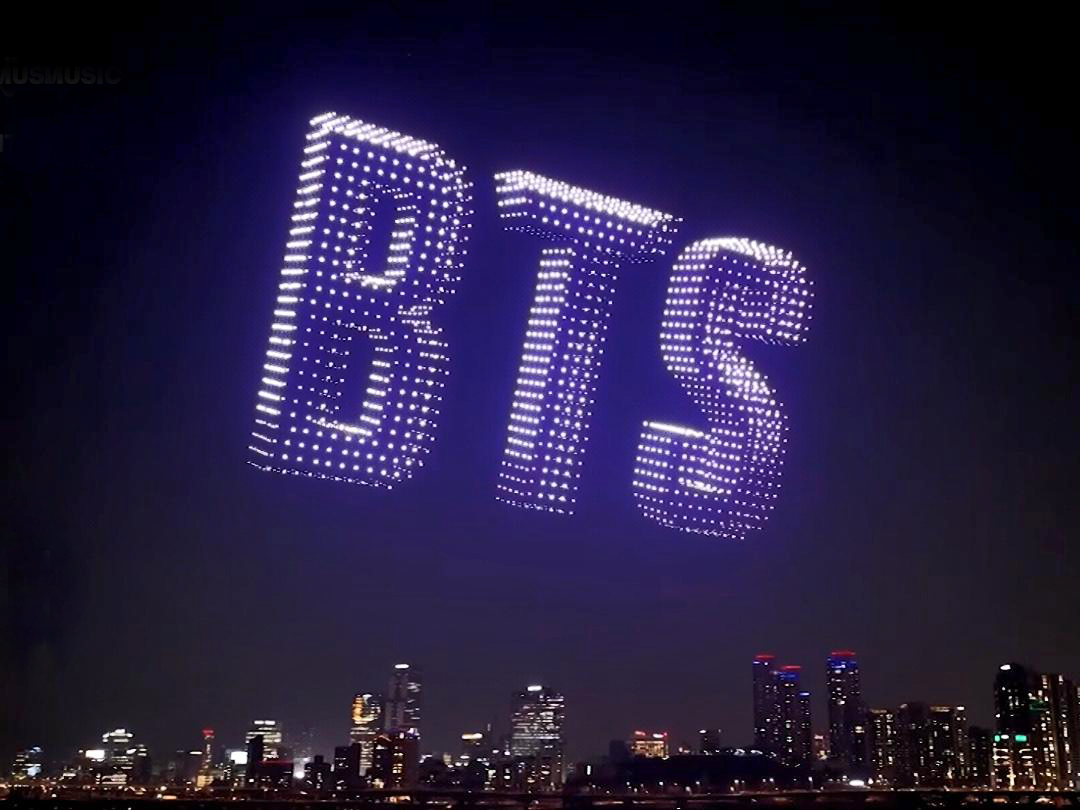
Drone show that accompanied the concert. Screen shot: CNN
By now, you’ve surely heard the roar of the BTS comeback last Saturday, even if you didn’t catch the Netflix livestream yourself. Central Seoul was shut down for the ticketed, but free performance, staged in Gwanghwamun Square, a major 555-metre-long public plaza, with the Gyeongbokgung Palace in one end. That late-14th-century citadel synonymous with the Joseon Dynasty provided the backdrop to the show. It wasn’t just a return to the stage for BTS after a 4-year hiatus due to the military obligations of RM, Jin, Suga, J-Hope, Jimin, V, and Jung Kook; it was a full-scale cultural restoration: eye-popping, kinetic, and loud enough to turn the Richter scale jumpy. Seven men able to make 70,000 people lose their collective minds simultaneously is not an act of the divine, but logistical overkill. And that estimate only reflected the live crowd, a mere fraction of the global fallout. According to the group’s parent company, HYBE, 104,000 members of the ARMY thronged the venue, but city officials and the police placed the figure at 40,000 to 42,000, which significantly fell short of the pre-show estimate of 250,000–260,000. (It was reported that the shortfall triggered a drop in Hype shares this morning.) The designated seating area on the grand boulevard Sejong-daero itself could have been the site of a political rally.
With the event streaming on Netflix and security being so intensive, the attendance not meeting expectations was no surprise. The figure now pale in comparison to the 2002 Korea-Japan World Cup, when massive crowds of 200,000 to 250,000 gathered to cheer on the home team. As fans pointed out online, stepping into Sejong-daero last Saturday was to enter a fortress, not a festival. With the conflict in the Middle East escalating into its fourth week, South Korea treated Gwanghwamun Square as a high-value target rather than a mosh pit. According to The Korea Times, over 6,700 police officers and tactical units were deployed—a staggering contrast to the mere 137 officers present during the 2022 Itaewon tragedy. Attendees were funneled through metal detectors at 31 gates, navigating a triple-layer barricade system that made the ‘Golden Ticket’ zone feel less like an invitation and more like a high-security enclosure for a state funeral. Reuters did not hesitate to label the measures as “draconian”, and they did not exaggerate. In a world where a regional war can turn a pop comeback into a strategic vulnerability, the digital front row of a Netflix stream has never looked more inviting. Or, safer.
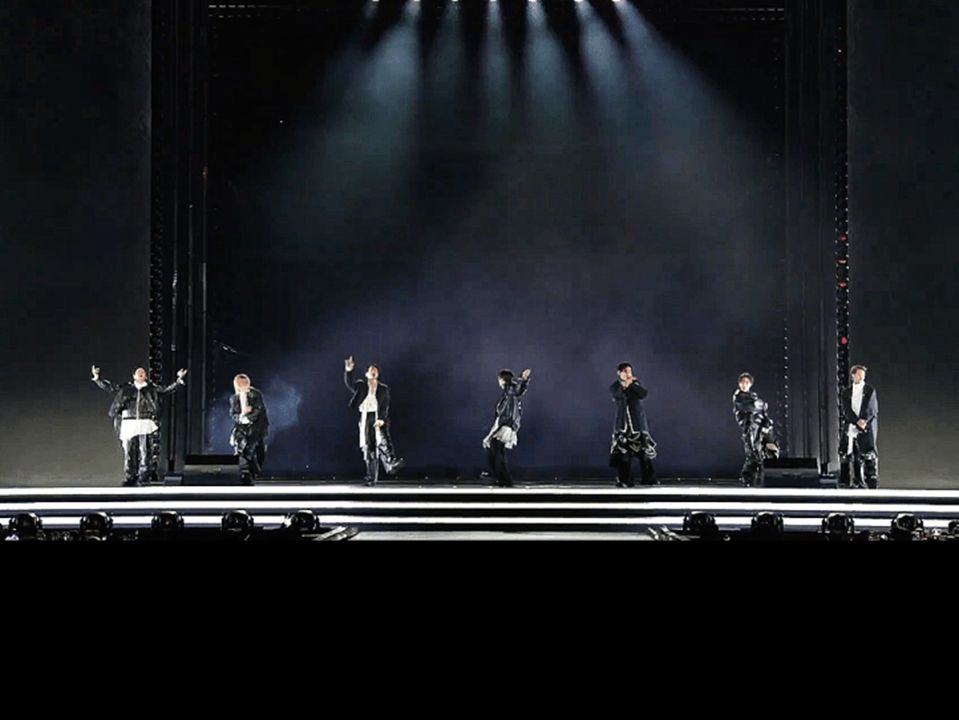
The main stage. Screen shot: Netflix
As the crowd moved into the venue and around it, what was also missing in impressive numbers were purple hoodies or anything in the colour of Barney the Dinosaur. It was not a mystery why that was so: The concertgoers were mostly bundled up because, while the sky was clear enough for a drone show designed to elicit screams, the evening was chilly. According to Accuweather at 8pm, the temperature in Seoul was 8°C, with a Real Feel of about 4°C. Many of the Southeast Asian fans were mobile insulation projects. But on stage, the seven members of BTS were artfully layered, their lankiness preserved. They were not imitating the Michelin Man. Customised by Korean designer Jay Songzio (of the Songzio brand), the clothes were a “lyrical armour”. For “the world’s biggest boy band”, according to the Financial Times, concert costumes would not be enough. They had to be something more than what Stray Cats would wear on stage. They had to be individual fortification. Armour implies weight, seriousness, and defense. It elevates fabric into something symbolic—shielding idols from vulnerability and,most likely, criticism. But they were not hard shells. Rather, they flowed with the body, dance with the wind.
BTS’s might is already immense. But rhetorically, armour is about legitimacy. It transforms stage wear into civic symbolism, insisting that these men are not just idols but national treasures carrying history. According to Jay Songzio, his designs for the post-military men embody “the spirit of a new generation of heroes”, “from the figures who shaped Korean history, valiant warriors, scholars, statesmen embodying dignity and intellect, and artists of profound insight and inspiration.” He mentioned that each member represented an archetype—RM as the “Hero,” Jin as the “Artist,” etc. BTS was now at a juncture where they were no longer required to be made stars. Now they are being fashioned as national symbols—the pop-stars-as-emissaries. In front of Gyeongbokgung Palace, we saw the perfect tableau. To steal a now-trending phrase, they were being re-authored. It is, however, hard to know if the ARMY, mostly watching the concert from massive screens, got all that or even superficially absorbed the full weight of Songzio’s designs, overloaded with the rhetoric. It was for the record, not the crowd. For the ARMY, the spectacle is about reunion, joy, and pride—not parsing archetypes.
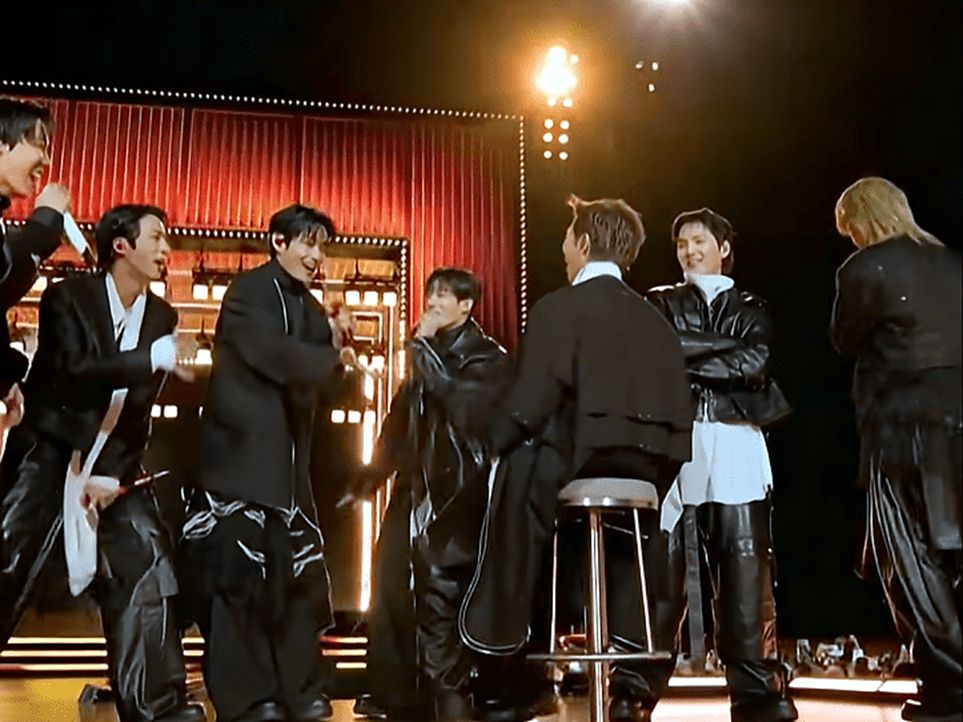
The get-back-together performance of the year. Photo: Netflix
Perhaps the members of BTS also armoured themselves against the passage of time. When they started in 2013, they were teens—Jungkook, the youngest was just 15. But now, at 28 to 32, they had outgrown the guise of adolescence. Armour was needed because they reframed maturity as dignity, shielding them from the “loss of youth” narrative. The spirited clothes, with many faux skirts (essentially airy versions of the ancient Greeks’ pteruges that warriors wore), and tapes and gapes that appeared to have a life of their own, dramatised BTS’s transformation from youthful idols to cultural ambassadors. Blackpink could continue to sell cuteness laced with sexiness, but BTS had to be cloaked with scholarly seriousness. Yet, the guys were still sticking to aegyo (cute). The attempt to project maturity through tailoring with moments of forced cuteness created the uncanny tension: grown men in couture still expressing cute. Fans are conditioned to expect eternal youth, but idols are mortal. The comeback allowed the audiences to confront the passage of time, but the production tried to overwrite it. The ‘boy’ in the band endured.
Netflix covered the full production cost of the free Gwanghwamun Square concert, estimated at ₩10 billion (about S$8.6 million). HYBE retained broadcasting and IP rights, but it was, ultimately, Seoul’s night. The capital city was shown off to the world like a high-spec Samsung smartphone held up in a dark room: luminous, impossibly sleek, and slightly distracting. Central Seoul was effectively shut down for the concert, with major roads closed, subway stations bypassed, and buses rerouted. It showed us that in today’s world, brilliance isn’t the prerequisite for influence—scale is. In one night, for an hour, BTS was elevated from K-pop stars to symbols of Korea itself, which might have explained why they wore not a shred of Louis Vuitton, their long-time clothier. They didn’t need a French luxury house to validate them. They preferred their national armourer Songzio. This wasn’t a commercial endeavor; it was a sovereign one. The comeback performance was engineered to erase their inevitable hiatus, to make the absence feel like continuity, a ritual of non-disruption. Seoul didn’t care if their boys looked older; what mattered was that BTS still functioned as a symbol of national prestige. The expensive machinery of spectacle ensured that when they returned, they appeared as if they had not left, perfectly synchronised, perfectly styled, perfectly intact.
 Style on the Dot