Markwayne Mullin is a relative unknown until now. At the recent Senate hearing, he tried to be defiantly aggressive, but more so was a little detail his attire—the cocky dimple of the delicately-coloured tie
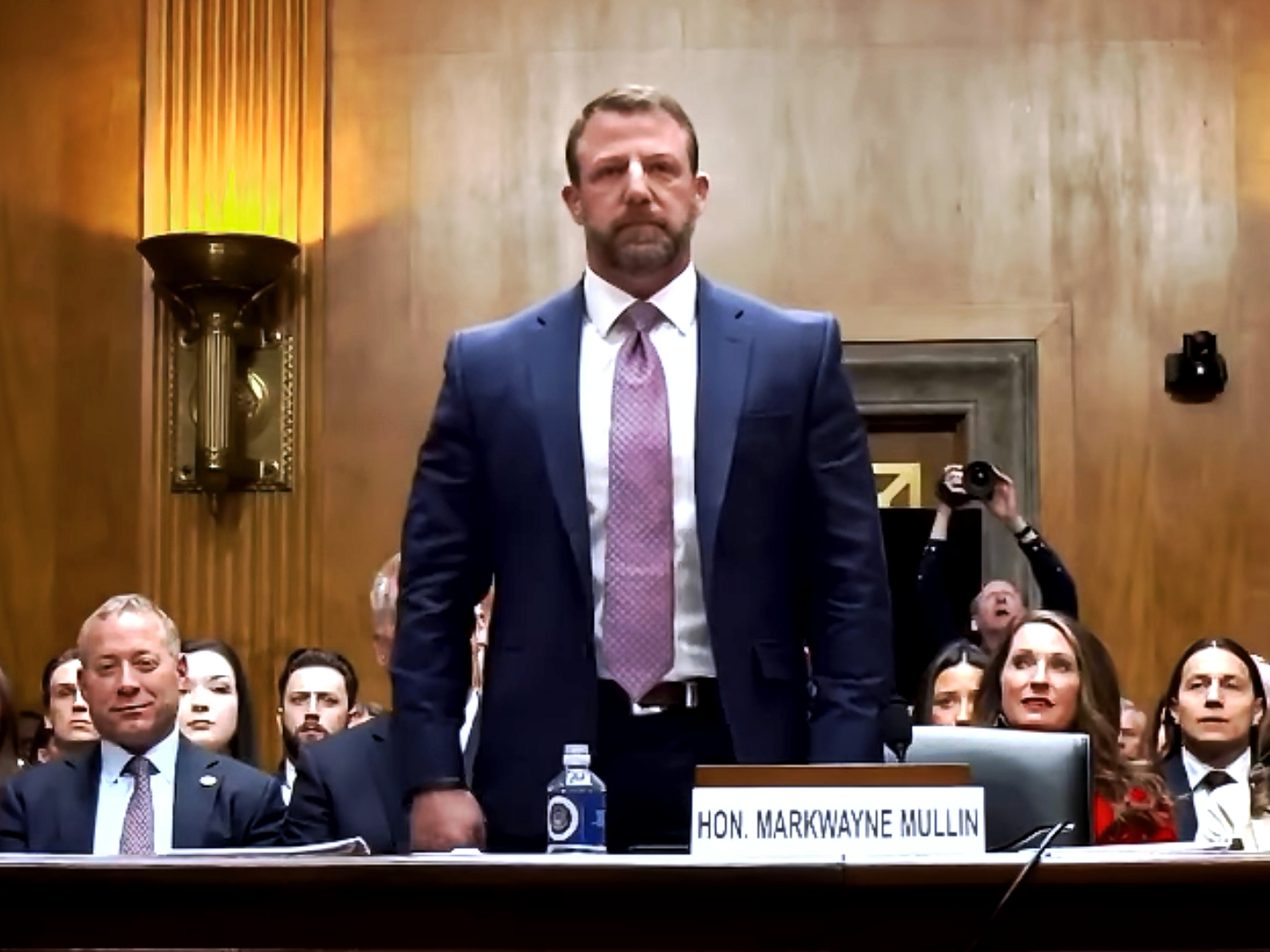
The U.S. Senate confirmation hearings are not new, but in the contentious Trump years, they tend to feature partisan combatants than those filling a cabinet role. There is another to join the long list: the short-fused firecracker in a wool suit, Markwayne Mullin. He is Donald Trump’s pick to replace the secretary of homeland security Kristi Noem, whom the president fired, very unceremoniously two weeks ago. The session was a textbook case of how confirmation hearings under the Trump administration became less about vetting competence and more about partisan spectacle and personal combat. The session notably didn’t just start with policy; it began with a personal grievance. This stemmed from Mr Mullin’s past remarks about the chairman, senator Rand Paul. Two of Mr Mullin’s comments set the tone for the clash: his sharp retort calling Mr Paul a “freaking snake” and his claim that he “understood” why Mr Paul’s neighbor attacked the latter in 2017. When the nominee refused to apologise, the clash turned deeply personal, shifting the focus from homeland security policy to a TV showdown of integrity and temperament.
That’s a sharp departure from the Eisenhower or Reagan eras, where hearings—however contentious—were anchored in policy or ethics rather than interpersonal feuds. Now, you can’t tell if it’s a sober vetting of leadership or an absurdist morality play. For many of us who have not previously paid much attention to confirmation hearings, this is especially eye-opening because it blurred the line between institutional oversight and personal vendetta, with senators weaponising past grudges in a setting meant to evaluate national security leadership. This was more akin to schoolyard discontent than a serious political discourse. It involved people who no longer represent the American intelligentsia or sophistication. Where earlier eras prized competence, ethics, or policy debate, hearings now often showcase grievance, insult, and loyalty tests. Senators perform for cameras, nominees spar over personal feuds, and the institution itself loses its claim to represent American exceptionalism. In that sense, the Mullin hearing wasn’t an isolated clash; it was a symptom of how partisan theatre has overtaken governance, leaving the public with the pit instead of a pitch.
You can’t tell if it’s a sober vetting of leadership or an absurdist morality play
How does a man who slammed a fellow senator as a “freaking snake” dress for a confirmation hearing? He came ready for a mating ball. Mr Mullin appeared before the Senate in a navy suit of plain weave, possibly wool or a wool blend. It has uncontroversial notched lapels, beautifully boring buttons, and pocket flaps of no particular distinction. The fit was on the small side, constricted to better augment his heaving chest, with the sleeves narrow enough to offer the obligatory dent between the end of the shoulder line and the biceps so as to better show off the pythons. In tailoring, such a depression is called a shoulder divot. This is a common fit issue where the sleeve fabric creases inwards at the point it should smoothly meet the shoulder seam. It happens when the jacket’s shoulder construction does not match the wearer’s natural or bulky body shape. We know Mr Mullin was a plumber, we also know he was an MMA (mixed martial arts) fighter. Chosen work and sport as star exhibits of his personal museum of manliness.
So to show how gorgeously hunky he was, there was also the added lift at the end of the shoulders, unambiguous skyward peaks that form the pagoda shoulder. The line dips slightly from the collar before rising at the sleeve head, mimicking the curved, stacked roofs of a Chinese pagoda, hence its name. Also known to the Italians as the saddle shoulder, but unlike the natural, rounded shoulders of American suits, such as those JD Vance prefers, this was a statement of confidence, extreme tailoring, and dramatic style. This was certainly not a symbol of power in the style of conventional American tailoring, but European tradition that can be traced to the house of Balmain in the ’70s. But, to be sure, Mr Mullin’s suit bore not the striking strictness of Carol Christian Poell tailoring. It was more like John Varvatos trying to be edgy. The senator was possibly reminding his interrogators that he was once a fighter, but he gave the impression of a man straining against the role he was hoping to inhabit. European-style drama over heartland humility.
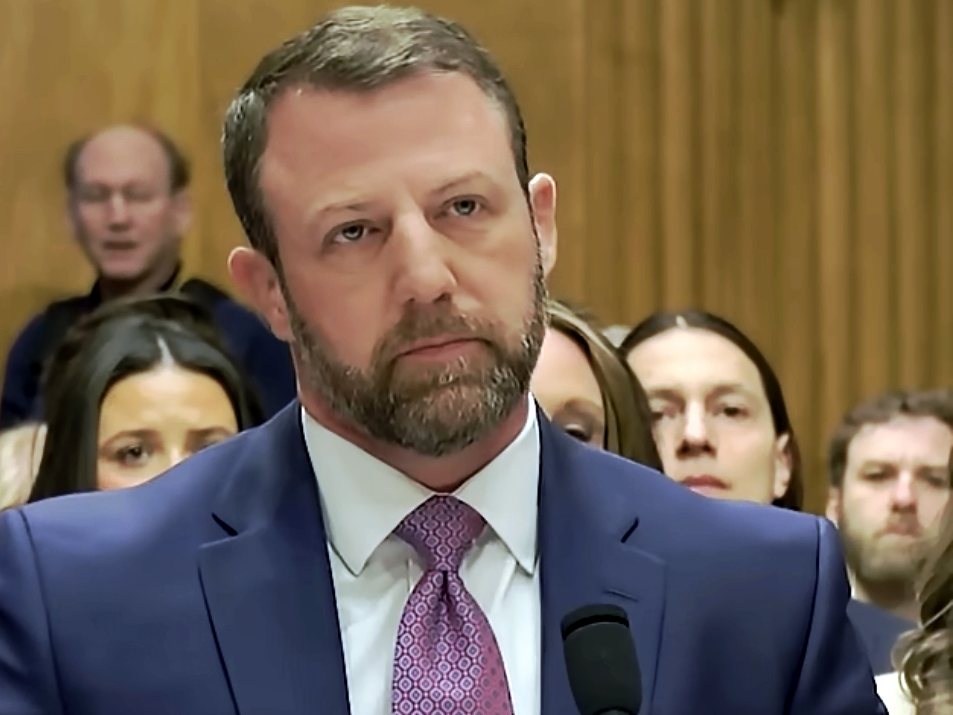
Perhaps the most unmissable was his tie. He picked an unusually light shade for a senate hearing: somewhere between periwinkle and calamine, in a foulard weave. The colour choice would be like wearing a white suit to the confirmation. So distant from Donald Trump’s frigid red. But the really eye-catching feature was the knot. It looked to be a full Windsor—substantial (to match his chin) and bold, its presence commanded attention and conveyed a sense of power and self-assurance in high-stakes environment, such as a senate hearing. Interestingly, in the James Bond novels, Ian Fleming wrote that 007 mistrusted anyone who wore a Windsor knot. He viewed it as a sign of vanity or the mark of a “cad”. But more fascinating was the dimple created beneath. It was a neat dimple and a large, flaring one. It is, in fact, not so much a dimple as a cavity—vivid, vacant, vaginal. If it was a mouth, it was ready to shout. The dimple added three-dimensional depth and volume, and was deliberately dilated to prevent the tie from looking flat or lifeless. Unlike Donald Trump’s.
By opting for a tie in Easter-egg pastel instead of the sycophants of the Hill’s preferred ‘Power Red’, Mr Mullin was clearly attempting to signal a temperament of “consistent kindness” (the very phrase Senator John Fetterman later used to describe him). Yet, the very boldness of the Windsor knot undermined the softness of the lilac shade. It was an old-fashioned power play rendered in softer hues, especially when the wife picked the tie. He wanted the authority of the knot to command the room, but he needed the sweet colour to stop the committee from feeling uncomfortable with or distracted by his history of boorish threats. It was a study in extremes: the raw, physical power of the fighter versus the meticulous, curated image of the diplomat. A man who condoned the violence inflicted on a fellow politician by the latter’s neighbour continued to use visual cues to show physical superiority. The irony is sharp: a nominee for homeland security—a role defined by managing force, discipline, and national security—was grilled not on policy, but on his own “machismo,” as Rand Paul put it, and his refusal to retract comments excusing violence. Markwayne Mullin auditioned to lead the nation’s force and discipline, but was undone by his own inability to discipline his tongue or his tailoring—a suit that couldn’t contain it, and a tie that handsomely distracted from it.
Screen shots: cbsnews/YouTube and CNN
 Style on the Dot