As oil prices and, by extension, polyester prices spike amid a war started by the Americans, Donald Trump is asking China for help. He should remember what his VP called the Chinese last year as China continues to stitch together the JD Vance paradox
Last year, when Donald Trump tried to be a “peacemaker”, as recommended by his wife, JD Vance was being hostile towards Chinese people. In an interview with the venerable Fox News in April 2025, Mr Vance said, “We borrow money from Chinese peasants to buy the things those Chinese peasants manufacture.” The disdain was clearer than varnish. Last weekend, in a chat with the Financial Times, Mr Trump demanded China send warships to help reopen the narrow Strait of Hormuz, the most critical chokepoint of world oil supply. The very next day, during a White House press conference, he stated that China “should be there” protecting the shipping lanes the Americans rely on. And the day after, at an Oval Office meeting, he linked the delay of the Xi-Trump summit to China’s lack of immediate help with the “excursion”. Were we back in primary school? It is surprising that his vice president did not emphasise to his boss, who to him is “smart”, that they do not need help from peasants or the weapons and ships the peasants make.
Of course, the peasants make their nation’s arsenal that Mr Trump is hoping China would use to further his war. But they also make the polyester resin that keeps the vice pesident’s American-made suit jacket closed and the elastane that allows his famously skinny pants to survive a media interview, especially with Fox News. Now, Mr Vance, who repeatedly called China “our adversary”, has to eat his words. We keep wondering if Mr Vance, busy attacking his perceived enemies, has even taken a close look at what he buys to wear. His supporters consider him one of the spiffiest dressers in the White House, but they and the man so admire have probably never considered that what he has on his dad bod, under those beautifully defined outlines of his eyes, comprises, even in bit parts, material made of petrochemicals. There’s a delicious irony in the spectacle of snazzy White House dressing, personified by another White House staffer, Karoline Leavitt, a huge supporter of made-in-China that she wears with striking regularity behind the podium of the James S Brady press briefing room. It’s a striking fashion statement: Nationalism in the streets, neo-liberalism on stage.
The peasants also make the polyester resin that keeps the vice pesident’s American-made jacket closed and the elastane that allows his famously skinny pants to survive a media interview
Mr Trump, Mr Vance, and Ms Leavitt may not be aware, but oil and polyester prices are indeed closely linked, since polyester is derived from petroleum. When oil markets are disrupted—whether by war, sanctions, or geopolitical manoeuvring—polyester costs rise sharply, rippling through industries from fashion to packaging to the Gorpcore water bottles so many people are now using. A fabric specialist based in Hong Kong told us, when asked how much polyester prices have risen, “possibly by 15 percent. But [Chinese] mills are not handing out price validity dates. (Some media estimates placed that at 20%.) They will only quote upon ordering.” China doesn’t just produce polyester (and kindred fabrics); they are the undisputed architects of the global synthetic supply chain, controlling a staggering 83% of the world’s polyester market share. Their other figures relating to polyester raw materials are just as eye-opening. For example, China accounts for 88% of the world’s Paraxylene (PX) supply—the essential building block for the polyester and nylon that appear so frequently in clothes. The Trump administration should be reminded that petrochemicals don’t just fuel cars and wars; they fuel the illusion of elegance.
JD Vance reportedly gets his suits from an Italian immigrant tailor Romualdo Pelle, a 90-year-old who operates in the Cincinnati suburb of Madeira (pronounced locally as muh-DEER-uh). So even when his suits are American-made, it may not be be entirely produced with materiel sourced States-side. We cannot, of course, perform a forensic laboratory test on the VP’s wardrobe, but the reality is, no suit today, even if handmade, comprises entirely of natural parts. A tailor of Mr Pelle’s pedigree typically works in ‘Super’ wools (100% pure new wools). But even heritage tailors are now increasingly forced to use performance fabrics—blends that incorporate polyester or nylon for wrinkle resistance, travel durability, and sit-down comfort of skinny pants. For a VP who spends his life on Air Force Two and at CPAC rallies, the all-natural route would leave him looking like a crumpled Erewhon paper bag within an hour. Assuming the shell of his suit is 100% virgin American wool, the guts likely tell a different and still compelling story.
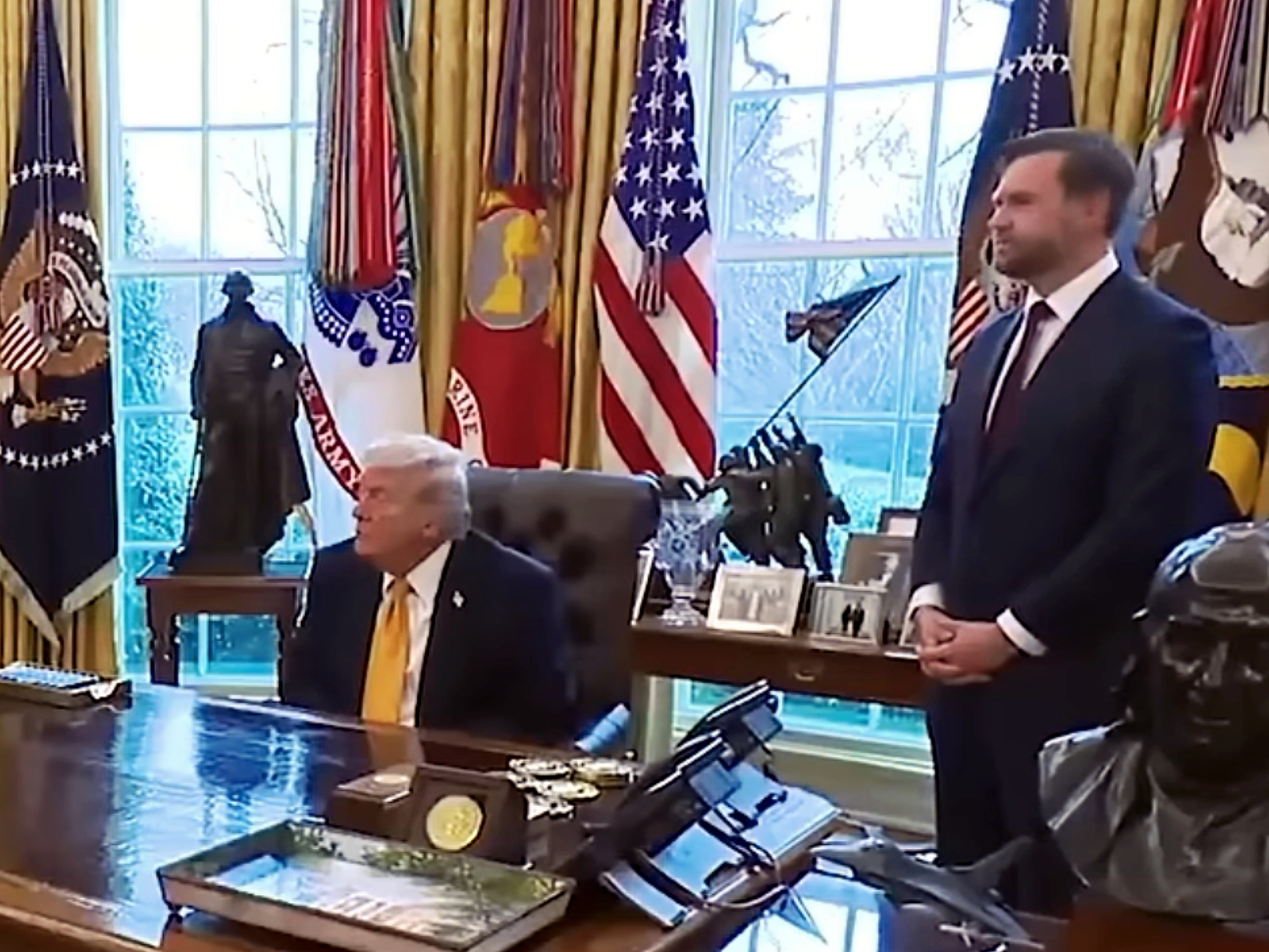
Donald Trump in the Oval Office, with JD Vance next to him. Screen shot: ForbesBreakingNews/YouTube
Modern suit linings are almost exclusively cupro or acetate or, to repeat, oil-based fabrics (domestic supply chain for specialised lining are, at best, limited). So too interfacings. The structural padding, for example, that gives his sharp shoulders their authority and his base cause for admiration is often a synthetic composite. In fact, for so many White House staffers, the transition from natural to synthetic materials is often hidden in plain sight. Mr Vance’s tailor may use, for example, genuine horn buttons, but chances are, he and the rest of his minions use unsaturated polyester resin buttons. These are engineered to perfectly mimic the variegation and swirls of real horn, but are essentially high-grade plastic. Polyester buttons are preferred for politicians because they are shatterproof. Real horn can crack during the rigors of a campaign trail or industrial dry cleaning. To maintain that pristine look while berating allies, the vice president likely relies on the durability of petroleum-based polymers. The unfortunate thing is, he is not aware of his synthetic dependency
In many ways, Mr Vance is right. He buys “the things those Chinese peasants manufacture” Yet he does not explain why he cannot be independent of the petrochemicals of that pesky “adversary” as America embarks on an “excursion” in the Middle East while his shoulder pads and buttons, down to his pocket bags are downstream products of a 宁波(ningbo) refinery. In his branding of the world’s second-largest economy as a primitive workforce, we must look at the literal threads that hold his public persona together. It is not just the oil-based polyester resin of his shatterproof buttons or the elastane that preserves the skinniness of his trousers as he belittles and berates China, it is the very thread in the seams of his American-made suits. As of March 2026, China controls roughly 75% of the global sewing thread market. Even ‘American-made’ brands like American & Efird (A&E) have shifted the vast majority of their manufacturing to high-capacity mills in Asia.
While Mr Vance lives his life against “borrowing from peasants”, his own spruced authority could be physically stitched together by their industrial output. He may not he aware—as he holds Chinese manufacturing in poor esteem, but there is a massive chasm between a garment being made in America and being grown, spun, and refined in America. JD Vance believes he has decoupled from the world, yet he cannot even stand up without the petrochemical-based, Chinese-spun thread in his trousers bearing the tension of his contradictions. The peasants’ threads aren’t just a figure of speech; they are the only thing preventing the vice president from a total, literal unraveling on the world stage. A made-in Cincinnati-statesman held together by a Ningbo refinery.
Illustration: Just So
 Style on the Dot