Just in case you mistake it for traditional Chinese brocade of Malaysia! Behati’s delightful product descriptions truly enjoy the prestige of being the country’s funniest
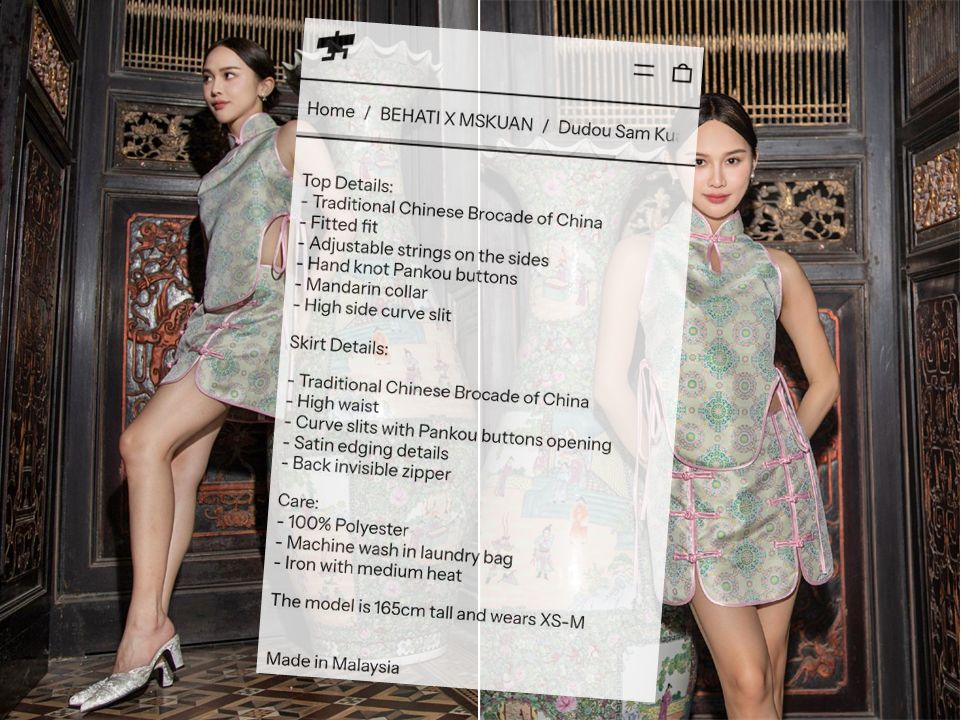
Bored during last month’s Chinese New Year holidays, we thought we’d scour Behati’s digital racks to see what festive delights we might find, only to be met with the seriously hilarious. We have always thought that the clothes are funny enough, but who knew the descriptions that accompany them make Ronny Chieng’s jokes on The Daily Show feel like a puckered seam on a rush-job? We were especially keen on the Behati X MsKuan collaboration, an ultimate cham (mixed in Hokkien, also this season’s theme) capsule apparently inspired by the hallowed corridors of Penang’s famous Cheong Fatt Tze Mansion. Even with the historical reference, the pieces, modelled by influencer Christinna Kuan (关丽婷 or Guan Liting), were as serious as a baju Melayu the size of a kampung house. Of course, just as impressive is that the legacy of a brand is so beautifully defined by an influencer’s follower count. In Behati’s world, the attention economy is the ruling raja of their little fandom.
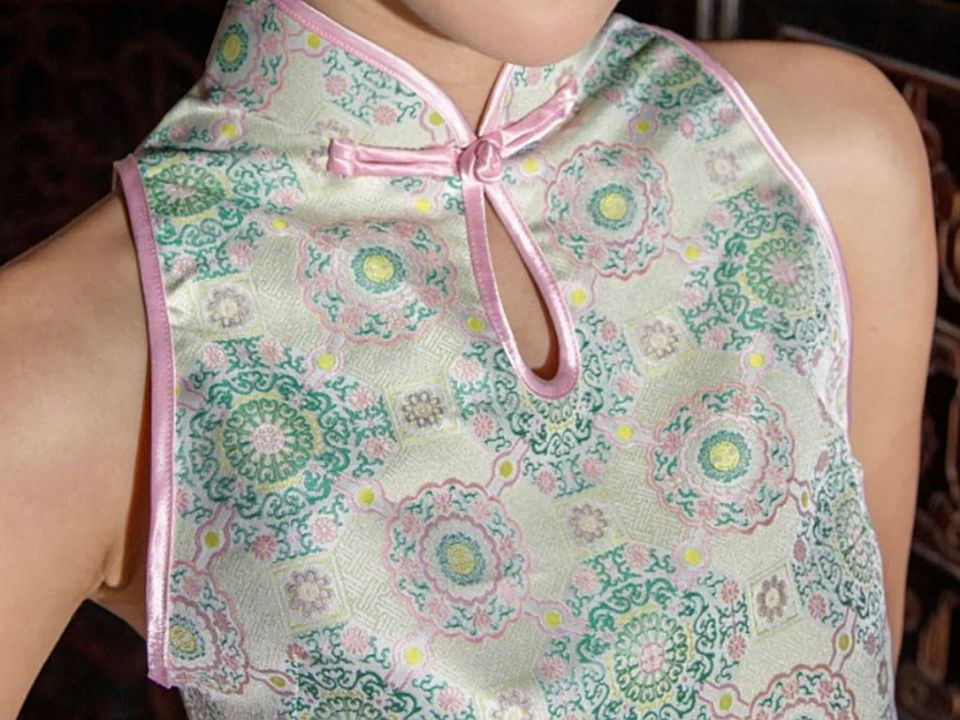
We are aware of their stunning cultural laxity, famous for taking a traditional form and inflating it until it becomes a karikatur. But we do not know that their genius also lies in their wonderful garment descriptions that aim at sounding starkly profound. We were struck by the information provided for one sexy “Dudou Sam Kuan” that isn’t a 肚兜 or an ancient undergarment that covers the front of the upper body. The “Top Details” in the product description revealed that it is made with a “Traditional Brocade of China”. This was such a learning experience, not of, say, 云锦 (yunjin) weave, mind you. That’d be too royal. Rather, it is the label insisting on reminding us that China is, in fact, in China. A revelation worthy of brocade. To understand how “traditional” the fabric is, we looked further down the list and saw that it is “100% Polyester”. Now, that’s traditional for petroleum-based monofilament that only appeared in the 20th century. You see, 100% polyester “traditional Chinese brocade,” provides all the costume drama Behati needs, made more stunning with coarse “hand knot pankou [盘扣] buttons”.
It is the label insisting on reminding us that China is, in fact, in China. A revelation worthy of brocade
But that wasn’t all. The five-word stutter is a mere starter. To tell you how the top would sit on your body so that you can make an informed purchase, it helpfully notifies the visitor that the garment is of a “fitted fit”. That could accurately sum up the top’s oddly-placed, shallow bust darts and the unhappy meeting of the shoulder and the neckline and collar, while the brand simultaneously embarks on a linguistic race to the bottom. The blouse comes with “adjustable strings on the sides”. Since you’d be wrapping yourself as a bak chang (肉粽), of course you’d need tali. So that your “fitted fit” can be a fitted-er fit. If that isn’t enough to make you want to part with RM359 (S$117) for the blouse, it comes with the added beauty of “high side curve slit[s]”. This is where true creativity strikes. In high-level construction, a slit is usually a clean, vertical opening. But here we have one that is curved and gaping, and on the “high side”. This is the theatre-of-the-leg moment, moved north to flash the waist. By making the slits high, Behati sings to the attention economy, as it always has and will, dutifully.
And that was just for one little blouse. A look at the other offerings of the collab really made for an entertaining holiday afternoon. We met the “Duchess” (when the baju is a minor royal) and encountered “blouse with cargo details” (with pockets, anything can have utility), “Chinese lamp gathered flare sleeves”(when in doubt, add “Chinese” and “lamp.” This isn’t just a sleeve—it’s a lighting solution that “gathers” arm coverings), “curved pants waist” (permission for us to say round circle or wet water), “stretchable jersey” with “sporty cyber panels” (cybernetic pieces from the Qing dynasty), “invisible back zipper” (so well concealed you can’t see it) and “hem falls on waist” (because you didn’t know the door closes on the doorway). Most intriguing was the “stitched on corset boning”. We were wondering how else could the boning be applied until we realised that they are narrow strips of fabric sewn on the bodice where boning on a corset might be positioned. The boning serves no function of holding the abdomen in. They are all marvelous because rarely has so much effort been used to describe so little actual garment.
We also love how helpful Behati can be. They really want the best outcomes for their customers, whether you’re wearing the brand’s abbreviated dresses to your 老乡(laoxiang, hometown) or on a night out with your besties in Damansara Uptown. For another stunning “traditional Chinese brocade” mini-cheongsam named Kuan, in “100% Polyester”, no less, they advise: “Wear with nipple covers or nude bra”. Because nothing says elegance like being instructed, mid‑list, to kepung your puting. It’s like your hypochondriac sister asking you to wear sunblock at midnight. It is a touching bit of sisterly concern, really—the brand knows that while the 100% polyester will certainly make you sweat in the Klang Valley heat, it shouldn’t be responsible for your public indecency as well. Behati truly knows their conservative audience. But the brand does not provide the protection. It does, however, give you a better prophylactic—a “Behati garment bag”.
And there is another beauty of a brocade. It is “traditional Chinese”, of course, but “weaved with running Horses motifs”. That is quite a piece of elaborate design. Honestly, it can only be admired: brocade that is both traditional and Chinese, “weaved” with horses that never stop running—because, as you must have enjoyed by now, in fashion copy, they gallop forever. We can’t stop thinking of basket making instead of working a loom. Warps and wefts are not evocative of heritage craft, but the suggestion of coiling, twining, and plaiting is. Given Behati’s love of anyaman (weaves) like those of the ketupat, this is about as prestigious as being the most charismatic person in an elevator in Merdeka 118. We love how, with a slip of the past participle, kutior instantly becomes a craft fair. It is clear language can be stacked thicker than Traditional Chinese Brocade of China. And Behati leads the way, petroleum-based wisdom intact.
 Style on the Dot