Haider Ackerman has brought considerable polish to Tom Ford. The shine is unmistakable. Contrast that to Demna Gvasalia’s Gucci, perhaps a little brazen
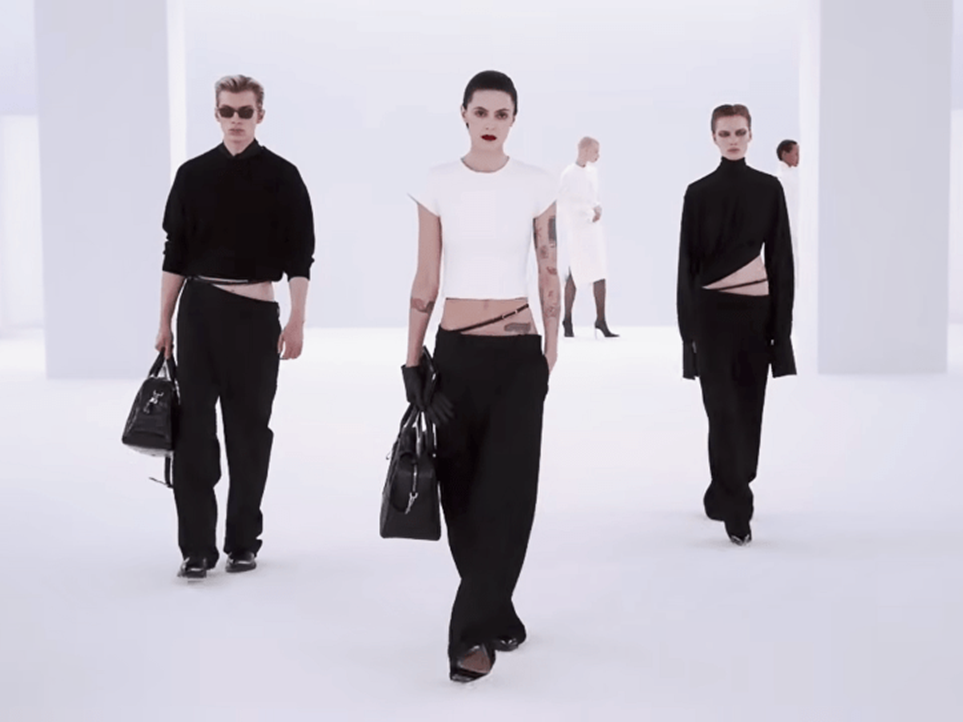
This season (so far), two designers from different ends of the spectrum were inspired by Tom Ford: the brand’s own Haider Ackermann and Gucci’s Demna Gvasalia. The latter gave a gentle nod to the former Gucci designer: It was raw, heaving, and possibly very now. In contrast, Mr Ackermann’s collection was clinical, haunting, and very enduring. He has eased into a minimalist philosopher, while Mr Gvasalia remained the indefatigable pop-culture provocateur. His Gucci was Mr Ford refracted through irony and archetypes, a deliberation of extremes: glamour can be squeezed out of the course or, a tad better, middle-of-the-road. Mr Ackermann, however, treated Tom Ford’s codes as raw material for evolution; he’s splicing them into new organisms rather than parodying them. It is a fascinating moment where the refined was actually the ‘new’, while the ‘cheap’ feels like it’s already dated.
In an era of luxury maximalism and viral stunts that often become viral shuns, refinement coming across as cutting-edge is a sign of how fashion has become saturated with the visually bombastic (like a texting model at Gucci?). For Tom Ford this day, even the show space is totally stripped down to walls of white (and bathed in white light) that was so blindingly stark, it could have been a solitary confinement in a psychiatric facility. But there was nothing aberrant about the show except that it was not your usual runway. The models—no beefcakes, no bombshells—did not just emerge one by one, but also walked in twos and threes, as if enjoying a stroll in a promenade, under a perennial moon, which is quite the opposite the brand’s early spasms of the nightclub strobe. In fact, the show was not soundtracked by a frantic pulse of ’70s club beats that Mr Ford was partial to, rather it swirled from nocturne to reverie, from the lush, solitary sorrow of the Chopin Nocturne in C-Sharp Minor to the shimmering synth bliss of The Beloved’s Sweet Harmony. While Mr Gvasalia’s Gucci adhered to the irony of a loud industrial/techno grind, Mr Ackermann was busy composing a refined future of Tom Ford.
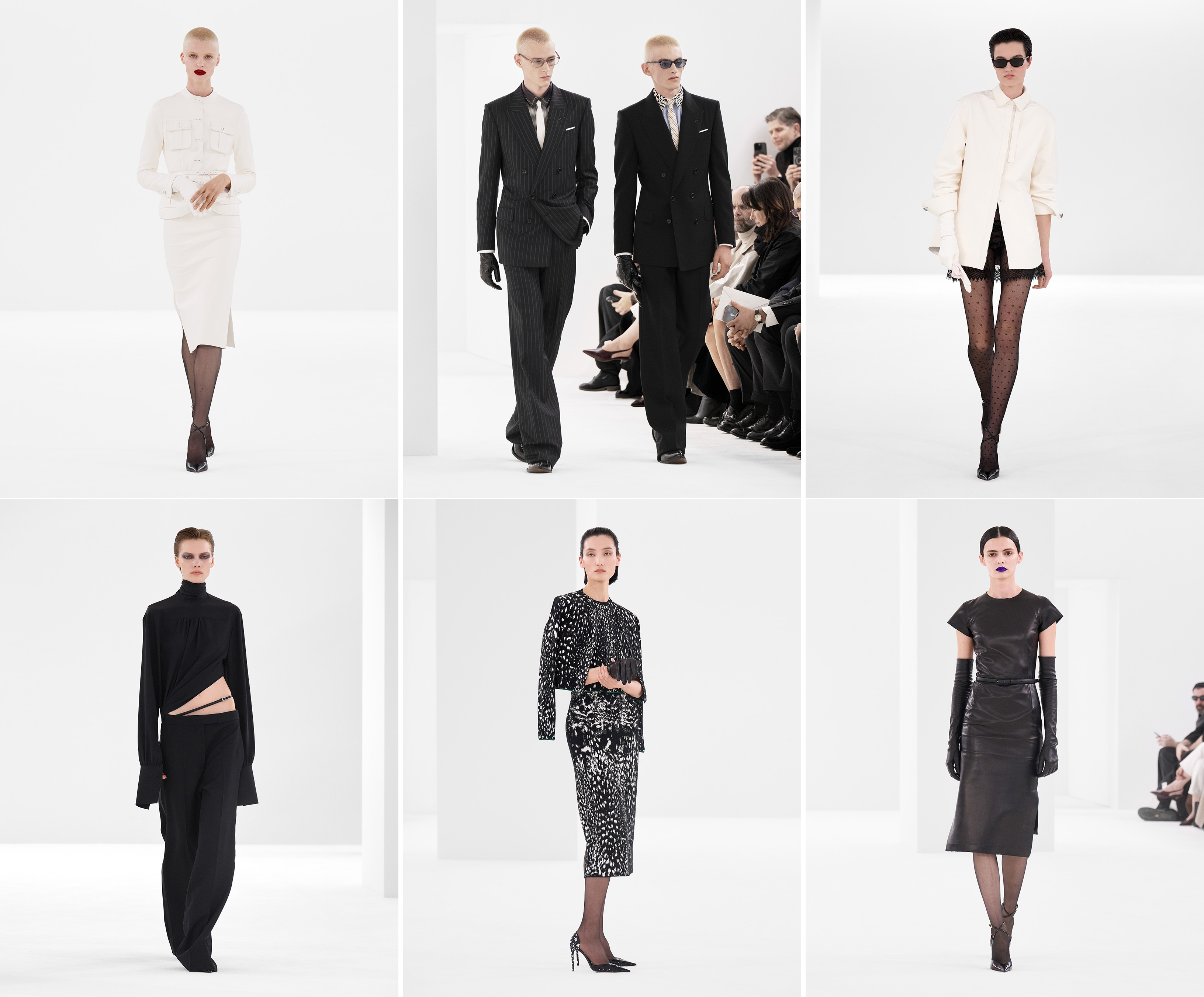
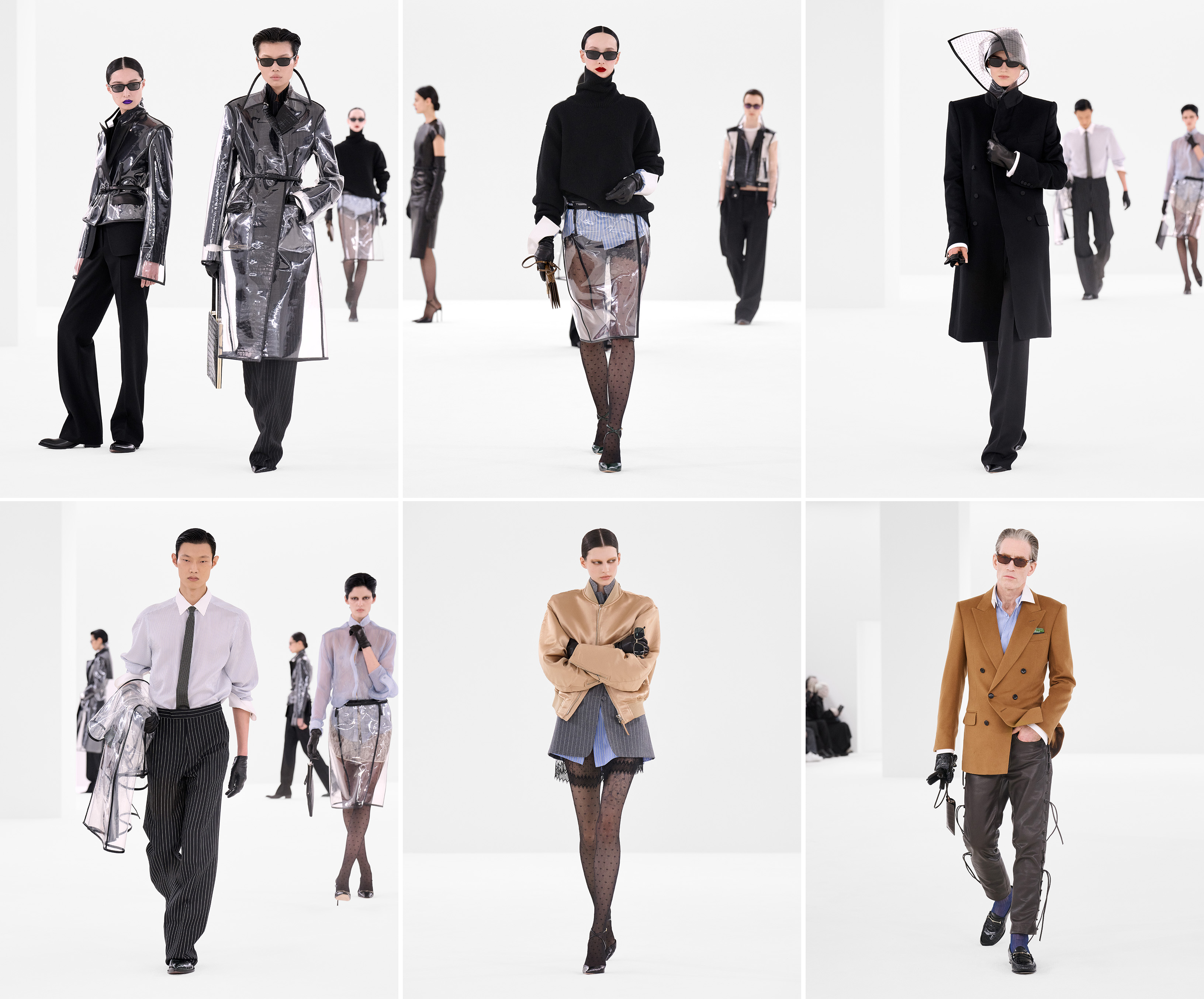
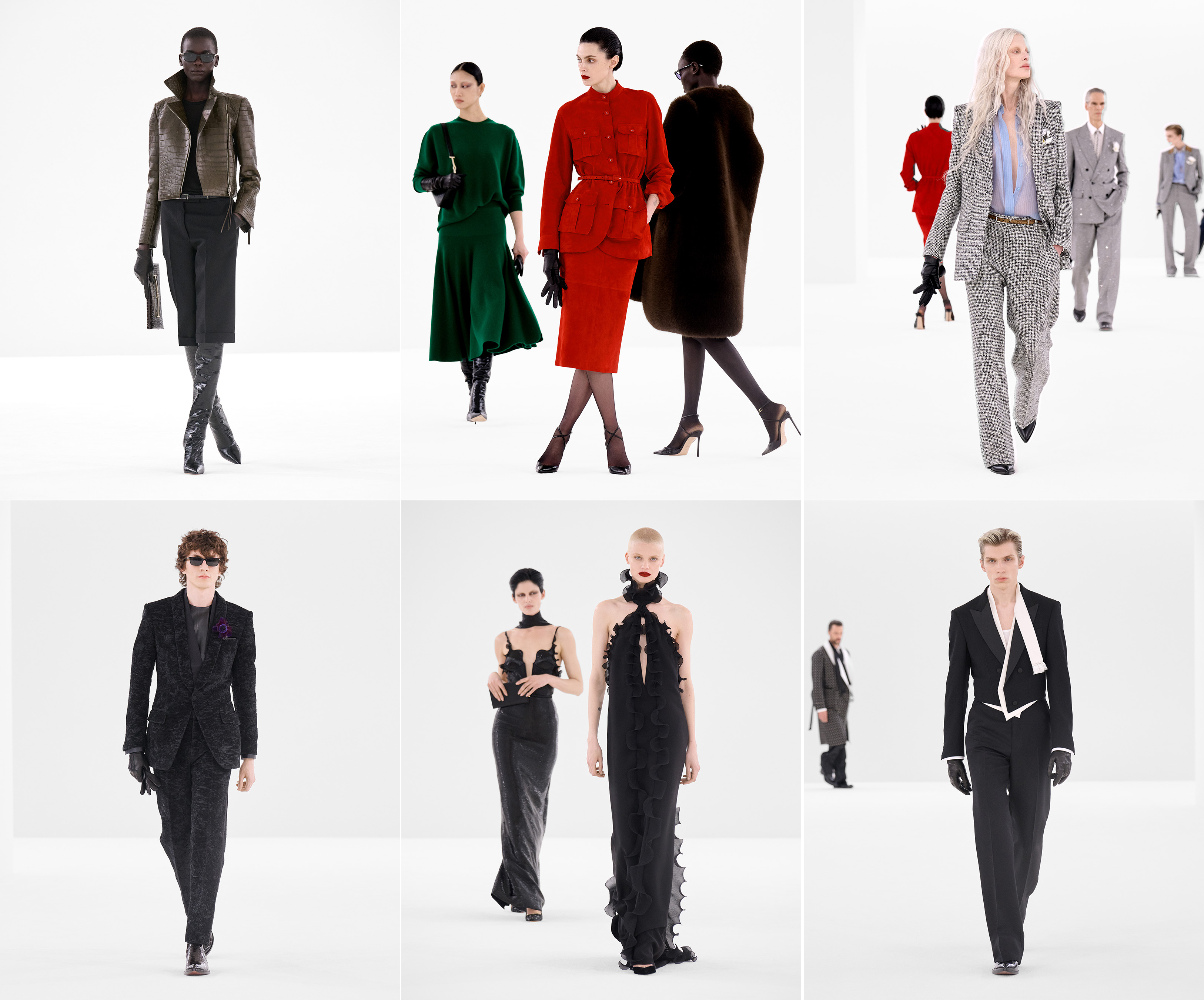
While the front row was, as usual, dizzy with celebrity, the runway belonged to a different kind of power. It began with an apparition: Kristen McMenamy, almost unrecognizable, but blink, and the long, wavy, silver mane was unmistakable. While the show opened with somewhat a lookalike (the make-up!), but with a buzz cut and a garment of such beautician-uniform white it felt less like fashion and more like a medical necessity. When Ms McMenamy appeared (look 53, photo: group three, top right), she was the collection’s sweet harmony. She didn’t just return; she walked as if she’d simply stepped out for lunch and forgotten to close the tab. This old bird togged in a tweedy grew pantsuit and a sheer baby blue blouse unbuttoned to there, was not so much wearing an outfit as she was presiding over a permanent establishment. Her hiding-a-smile nonchalance wasn’t an accessory; it was the load-bearing confidence of the entire silhouette. Like her, the garments possessed that rare, un-convulsed composure that does not need to raise its voice to be heard, even in the front row, where, interestingly, Kate Moss sat, probably thinking, what was I doing, bearing a thong?
The collection was a rigorous luxury, one that rejected the seizure of bling for the certainty of atmospheric depth. It has been clear that Mr Ackermann is quite the technician—his tailoring possesses an unflinching architecture that made the maximalist look like an unfinished over-thought. We don’t remember ever seeing denim jeans in the Tom Ford years, but here they were, sleek and sturdy, without the barrel cut or roominess of present-day infatuation. And on the other dressed-up extreme, the evening wear: gowns so sublime you could forgo the champagne. It would be a famine of choice for the current award season—there were just two, but what the pair could do and evoke was far more than the stuttering drafts on other runways, in their entirety. The sleek black dresses, one with tendrils adorning and supporting the bodice and the other, Garden by the Bay’s Super Trees for the body, were a lunar finality.
What could have been a ‘best of’ collection was, instead, Mr Ackermann taking the essence of that era—the power, the elitism, the underlying threat—into the presentation without the disco camp. (Frankly, the spring/summer 2026 collection, referencing Mr Ford’s trifling with Halston, did not speak to us.) These were clothes that reminded us what dressed-up was like and could be, a quiet authority that doesn’t need to beg for its dinner. Even for the men, these were not for tech bros or hip-hop moguls, but sharp suits and such, with the ease of happier, pastoral times. The Columbian designer told the media: “We’re living in quite a violent world where everybody has a very loud voice, screaming and shouting and telling lies.” This was the only commentary on the real world this Paris Fashion Week. With Tom Ford, Haider Ackermann showed that the misery need not be.
Screen shot (top): tomford/YouTube. Photos: Tom Ford
This was anti-tech bro.
 Style on the Dot