Melania Trump has donated her second inauguration gown to a museum in what has been described as a “historic moment”, officially outsourcing her garment storage and care to the government
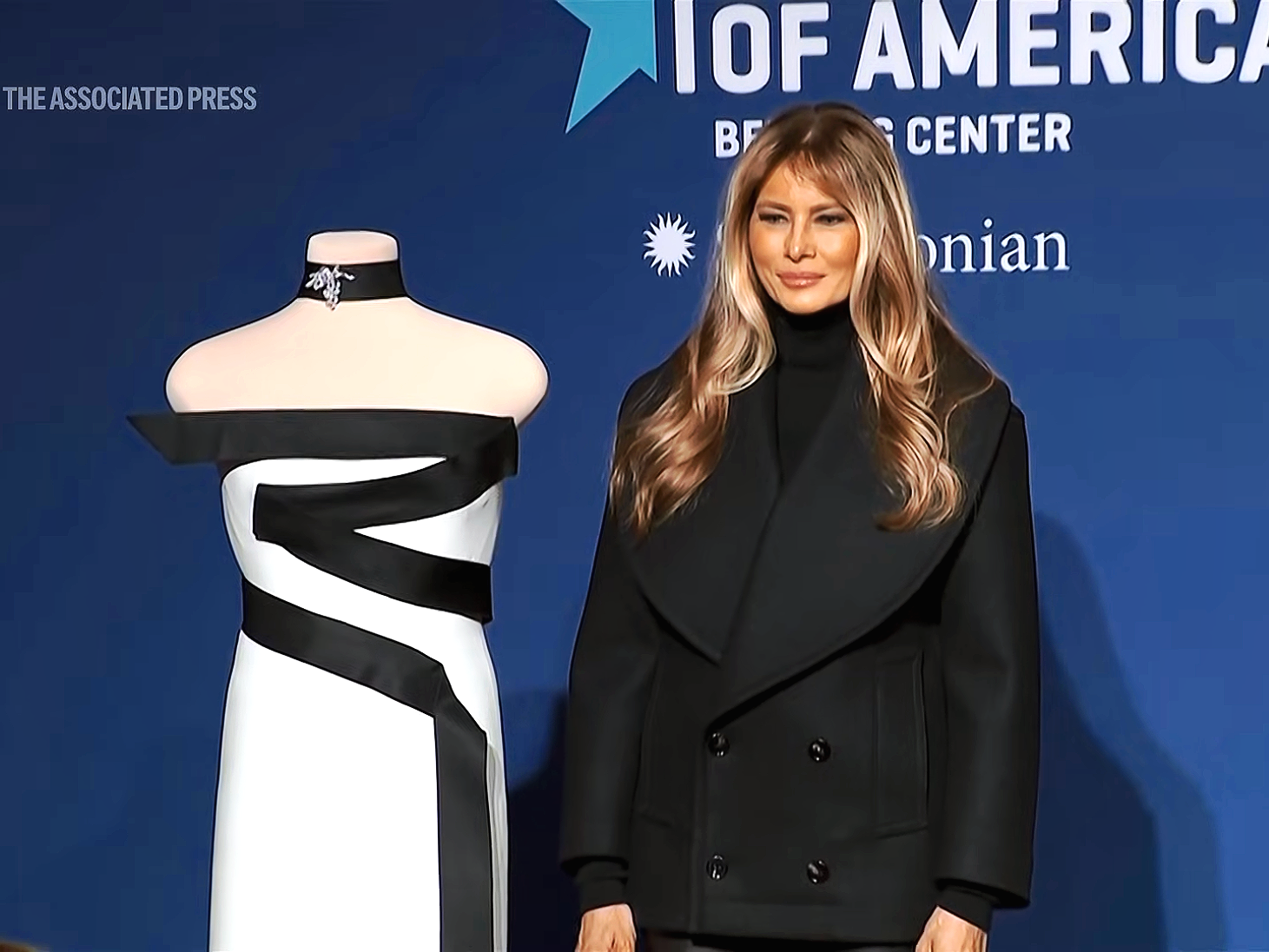
Melania Trump and her second presidential inauguration dress. Screen shot: ap/YouTube
There she was on stage, next to a dress she wore just once a year ago, but now, it appears seemingly a mere memory. At the announcement of her donation of the said gown to the National Museum of American History, Melania Trump did not approach the black and white piece as if it were her closest pal. She was tentative and she kept a noticeable distance. This gown once grazed the first lady’s well-prepped skin, mapping her contours more efficiently than a LiDAR scan, for a moment of national pride and MAGA jubilation. It carried her presence, her movement, her breath, all still mysterious. And yet, upon donation, FLOTUS made sure you knew it was pre-loved. She stood quite apart from it, as if estranged from the very fabric that had once been closest to her. Even when she held the tailor dummy on which the dress was displayed, it was a light pat of the back. There was no shoulder hug. A curator handling a suspicious relic. She was dressed in all black for the occasion in what appeared to be a Bottega Veneta peacoat—adequately subdued and European to let the American dress do the necessary MAGA beaming.
The ceremony was staged with the gravity of a pharaonic unveiling, as if the museum had been gifted a Tutankhamen treasure. Unlike her husband, she spoke from a script, solemnly, augmented by her very black attire. It was only a dress that was donated, but the grand spotlighting suggested an artifact of civilisational heft. While the first lady was ceremonially making the material donation, the U.S. Supreme Court struck down, in a 6-3 ruling, Donald Trump’s sweeping global tariffs. One was a ritualised transfer of a fabric form into history, staged with grandeur, but anticlimactic in substance. The other, a dramatic dismantling of Mr Trump’s economic centerpiece, stripping away the aura of national destiny he had attached to tariffs. Together, they spotlit the paradox of American rhetorical posturing. Objects and policies are inflated into symbols of supremacy, only to be revealed as fragile when tested. The gown touched the first lady’s skin but became estranged; the tariffs touched global trade, but collapsed under law. Both moments show how ceremony and rhetoric can oversell reality, and how timing can sharpen the irony.
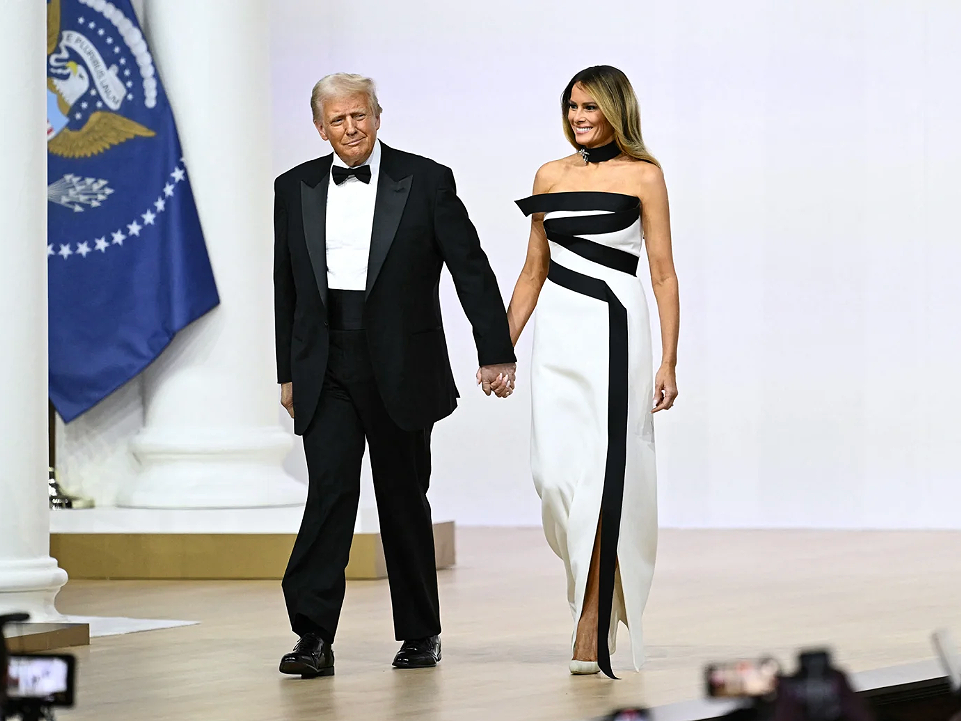
The Trump’s at one of the president’s inaugural balls. Photo: Getty Images
Having safely established her physical distance, Mrs Trump proceeded to fill the auditorium with a dizzying amount of linguistic puffery. We do not know who her script writers were, but she should consider terminating their service. However much she has claimed to love and wear fashion, she is not exactly literate in the medium—she has the vocabulary of a hang tag and the insight of a Siegel & Stockman dummy. She pronounced “silhouette”, “bodice”, and “couture” as if the script was littered with typos. In place of all that, a Be Best approach to dress description. She heralded the gown as a “vessel for the human condition.” If the gown was indeed a vessel, what was in it? Waste? Given its form, might it have been inspired by a spittoon? Or was this to appeal to the Bible Belt—a chalice of revelation? And what did she know about the human condition? The dress’s new home is in the same museum that holds Abraham Lincoln’s top hat—an object that actually witnessed the “human condition” in all its tragedy and triumph. By contrast, her gown saw only a ballroom circuit and a donation ceremony. If anything, the vessel held the anticlimax of a few hours of wear, then laid embalmed in a glass cabinet.
The revelation was that the garment “is not a dress” but an embodiment of “50 years of education and wisdom”. What education? Whose wisdom? What dress does that? This is not Diane von Furstenberg’s jersey wrap-dress. Mrs Trump’s gown was worn for a single evening. To inflate that into half a century of enlightenment is pure bunkum. It’s a parody of scripture: the gown as vessel, the vessel as repository of wisdom, the wisdom as perfume and pretentious speech. Sure, inaugural gowns are not just garments, they’re staged as symbols of national destiny, so the rhetoric has to oversell their meaning. Without that exaggeration, the gown is simply fabric worn, like Cinderella’s, for a night. But, borrowing the language of scripture and philosophy is to elevate a dress into a relic. But what is it about the Melania celluloid hagiography that failed to achieve for the gown, which had a starring role in the film, that she needed to ‘elevate’ it at the Smithsonian? To a first lady who has not establish herself as the next Jackie Kennedy, film and media can only dramatize the moment. They can’t confer permanence. A US$40 million movie is just pixels and hype, whereas a museum case is a taxpayer-funded grab for immortality.
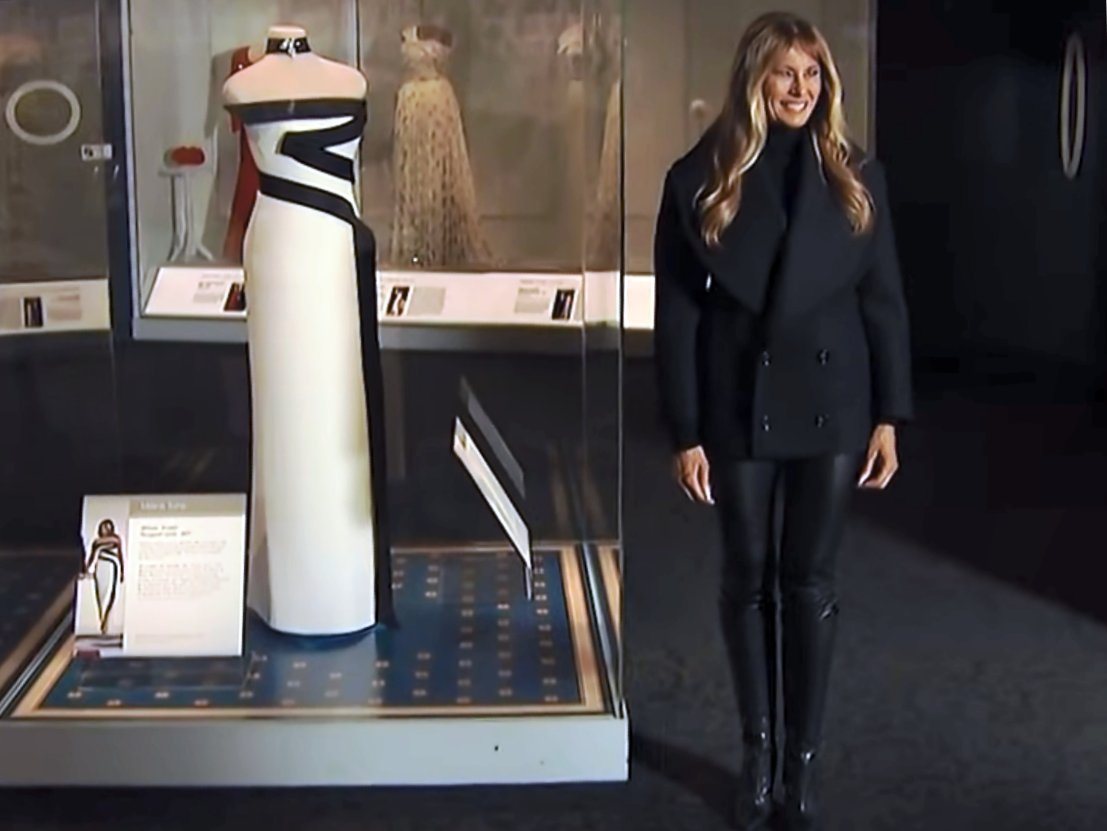
With the dress in her final home. Screen shot: ap/YouTube
She spent a bizarrely inordinate amount of time on the “meticulously-formed black shape, ‘Z’” of the dress, claiming it “summons decades of my early memories”. Was she talking about her version of the Rosetta Stone? But since we’re at the Smithsonian, the Ocean Library? She called the zig-zag treatment on a classic column dress with the seams in all the usual places a ‘Z’ (pronounced ‘zee’), but it isn’t a regular font. It is a scribble, like a child writing, for the first time, the last letter of the alphabet. ‘Z’ is the end, the closing mark. To claim it summons “early memories” is paradoxical. If the ‘Z’ represents the end, perhaps it is the only honest thing on that stage. So, what is the true significance of ‘Z’, what cultural shorthand was she attempting? ‘Z’ often signals sleep (zzz), subversion (Generation Z), or danger (Zorro’s slash). None of these meanings align with couture gravitas. The more she insisted on profundity, the more the symbol revealed its emptiness. ‘Z’ is also for zero. Inflating a free-hand line into a mystical symbol is tantamount to nothing. Or, another ‘Z’ word: Zilch.
Echoing her husband’s sweet Make American Great Again cadence, she said of the dress: “It’s a testament as to why America’s fashion industry can lead the rest of the world.” There is only one word for that hopefulness: delusional. We’ve said it before and we’ll repeat ourselves. American fashion is an oxymoron. American ‘couture’ is a cry for help. Couture customers are aware that couture is rooted in Parisian ateliers, vastly more than 50 years of craft, and a culture that treats clothing as art. Anything resembling what she called couture in America was—and still is—copied from Paris. In her optimistic delight, she ignored the long, messy history of how American style actually came to be. Ask her favourite brand Christian Dior! Fashion literacy is expendable when you prefer to expound national myth‑making. What is truly ironic is that she used the work of a Loire Valley-born designer Hervé Pierre, who was trained in French ateliers, specifically Balmain to point to a possible U.S. future. American lineage, it seems, has apparently no place in “leading the world”. You can really import the craft and export the myth. Until then, there’s that dress in the glass sarcophagus to admire. America would want you to.
 Style on the Dot