In India, one communication specialist has pivoted from polishing a university’s brand to hardening her own flaccid sari-as-armour
Professor of communications Neha Singh. Illustration: Just So
This was supposed to be India’s big, beautiful AI moment. But the India AI Impact Summit 2026 turned out to be such a farce that even Bollywood couldn’t script one so marvelously. A “professor of communications”, Neha Singh, turned a Chinese robodog into her university’s mascot. India’s innovation circus was quickly blessed with branding that can bark louder than invention. A reel of Ms Singh introducing the robo-rover to a reporter under the banner of Galgotias University went viral. At the New Delhi event, she informed that the metal creature was called “Orion”. She proudly added that the headless beast “has been developed by the Centre of Excellences (sic) at the Galgotias University”. She went to state that the private uni of comfortable obscurity—ranked overall in India between 101–150—has invested “more than 350 crore rupees (about S$48.8 million) in artificial intelligence”. If only they had spent that much in the human version. Both Netizens in India and China were quick to identify the origin of Orion to China’s fast-rising Unitree. Even India’s largest banyan could not shade her from the immediate fallout. It is hard to resist the irony that a woman whose career is built on (and the teaching of) clarity, now seemed incapable of explaining why “developed” did not quite manage to show up as delivered.
Making a mockery of the university’s Centre of Excellence is one thing, outright lying and refusing to acknowledge that a mistake was made is the pathetic spectacle of a specialist (we resist ‘coward’) who has a flair in finding an alibi for every disaster she helped engineer, while insisting she is not one, and is only a communicator. And what charming articulation when she repeated the comment of the reporter: “it’s quite naughty also”. But the real mischief was her anthropomorphising a piece of Chinese surveillance hardware as a playfully annoying pet, one that was bought, probably online. It was the ultimate comms failure for which, in a separate interview, she defended her media exchange as a misunderstanding because it “was done with a lot of energy and a lot of enthusiasm”. Just like Orion? But he didn’t lose his balance. She also added confidently: “I may not have come across as eloquent, which is a rare case.” The humble-brag on national television, regrettably for her, turned into an arrogant defence. Instead of taking “accountability” for her faux pas (which she claimed to do), she qualified it with a reminder of her own greatness. Who knew delusional could be this entertaining. However “naughty” Orion was. He clearly didn’t learn the best tricks.
She also added confidently: “I may not have come across as eloquent, which is a rare case”
So this was telegraphed and received: “I’m usually so brilliant and well-spoken that you should treat this disaster as a collector’s item.” That would have been the end of her arrogance, but like any low-budget Bollywood horror villain, she simply refused to stay delivered to the kabr (grave). She went on to show how good she was with numbers. When cornered by the undeniable fact that Orion was an import from China, she offered the media a philosophical olive branch that even the Athenians would not have accepted: “Your six can be my nine.” Ms Singh was referencing the classic viral drawing of two people standing on opposite sides of a number drawn on the ground—one sees a ‘6’, the other a ‘9’, and both are “right” from their respective angle. But from the singular perspective of the Internet, first mentioning a “naughty” canine and then talking about 69 are innuendos so sexually loud that it would deafen a probability-obsessed math professor. Apparently, our specialist’s flair for communication did not extend to reading the room—or hearing herself speak. While the university was busy unboxing a Chinese dog, they forgot to ask their staffers to unbox some common sense. Or admit that the excellence they’d been promised was a manufactured lie.
Dressed in fetching sarees, one in a modern Amul dark chocolate and the other, as crimson as the red flag that she was waving, on the two incriminating occasions, she came across more nuance-free than both her attires. Ms Singh clearly chose sarees that suggested nuance, tradition, and even depth, but then spoke in a way that felt blunt, smug, and aggressively one‑note. The dissonance was jarring. Clothing can be used to soften or humanise an image, while speech is deliberately honed to dominate. As a communication specialist, she knew which she was using. She wasn’t naïve about the tools at her disposal. Yet, she chose the sharper, the more damning. It’s all performative, of course, as public appearances often are these days. The costume whispered trust me, while the words shouted believe me. And when the latter is exposed as hollow, the costume can’t save the flailing actor. In the theatre of the debut AI exhibition, her outfits whispered sincerity while her speech shouted authority, until the imported robodog tore through the spin, leaving her to declare, in the midst of a palpable national embarrassment, how much she loved India.
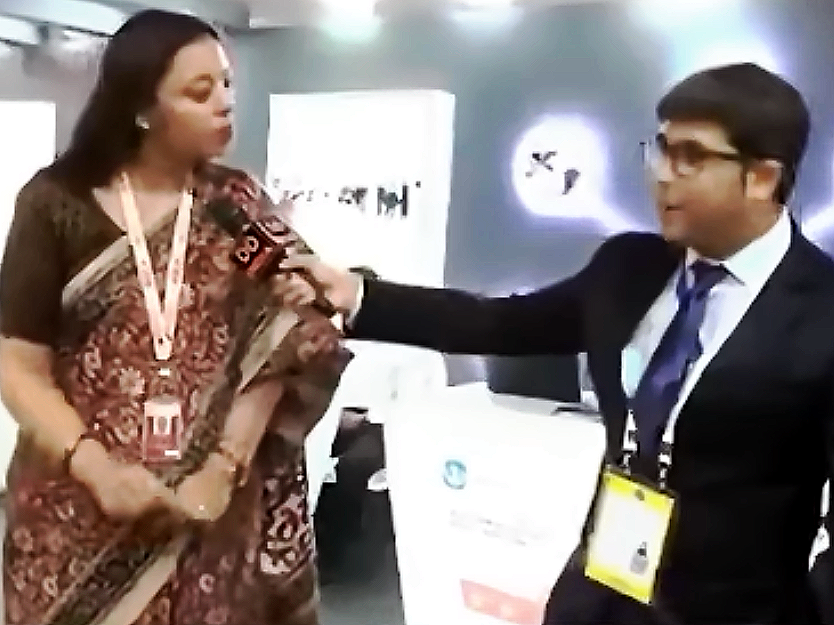
Neha Singh introducing her “naughty” robodog. Screen shot: DD India
As Ms Singh’s rhetorical defence quickly became a national embarrassment, the Indian government eventually evicted Galgotias University from the event and cut the power supply to their still-drawing-attention booth. On LinkedIn a day later, the professor stated that she was “open to work”. Speculation was that she was fired, but her employer claimed that she was not. The official announcement stated that she wasn’t sacked nor suspended. To most watching the situation unfold, she was simply locked to the limbo of institutional damage control, while Galgotias stitched its ripped credibility. The Uttar Pradesh institution was trying to manage optics, publicly scapegoating her as “ill‑informed”. It is rather tragic that a HoD was now considered to be a clueless amateur, but Ms Singh’s behaviour was really a localised symptom of a global epidemic of ego. Her brand of fierce arrogance and spin is remarkably consistent with the political theater of India’s close ally—the United States of America. But Karoline Leavitt beat her to it.
In the reportedly WiFi-deprived, over-packed, digital payment nought halls of Bharat Mandapam in New Delhi, a rare astronomical event occurred: India was showing off their AI might. But, there is something deliciously ironic about the whole affair. Even with a Chinese-made robodog, they impressed few (Bill Gates and Jensen Huang pulled out at the last minute). Around the same time, over in China, a traditional 春晚 (chunwan) performance to mark Chinese New Year, featuring gongfu-abled robots showing off their smooth pugilistic skills, had the world paused and asked: “should we be worried?” One, a bought bark, the other a choreographed strike. There was no allaying of fears. Next season tech theatre may promise less purchased canines, more polished spectacles, and no one would laugh when the robots bow. But in China, they did better, without a ‘6’ as a ‘9’. In the closing scene of that balletic display, involving even nanchakus, a giant of a robot-pugilist held out his hand and took that of friendly sparing partner’s—it belonged to a child. The message could’nt be clearer. Man and machine can co-exist.
 Style on the Dot